
CXCL13阳性细胞定位可预测肺非小细胞癌对抗PD-1/PD-L1治疗的反应
CXCL13 Positive Cells Localization Predict Response to Anti-PD-1/PD-L1 in Pulmonary Non-Small Cell Carcinoma.
作者信息
Vahidian Fatemeh, Lamaze Fabien C, Bouffard Cédrik, Coulombe François, Gagné Andréanne, Blais Florence, Tonneau Marion, Orain Michèle, Routy Bertrand, Manem Venkata S K, Joubert Philippe
机构信息
Centre de Recherche de l'Institut Universitaire de Cardiologie et de Pneumologie de Québec (IUCPQ), Quebec City, QC G1V 4G5, Canada.
Faculty of Medicine, Laval University, Quebec City, QC G1V 4G5, Canada.
出版信息
Cancers (Basel). 2024 Feb 7;16(4):708. doi: 10.3390/cancers16040708.
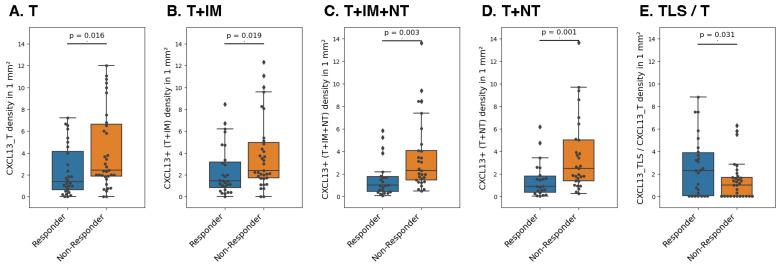
Immune checkpoint inhibitors (ICIs) have revolutionized non-small cell lung cancers (NSCLCs) treatment, but only 20-30% of patients benefit from these treatments. Currently, PD-L1 expression in tumor cells is the only clinically approved predictor of ICI response in lung cancer, but concerns arise due to its low negative and positive predictive value. Recent studies suggest that CXCL13+ T cells in the tumor microenvironment (TME) may be a good predictor of response. We aimed to assess if CXCL13+ cell localization within the TME can predict ICI response in advanced NSCLC patients. This retrospective study included 65 advanced NSCLC patients treated with Nivolumab/Pembrolizumab at IUCPQ or CHUM and for whom a pretreatment surgical specimen was available. Good responders were defined as having a complete radiologic response at 1 year, and bad responders were defined as showing cancer progression at 1 year. IHC staining for CXCL13 was carried out on a representative slide from a resection specimen, and CXCL13+ cell density was evaluated in tumor (T), invasive margin (IM), non-tumor (NT), and tertiary lymphoid structure (TLS) compartments. Cox models were used to analyze progression-free survival (PFS) and overall survival (OS) probability, while the Mann-Whitney test was used to compare CXCL13+ cell density between responders and non-responders. We showed that CXCL13+ cell density localization within the TME is associated with ICI efficacy. An increased density of CXCL13+ cells across all compartments was associated with a poorer prognostic (OS; HR = 1.22; 95%CI = 1.04-1.42; = 0.01, PFS; HR = 1.16; = 0.02), or a better prognostic when colocalized within TLSs (PFS; HR = 0.84, = 0.03). Our results support the role of CXCL13+ cells in advanced NSCLC patients, with favorable prognosis when localized within TLSs and unfavorable prognosis when present elsewhere. The concomitant proximity of CXCL13+ and CD20+ cells within TLSs may favor antigen presentation to T cells, thus enhancing the effect of PD-1/PD-L1 axis inhibition. Further validation is warranted to confirm the potential relevance of this biomarker in a clinical setting.
免疫检查点抑制剂(ICIs)彻底改变了非小细胞肺癌(NSCLCs)的治疗方式,但只有20%-30%的患者能从这些治疗中获益。目前,肿瘤细胞中的PD-L1表达是肺癌中唯一经临床批准的ICI反应预测指标,但因其阴性和阳性预测价值较低而引发担忧。最近的研究表明,肿瘤微环境(TME)中的CXCL13+ T细胞可能是反应的良好预测指标。我们旨在评估TME内CXCL13+细胞的定位是否能预测晚期NSCLC患者的ICI反应。这项回顾性研究纳入了65例在IUCPQ或CHUM接受纳武单抗/帕博利珠单抗治疗且有预处理手术标本的晚期NSCLC患者。良好反应者定义为在1年时具有完全放射学反应,不良反应者定义为在1年时出现癌症进展。对切除标本的代表性切片进行CXCL13的免疫组化染色,并在肿瘤(T)、浸润边缘(IM)、非肿瘤(NT)和三级淋巴结构(TLS)区域评估CXCL13+细胞密度。使用Cox模型分析无进展生存期(PFS)和总生存期(OS)概率,同时使用Mann-Whitney检验比较反应者和非反应者之间的CXCL13+细胞密度。我们发现TME内CXCL13+细胞密度定位与ICI疗效相关。所有区域中CXCL13+细胞密度增加与较差的预后相关(OS;HR = 1.22;95%CI = 1.04-1.42;P = 0.01,PFS;HR = 1.16;P = 0.02),而当共定位于TLS内时则与较好的预后相关(PFS;HR = 0.84,P = 0.03)。我们的结果支持CXCL13+细胞在晚期NSCLC患者中的作用,定位于TLS内时预后良好,在其他部位时预后不良。TLS内CXCL13+和CD20+细胞的同时接近可能有利于向T细胞呈递抗原,从而增强PD-1/PD-L1轴抑制的效果。需要进一步验证以确认该生物标志物在临床环境中的潜在相关性。


 Zotero 插件