
在英格兰和威尔士,辅助使用大麻二酚与单纯常规护理治疗结节性硬化症相关癫痫发作的成本效用分析。
A Cost-Utility Analysis of Add-On Cannabidiol Versus Usual Care Alone for the Treatment of Seizures Associated with Tuberous Sclerosis Complex in England and Wales.
作者信息
Burke Colin, Crossan Catriona, Tyas Emma, Hemstock Matthew, Lee Dawn, Bowditch Sally
机构信息
Lumanity, Inc., Great Suffolk Yard, 121-131 Great Suffolk Street, London, SE1 1PP, UK.
Jazz Pharmaceuticals, Inc., 1 Cavendish Place, Marylebone, London, W1G 0QF, UK.
出版信息
Pharmacoecon Open. 2024 Jul;8(4):611-626. doi: 10.1007/s41669-024-00474-x. Epub 2024 Mar 5.
OBJECTIVES
The aim of this study was to evaluate the cost effectiveness of plant-derived highly purified cannabidiol (Epidyolex in the UK; 100 mg/mL oral solution) as an add-on treatment to usual care for the management of treatment-refractory seizures associated with tuberous sclerosis complex (TSC) in patients aged ≥ 2 years.
METHODS
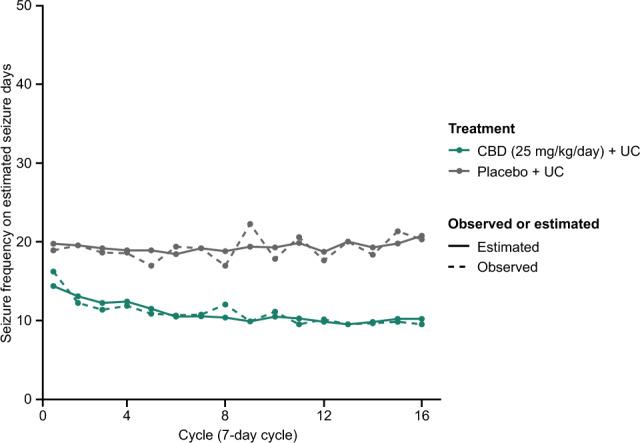
A cohort-based model was developed using a National Health Service perspective and lifetime horizon. Health states were based on weekly seizure frequency and seizure-free days, utilizing patient-level data from the GWPCARE6 trial (ClinicalTrials.gov identifier: NCT02544763). Two independent regression models were applied to individual patient-level data to predict seizure-free days and seizure frequency. Healthcare resource utilization data were sourced from a Delphi panel, and patient and caregiver health-related quality of life values were elicited using vignettes valued by the general public. Outcomes relating to TSC-associated neuropsychiatric disorders were modeled with costs and quality-adjusted life-years sourced from published literature.
RESULTS
In the base case, compared with usual care alone, 12 mg/kg/day cannabidiol was associated with an incremental cost-effectiveness ratio (ICER) of £23,797. The National Institute for Health and Care Excellence disease severity modifier reduced the ICER to £19,831. Probabilities of cost effectiveness at willingness-to-pay thresholds of £20,000 and £30,000 were 30% and 52%, respectively, for the base case and 39% and 66%, respectively, for the disease severity modifier. Results were robust to sensitivity and scenario analyses.
CONCLUSIONS
At 12 mg/kg/day and an ICER threshold of £20,000-£30,000, we provide evidence for the cost effectiveness of add-on cannabidiol treatment for patients with TSC-associated seizures aged ≥ 2 years who are refractory to current treatment.
目的
本研究旨在评估植物来源的高纯度大麻二酚(英国的 Epidyolex;100mg/mL 口服溶液)作为≥2 岁结节性硬化症(TSC)相关难治性癫痫患者常规治疗附加疗法的成本效益。
方法
采用基于队列的模型,从英国国家医疗服务体系的角度和终身视角进行构建。健康状态基于每周癫痫发作频率和无癫痫发作天数,利用 GWPCARE6 试验(ClinicalTrials.gov 标识符:NCT02544763)的患者层面数据。将两个独立的回归模型应用于个体患者层面数据,以预测无癫痫发作天数和癫痫发作频率。医疗资源利用数据来自德尔菲专家小组,通过公众评估的 vignettes 法获取患者及照料者与健康相关的生活质量值。与 TSC 相关神经精神障碍的结局通过已发表文献中的成本和质量调整生命年进行建模。
结果
在基础病例中,与单纯常规治疗相比,12mg/kg/天的大麻二酚的增量成本效益比(ICER)为 23,797 英镑。英国国家卫生与临床优化研究所疾病严重程度修正因子将 ICER 降至 19,831 英镑。在 20,000 英镑和 30,000 英镑支付意愿阈值下,基础病例的成本效益概率分别为 30%和 52%,疾病严重程度修正因子的概率分别为 39%和 66%。结果对敏感性分析和情景分析具有稳健性。
结论
在 12mg/kg/天且 ICER 阈值为 20,000 - 30,000 英镑时,我们为≥2 岁的 TSC 相关癫痫且对当前治疗难治的患者附加使用大麻二酚治疗的成本效益提供了证据。




 Zotero 插件