
一项PRISMA-IPD系统评价与荟萃分析:年龄和随访时间是否能改善小儿上肢脑瘫手术后腕关节和前臂的主动活动范围?
A PRISMA-IPD systematic review and meta-analysis: does age and follow-up improve active range of motion of the wrist and forearm following pediatric upper extremity cerebral palsy surgery?
作者信息
Song Amy X, Saad Anthony, Hutnik Lauren, Chandra Onrina, McGrath Aleksandra, Chu Alice
机构信息
Department of Orthopedic Surgery, Rutgers New Jersey Medical School, Newark, NJ, United States.
Department of Statistics, Rutgers University, New Brunswick, NJ, United States.
出版信息
Front Surg. 2024 Feb 20;11:1150797. doi: 10.3389/fsurg.2024.1150797. eCollection 2024.
PURPOSE
Surgical treatments such as tendon transfers and muscle lengthening play a significant role in cerebral palsy management,but timing of upper extremity cerebral palsy surgery remains controversial. This study systematically reviews the current literature and investigates the correlation between age at surgery and follow-up time with surgical outcomes in pediatric upper extremity cerebral palsy patients.
METHODS
A comprehensive search of PubMed, Cochrane, Web of Science, and CINAHL databases was performed from inception to July 2020 and articles were screened using PRISMA guidelines to include full-text, English papers. Data analysis was performed using itemized data points for age at surgery, follow-up length, and surgery outcomes, reported as changes in active forearm and wrist motion. A 3D linear model was performed, to analyze the relationship between age, follow-up length, and surgery outcomes.
RESULTS
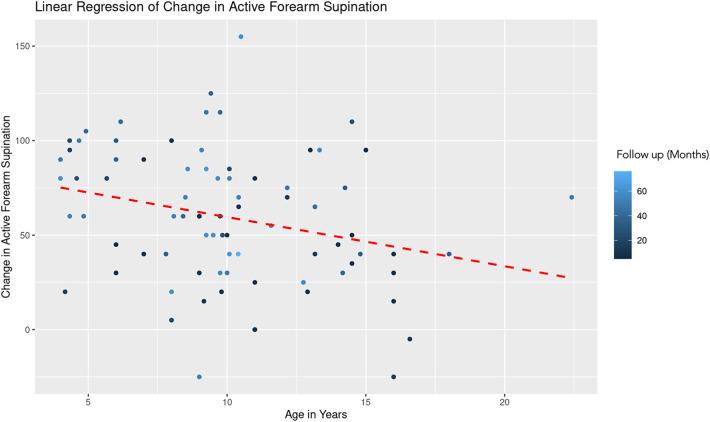
A total of 3,855 papers were identified using the search terms and a total of 8 studies with itemized patient data (=126) were included in the study. The studies overall possessed moderate bias according to the ROBINS-I scale. Regression analysis showed that age is a significant predictor of change (|t| > 2) in active forearm supination (Estimate = -2.3465, Std. Error = 1.0938, -value= -2.145) and wrist flexion (Estimate = -2.8474, Std. Error = 1.0771, -value = -2.643) post-intervention, with older individuals showing lesser improvements. The duration of follow-up is a significant predictor of improvement in forearm supination (Estimate = 0.3664, Std. Error = 0.1797, -value = 2.039) and wrist extension (Estimate = 0.7747, Std. Error = 0.2750, -value = 2.817). In contrast, forearm pronation (Estimate = -0.23756, Std. Error = 0.09648, -value = -2.462) and wrist flexion (Estimate = -0.4243, Std. Error=0.1859, -value = -2.282) have a significant negative association with follow-up time.
CONCLUSION
These results suggest that there is significant correlation between the age and follow up after surgery with range of motion gains. Most notably, increased age at surgery had a significant negative correlation with select active range of motion postoperative outcomes. Future research should focus on identifying other factors that could affect results of surgical treatment in upper extremity.
目的
肌腱转移和肌肉延长等手术治疗在脑瘫治疗中发挥着重要作用,但上肢脑瘫手术的时机仍存在争议。本研究系统回顾了当前文献,并调查了小儿上肢脑瘫患者的手术年龄、随访时间与手术结果之间的相关性。
方法
对PubMed、Cochrane、Web of Science和CINAHL数据库进行全面检索,检索时间从建库至2020年7月,并使用PRISMA指南筛选文章,纳入全文、英文论文。使用手术年龄、随访时长和手术结果的分项数据点进行数据分析,手术结果以主动前臂和腕关节活动度的变化来报告。采用三维线性模型分析年龄、随访时长和手术结果之间的关系。
结果
使用检索词共识别出3855篇论文,本研究共纳入8项具有分项患者数据(n = 126)的研究。根据ROBINS-I量表,这些研究总体存在中度偏倚。回归分析表明,年龄是干预后主动前臂旋后(估计值 = -2.3465,标准误差 = 1.0938,p值 = -2.145)和腕关节屈曲(估计值 = -2.8474,标准误差 = 1.0771,p值 = -2.643)变化的显著预测因素,年龄较大者改善较小。随访时长是前臂旋后改善(估计值 = 0.3664,标准误差 = 0.1797,p值 = 2.039)和腕关节伸展改善(估计值 = 0.7747,标准误差 = 0.2750,p值 = 2.817)的显著预测因素。相比之下,前臂旋前(估计值 = -0.23756,标准误差 = 0.09648,p值 = -2.462)和腕关节屈曲(估计值 = -0.4243,标准误差 = 0.1859,p值 = -2.282)与随访时间呈显著负相关。
结论
这些结果表明,手术年龄和术后随访与活动度增加之间存在显著相关性。最值得注意的是,手术年龄的增加与特定的术后主动活动度结果呈显著负相关。未来研究应专注于确定其他可能影响上肢手术治疗结果的因素。




 Zotero 插件