
细胞壁和质膜中的碳酸酐酶是植物在低二氧化碳环境下实现最佳生长所必需的。
Carbonic anhydrases in the cell wall and plasma membrane of are required for optimal plant growth on low CO.
作者信息
Weerasooriya Hiruni N, Longstreth David J, DiMario Robert J, Rosati Viviana C, Cassel Brittany A, Moroney James V
机构信息
Department of Biological Sciences, Louisiana State University, Baton Rouge, LA, United States.
出版信息
Front Mol Biosci. 2024 Feb 22;11:1267046. doi: 10.3389/fmolb.2024.1267046. eCollection 2024.
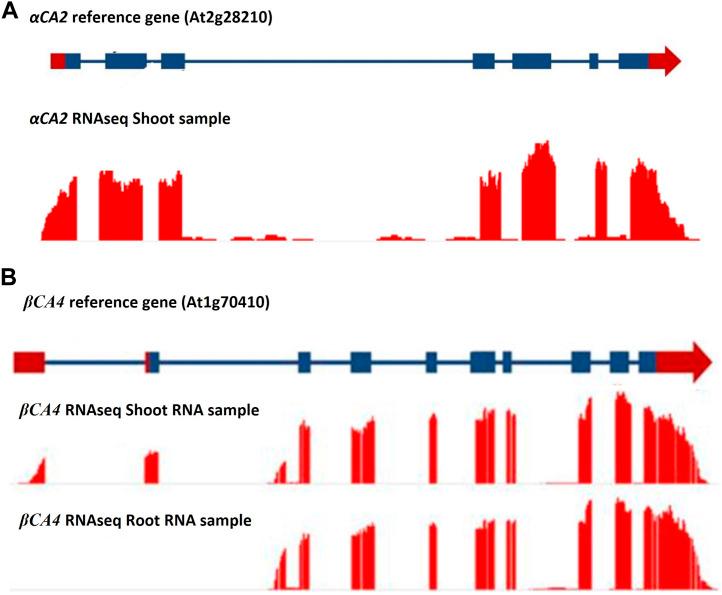
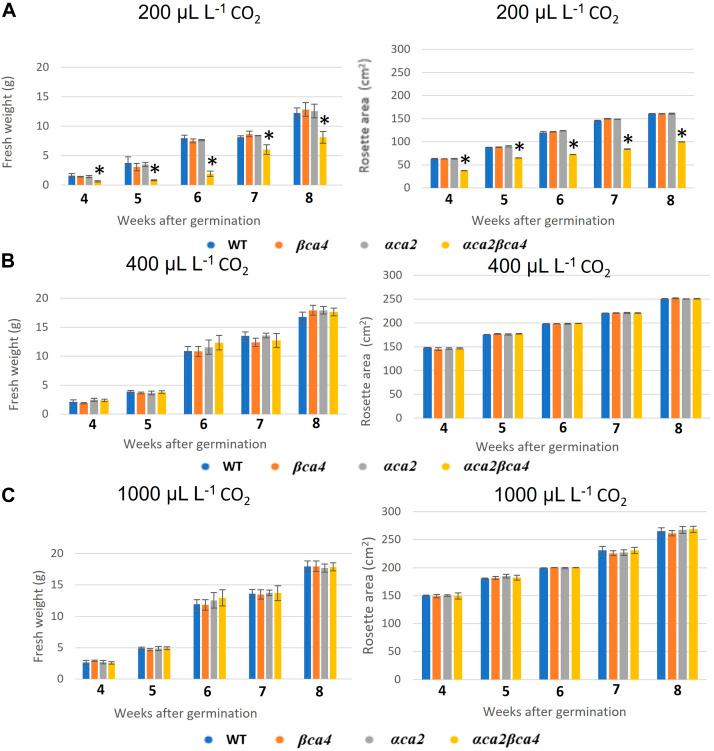
Plants have many genes encoding both alpha and beta type carbonic anhydrases. Arabidopsis has eight alpha type and six beta type carbonic anhydrase genes. Individual carbonic anhydrases are localized to specific compartments within the plant cell. In this study, we investigate the roles of αCA2 and βCA4.1 in the growth of the plant under different CO regimes. Here, we identified the intracellular location of αCA2 and βCA4.1 by linking the coding region of each gene to a fluorescent tag. Tissue expression was determined by investigating GUS expression driven by the αCA2 and βCA4.1 promoters. Finally, the role of these proteins in plant growth and photosynthesis was tested in plants with T-DNA insertions in the αCA2 and βCA4 genes. Fluorescently tagged proteins showed that αCA2 is localized to the cell wall and βCA4.1 to the plasma membrane in plant leaves. Both proteins were expressed in roots and shoots. Plants missing either αCA2 or βCA4 did not show any growth defects under the conditions tested in this study. However, if both αCA2 and βCA4 were disrupted, plants had a significantly smaller above- ground fresh weight and rosette area than Wild Type (WT) plants when grown at 200 μL L CO but not at 400 and 1,000 μL L CO. Growth of the double mutant plants at 200 μL L CO was restoredif either αCA2 or βCA4.1 was transformed back into the double mutant plants. Both the cell wall and plasma membrane CAs, αCA2 and βCA4.1 had to be knocked down to produce an effect on Arabidopsis growth and only when grown in a CO concentration that was significantly below ambient. This indicates that αCA2 and βCA4.1 have overlapping functions since the growth of lines where only one of these CAs was knocked down was indistinguishable from WT growth. The growth results and cellular locations of the two CAs suggest that together, αCA2 and βCA4.1 play an important role in the delivery of CO and HCO to the plant cell.
植物有许多编码α型和β型碳酸酐酶的基因。拟南芥有8个α型和6个β型碳酸酐酶基因。单个碳酸酐酶定位于植物细胞内的特定区室。在本研究中,我们调查了αCA2和βCA4.1在不同CO条件下对植物生长的作用。在此,我们通过将每个基因的编码区与荧光标签连接来确定αCA2和βCA4.1的细胞内定位。通过研究由αCA2和βCA4.1启动子驱动的GUS表达来确定组织表达。最后,在αCA2和βCA4基因中存在T-DNA插入的植物中测试了这些蛋白质在植物生长和光合作用中的作用。荧光标记的蛋白质显示,在植物叶片中,αCA2定位于细胞壁,βCA4.1定位于质膜。这两种蛋白质在根和芽中均有表达。在本研究测试的条件下,缺失αCA2或βCA4的植物未表现出任何生长缺陷。然而,如果αCA2和βCA4均被破坏,当在200μL/L CO条件下生长时,植物地上部鲜重和莲座叶面积显著小于野生型(WT)植物,但在400和1000μL/L CO条件下生长时则不然。如果将αCA2或βCA4.1重新导入双突变植物中,双突变植物在200μL/L CO条件下的生长得以恢复。细胞壁和质膜碳酸酐酶αCA2和βCA4.1都必须被敲低才能对拟南芥生长产生影响,且仅在显著低于环境浓度的CO浓度下生长时才会如此。这表明αCA2和βCA4.1具有重叠功能,因为仅敲低其中一种碳酸酐酶的株系的生长与野生型生长无明显差异。这两种碳酸酐酶的生长结果和细胞定位表明,αCA2和βCA4.1共同在向植物细胞输送CO和HCO方面发挥重要作用。





 Zotero 插件