
颅内海绵状血管畸形的抗血栓治疗:系统评价、荟萃分析和网络荟萃分析。
Antithrombotic Therapy in Cerebral Cavernous Malformations: A Systematic Review, Meta-Analysis, and Network Meta-Analysis.
机构信息
Department of Neurosurgery Duke University Hospital Durham NC USA.
Department of Neurosurgery Louisiana State University Hospital Shreveport LA USA.
出版信息
J Am Heart Assoc. 2024 Mar 19;13(6):e032910. doi: 10.1161/JAHA.123.032910. Epub 2024 Mar 12.
BACKGROUND
Cerebral cavernous malformations are complex vascular anomalies in the central nervous system associated with a risk of intracranial hemorrhage. Traditional guidelines have been cautious about the use of antithrombotic therapy in this patient group, citing concerns about potential bleeding risk. However, recent research posits that antithrombotic therapy may actually be beneficial. This study aims to clarify the association between antithrombotic therapy, including antiplatelet and anticoagulant medications, and the risk of intracranial hemorrhage in patients with cerebral cavernous malformations.
METHODS AND RESULTS
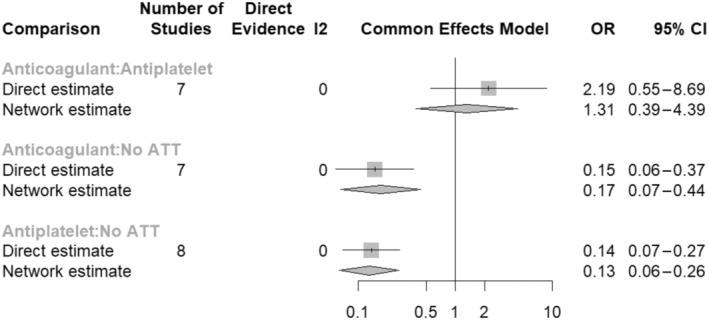
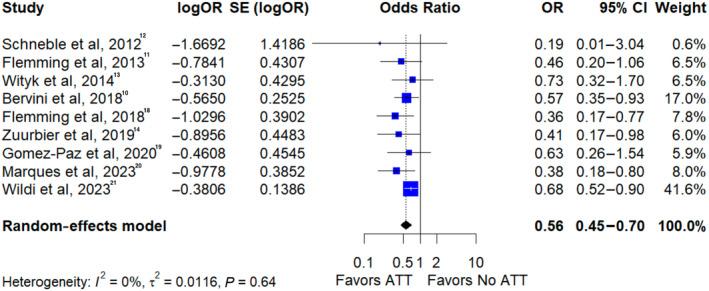
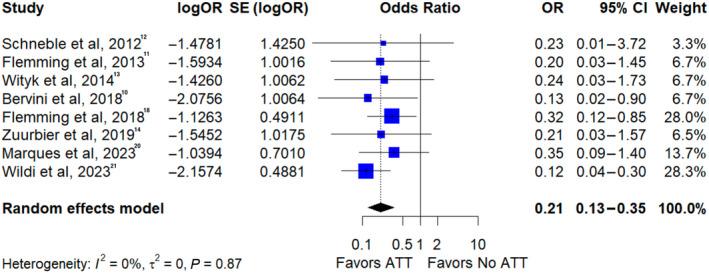
A comprehensive literature search was conducted in PubMed, Web of Science, and Scopus databases, following Preferred Reporting Items for Systematic Reviews and Meta-Analyses guidelines. Nine single-center, nonrandomized cohort studies involving 2709 patients were included. Outcomes were analyzed using random-effects model, and a network meta-analysis was conducted for further insight. Of the 2709 patients studied, 388 were on antithrombotic therapy. Patients on antithrombotic therapy had a lower risk of presenting with intracranial hemorrhage (odds ratio [OR], 0.56 [95% CI, 0.45-0.7]; <0.0001). In addition, the use of antithrombotic therapy was associated with lower risk of intracranial hemorrhage from a cerebral cavernous malformation on follow-up (OR, 0.21 [95% CI, 0.13-0.35]; <0.0001). A network meta-analysis revealed a nonsignificant OR of 0.73 (95% CI, 0.23-2.56) when antiplatelet therapy was compared with anticoagulant therapy.
CONCLUSIONS
Our study explores the potential benefits of antithrombotic therapy in cerebral cavernous malformations. Although the analysis suggests a possible role for antithrombotic agents, it is critical to note that the evidence remains preliminary. Fundamental biases in study design, such as ascertainment and assignment bias, limit the weight of our conclusions. Therefore, our findings should be considered hypothesis-generating and not definitive for clinical practice change.
背景
脑内海绵状血管畸形是一种中枢神经系统的复杂血管异常,伴有颅内出血的风险。传统指南对该患者群体使用抗血栓治疗持谨慎态度,理由是担心潜在的出血风险。然而,最近的研究认为抗血栓治疗实际上可能是有益的。本研究旨在阐明抗血栓治疗(包括抗血小板和抗凝药物)与脑内海绵状血管畸形患者颅内出血风险之间的关联。
方法和结果
按照系统评价和荟萃分析的首选报告项目,在 PubMed、Web of Science 和 Scopus 数据库中进行了全面的文献检索。纳入了 9 项单中心、非随机队列研究,共涉及 2709 例患者。使用随机效应模型分析结局,并进行网络荟萃分析以进一步深入了解。在研究的 2709 例患者中,有 388 例接受了抗血栓治疗。接受抗血栓治疗的患者颅内出血风险较低(比值比 [OR],0.56 [95% CI,0.45-0.7];<0.0001)。此外,抗血栓治疗与随访时脑内海绵状血管畸形引起的颅内出血风险降低相关(OR,0.21 [95% CI,0.13-0.35];<0.0001)。网络荟萃分析显示,与抗凝治疗相比,抗血小板治疗的 OR 为 0.73(95% CI,0.23-2.56),但无统计学意义。
结论
本研究探讨了抗血栓治疗在脑内海绵状血管畸形中的潜在益处。尽管分析表明抗血栓药物可能具有一定作用,但需要注意的是,证据仍然初步。研究设计中的基本偏倚,如确定和分配偏倚,限制了我们结论的权重。因此,我们的发现应被视为产生假说,而不是对临床实践改变的明确结论。


 Zotero 插件