
非编码RNA在多发性骨髓瘤诊断、预测及预后中的作用
Role of Non-Coding RNAs in Diagnosis, Prediction and Prognosis of Multiple Myeloma.
作者信息
Dubaj Maciej, Bigosiński Karol, Dembowska Aleksandra, Mlak Radosław, Szudy-Szczyrek Aneta, Małecka-Massalska Teresa, Homa-Mlak Iwona
机构信息
Student Scientific Group, Department of Human Physiology, Medical University of Lublin, 20-080 Lublin, Poland.
Department of Laboratory Diagnostics, Medical University of Lublin, Doktora Witolda Chodźki 1 Str., 20-093 Lublin, Poland.
出版信息
Cancers (Basel). 2024 Mar 2;16(5):1033. doi: 10.3390/cancers16051033.
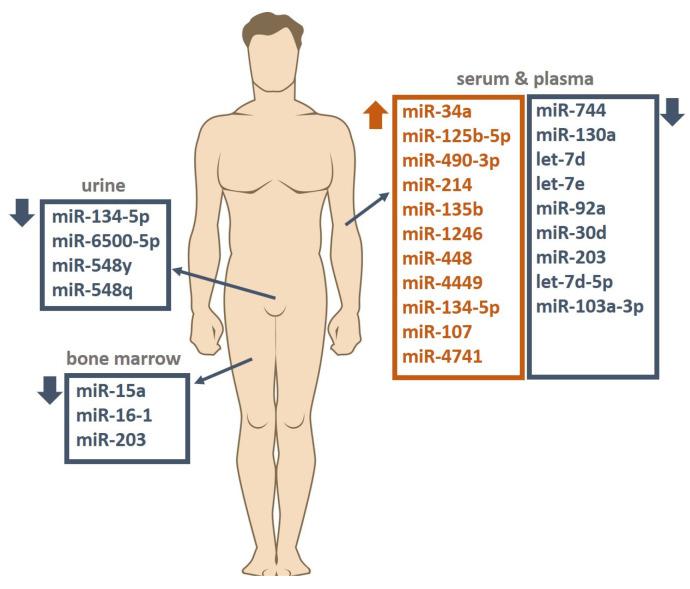
Multiple myeloma (MM) is the second most common hematologic malignancy in the world and accounts for 15% of primary hemocytopathies, with an ever-increasing number of new cases. It is asymptomatic in 30% of instances; hence, the determination of highly sensitive and specific markers is necessary to make a proper diagnosis. In the last 20 years, miRNAs, involved in regulating the expression of genes responsible for cell proliferation and differentiation, including tumor cells, have been identified as potential diagnostic and prognostic markers. The main aim of the following review was to outline the role of miRNAs in the diagnosis and prognosis of MM, considering their role in the pathogenesis of the disease and identifying their target genes and pathways. For this purpose, publications dating from 2013-2023 have been reviewed. Based on the available data, it is concluded that non-coding RNAs including miRNAs could be potential markers in MM. Furthermore, they may serve as therapeutic targets for certain drugs.
多发性骨髓瘤(MM)是全球第二常见的血液系统恶性肿瘤,占原发性血细胞病的15%,新发病例数不断增加。30%的病例无症状;因此,确定高度敏感和特异的标志物对于做出正确诊断至关重要。在过去20年中,参与调节负责细胞增殖和分化(包括肿瘤细胞)的基因表达的微小RNA(miRNA)已被确定为潜在的诊断和预后标志物。以下综述的主要目的是概述miRNA在MM诊断和预后中的作用,考虑它们在疾病发病机制中的作用,并确定其靶基因和信号通路。为此,对2013年至2023年的出版物进行了综述。根据现有数据,得出结论:包括miRNA在内的非编码RNA可能是MM的潜在标志物。此外,它们可能作为某些药物的治疗靶点。



 Zotero 插件