
利用皮层和皮层下电生理信号进行语音解码。
Speech decoding using cortical and subcortical electrophysiological signals.
作者信息
Wu Hemmings, Cai Chengwei, Ming Wenjie, Chen Wangyu, Zhu Zhoule, Feng Chen, Jiang Hongjie, Zheng Zhe, Sawan Mohamad, Wang Ting, Zhu Junming
机构信息
Department of Neurosurgery, Second Affiliated Hospital, Zhejiang University School of Medicine, Hangzhou, China.
Clinical Research Center for Neurological Disease of Zhejiang Province, Hangzhou, China.
出版信息
Front Neurosci. 2024 Feb 29;18:1345308. doi: 10.3389/fnins.2024.1345308. eCollection 2024.
INTRODUCTION
Language impairments often result from severe neurological disorders, driving the development of neural prosthetics utilizing electrophysiological signals to restore comprehensible language. Previous decoding efforts primarily focused on signals from the cerebral cortex, neglecting subcortical brain structures' potential contributions to speech decoding in brain-computer interfaces.
METHODS
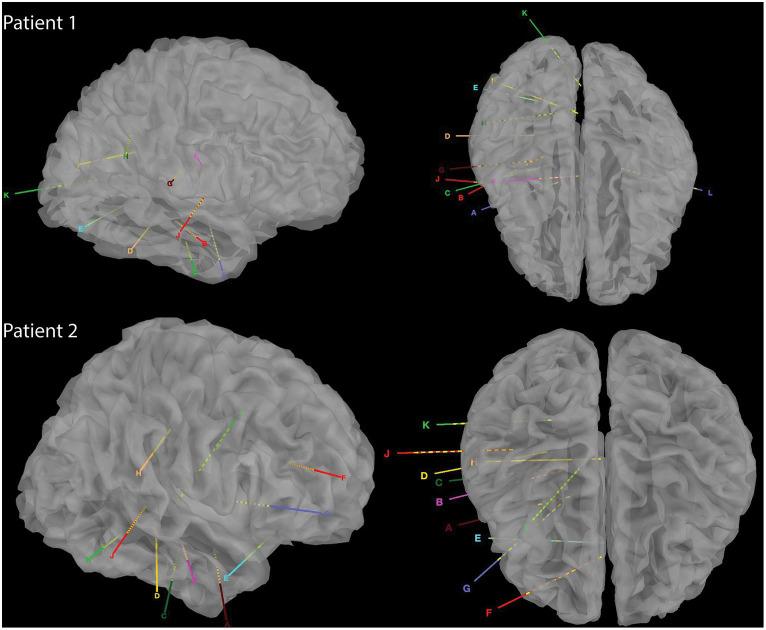
In this study, stereotactic electroencephalography (sEEG) was employed to investigate subcortical structures' role in speech decoding. Two native Mandarin Chinese speakers, undergoing sEEG implantation for epilepsy treatment, participated. Participants read Chinese text, with 1-30, 30-70, and 70-150 Hz frequency band powers of sEEG signals extracted as key features. A deep learning model based on long short-term memory assessed the contribution of different brain structures to speech decoding, predicting consonant articulatory place, manner, and tone within single syllable.
RESULTS
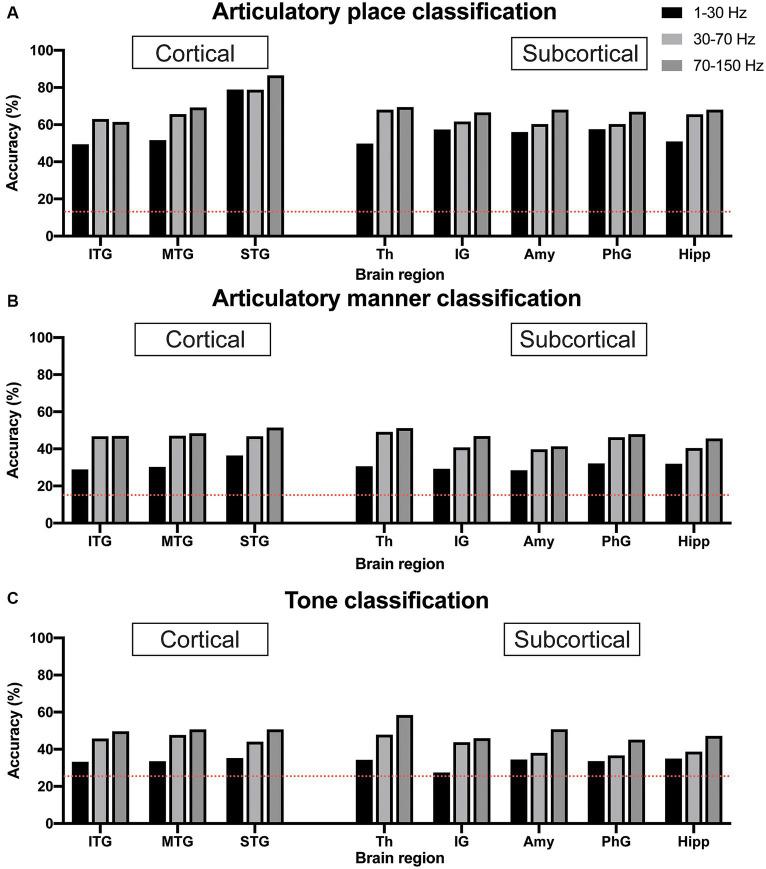
Cortical signals excelled in articulatory place prediction (86.5% accuracy), while cortical and subcortical signals performed similarly for articulatory manner (51.5% vs. 51.7% accuracy). Subcortical signals provided superior tone prediction (58.3% accuracy). The superior temporal gyrus was consistently relevant in speech decoding for consonants and tone. Combining cortical and subcortical inputs yielded the highest prediction accuracy, especially for tone.
DISCUSSION
This study underscores the essential roles of both cortical and subcortical structures in different aspects of speech decoding.
引言
语言障碍通常由严重的神经系统疾病引起,这推动了利用电生理信号来恢复可理解语言的神经假体的发展。以往的解码工作主要集中在大脑皮层的信号上,而忽略了皮层下脑结构在脑机接口语音解码中的潜在作用。
方法
在本研究中,采用立体定向脑电图(sEEG)来研究皮层下结构在语音解码中的作用。两名以汉语为母语的受试者参与了研究,他们因癫痫治疗而接受了sEEG植入。受试者阅读中文文本,提取sEEG信号在1-30Hz、30-70Hz和70-150Hz频段的功率作为关键特征。基于长短期记忆的深度学习模型评估了不同脑结构对语音解码的贡献,预测单个音节内的辅音发音部位、方式和声调。
结果
皮层信号在发音部位预测方面表现出色(准确率86.5%),而皮层和皮层下信号在发音方式预测上表现相似(准确率分别为51.5%和51.7%)。皮层下信号在声调预测方面表现更优(准确率58.3%)。颞上回在辅音和声调的语音解码中始终具有相关性。结合皮层和皮层下输入可获得最高的预测准确率,尤其是在声调预测方面。
讨论
本研究强调了皮层和皮层下结构在语音解码不同方面的重要作用。


 Zotero 插件