
使用非侵入性脑电图测量评估一种用于养殖的成年咸水鳄()的商业电击致昏方法。
Evaluation of a commercial electrical stunning method for farmed grower saltwater crocodiles () using non-invasive EEG measurements.
作者信息
Small Alison, Niemeyer Dominic, Hewitt Leisha
机构信息
CSIRO Agriculture & Food, Chiswick, New England Highway, Armidale NSW 2358 Australia.
Dr Leisha Hewitt Livestock Welfare, Franklin, Tasmania 7113 Australia.
出版信息
Anim Welf. 2023 Jul 19;32:e49. doi: 10.1017/awf.2023.45. eCollection 2023.
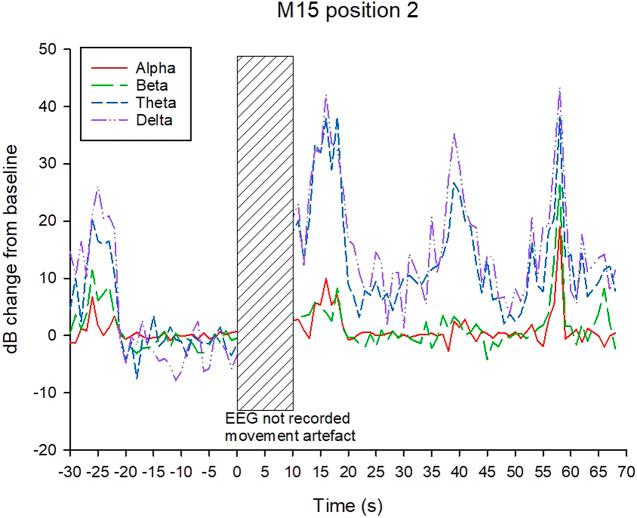
The aim of this study was to assess welfare outcomes of electrical stunning as a means of restraint in farmed grower saltwater crocodiles (). Physical handling of a stunned, unconscious crocodile is far safer for the operator than handling a fully conscious animal. Electroencephalogram (EEG) was recorded before and after the application of electrical stunning at 50 Hz or 400 Hz using an electrical stunner applied to the cranial plate (Position 1: P1-50 Hz; n = 31, P1-400 Hz; n = 29) or immediately behind the skull (Position 2: P2-50 Hz; n = 29; P2-400 Hz; n = 30). For all electrical stuns, percentage total EEG power in a 10-s epoch decreased in the alpha and beta frequency bands; and increased in the delta and lower frequencies bands. All electrical stuns resulted in increased strength of signal, based on the quadratic mean EEG power in all frequency bands of the EEG. Greatest change in power occurred in the delta frequency band, with P1-50 Hz. This was greater than with P2-50 Hz; while decibel change using 400 Hz at either position was intermediate and not significantly different from either. Application of either electrical stunner at position 1 resulted in seizure-like activity and activation in low frequencies, but at position 2 this was not consistent across all animals. The ability of the electrical stunning equipment to consistently induce recoverable unconsciousness could be ranked in decreasing order as: P1-50 Hz > P1-400 Hz = P2-50 Hz > P2-400 Hz. Based on behavioural observations, all animals in the study appeared to stunned however evaluation of duration of EEG changes indicates that use of the electrical stunning equipment at 50 Hz would allow some margin for inaccuracies in tong placement, while achieving a consistently reliable stun.
本研究的目的是评估电晕作为圈养育成期咸水鳄()一种约束手段的福利结果。对于操作人员而言,处理一只被电晕、失去意识的鳄鱼远比处理一只完全清醒的动物安全得多。使用电晕器分别作用于颅板(位置1:P1 - 50Hz;n = 31,P1 - 400Hz;n = 29)或颅骨后方紧邻处(位置2:P2 - 50Hz;n = 29;P2 - 400Hz;n = 30),在施加50Hz或400Hz电晕前后记录脑电图(EEG)。对于所有电晕处理,在10秒时间段内,脑电图总功率百分比在α和β频段降低,在δ和更低频段升高。基于脑电图所有频段的二次平均EEG功率,所有电晕处理均导致信号强度增加。功率变化最大的是δ频段,P1 - 50Hz时变化最大。这比P2 - 50Hz时更大;而在任一位置使用400Hz时的分贝变化处于中间水平,且与两者均无显著差异。在位置1使用任一电晕器都会导致癫痫样活动和低频激活,但在位置2并非所有动物都如此。电晕设备持续诱导可恢复性昏迷的能力按降序排列为:P1 - 50Hz > P1 - 400Hz = P2 - 50Hz > P2 - 400Hz。基于行为观察,研究中的所有动物似乎都被电晕了,然而对EEG变化持续时间的评估表明,使用50Hz的电晕设备在钳夹放置不准确时仍有一定余地,同时能实现持续可靠的电晕效果。



 Zotero 插件