
用于4类钢柱火灾诱发屈曲分析的新型基于梁的模型。
New beam-based models for fire-induced buckling analysis of class 4 steel columns.
作者信息
Pallares-Muñoz Myriam R, Paya-Zaforteza Ignacio, Hospitaler-Perez Antonio
机构信息
Universidad Surcolombiana, Cra 1 Aven. 26, 410010, Neiva, Colombia.
Universitat Politècnica de València, ICITECH, Camino de Vera S/N, 46022, València, Spain.
出版信息
Heliyon. 2024 Mar 2;10(5):e26951. doi: 10.1016/j.heliyon.2024.e26951. eCollection 2024 Mar 15.
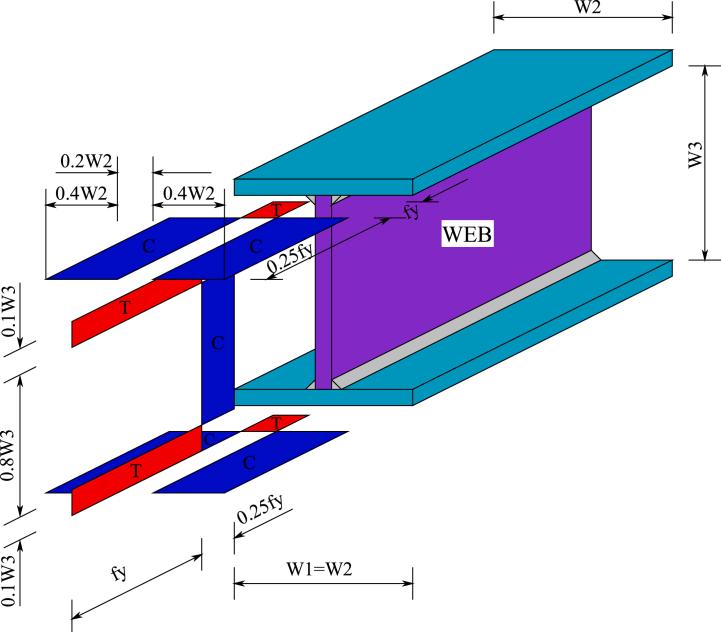
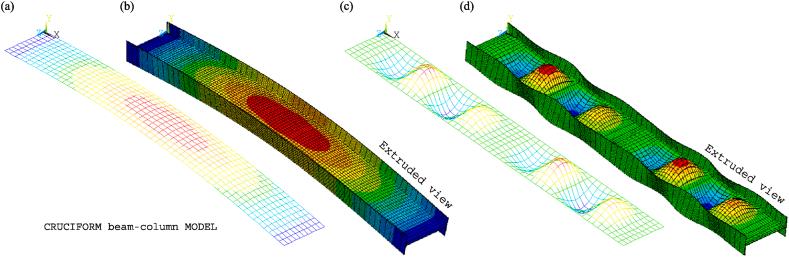
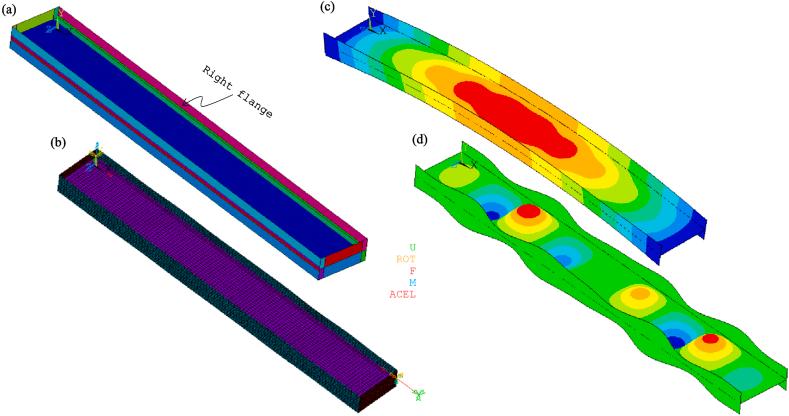
Steel cross-sections with thin walls are vulnerable to fire-induced buckling instability, which reduces their load-bearing capacity. Eurocode 3 design provisions have been found inadequate, leading to alternative methods such as effective design strategies and advanced structural models built mostly with shell FE, which can be complex. For Class 4 steel beam-columns subjected to fire conditions, beam-type modelling to predict the Flexural-Torsional Buckling (FTB) strength has been proposed as an alternative approach, but it has not yielded satisfactory results for large compressive load eccentricities. This paper presents two new low computational cost modelling strategies based on Timoshenko's beam FE to address this issue: the Single beam-column Model (SbcM) and the Cruciform beam-column Model (CbcM). The first consists of a single line of beam FE, while the second uses a grid of beam FE for more flexibility. Both strategies effectively simulate the FTB behaviour in Class 4 steel beam-column during a fire, offering quicker computations compared to shell models. Still, the single-line model is favoured for its simplicity, making it more efficient in analysing complex fire engineering problems.
薄壁钢截面易受火灾引起的屈曲失稳影响,这会降低其承载能力。已发现欧洲规范3的设计规定并不充分,从而导致了一些替代方法,如有效的设计策略以及主要基于壳有限元构建的先进结构模型,而这些模型可能很复杂。对于处于火灾条件下的4类钢梁柱,已提出采用梁式建模来预测弯扭屈曲(FTB)强度作为一种替代方法,但对于较大的压缩载荷偏心距,该方法尚未取得令人满意的结果。本文提出了两种基于铁木辛柯梁有限元的低计算成本建模策略来解决这一问题:单梁柱模型(SbcM)和十字形梁柱模型(CbcM)。第一种由单排梁有限元组成,而第二种使用梁有限元网格以获得更大的灵活性。两种策略都能有效模拟4类钢梁柱在火灾中的FTB行为,与壳模型相比计算速度更快。不过,单线模型因其简单性而更受青睐,使其在分析复杂的火灾工程问题时更高效。








 Zotero 插件