
运用机器学习技术对通过井口节流器的液流速率进行建模。
Modeling liquid rate through wellhead chokes using machine learning techniques.
作者信息
Dabiri Mohammad-Saber, Hadavimoghaddam Fahimeh, Ashoorian Sefatallah, Schaffie Mahin, Hemmati-Sarapardeh Abdolhossein
机构信息
Department of Petroleum Engineering, Shahid Bahonar University of Kerman, Kerman, Iran.
Ufa State Petroleum Technological University, Ufa, Russia, 450064.
出版信息
Sci Rep. 2024 Mar 23;14(1):6945. doi: 10.1038/s41598-024-54010-2.
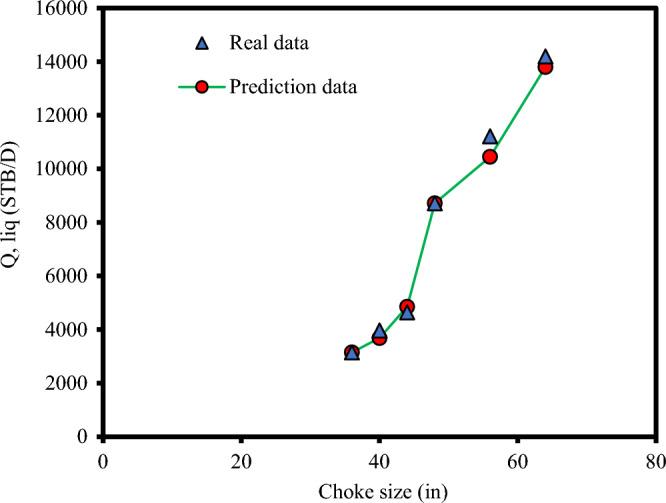
Precise measurement and prediction of the fluid flow rates in production wells are crucial for anticipating the production volume and hydrocarbon recovery and creating a steady and controllable flow regime in such wells. This study suggests two approaches to predict the flow rate through wellhead chokes. The first is a data-driven approach using different methods, namely: Adaptive boosting support vector regression (Adaboost-SVR), multivariate adaptive regression spline (MARS), radial basis function (RBF), and multilayer perceptron (MLP) with three algorithms: Levenberg-Marquardt (LM), bayesian-regularization (BR), and scaled conjugate gradient (SCG). The second is a developed correlation that depends on wellhead pressure (P), gas-to-liquid ratio (GLR), and choke size (D). A dataset of 565 data points is available for model development. The performance of the two suggested approaches is compared with earlier correlations. Results revealed that the proposed models outperform the existing ones, with the Adaboost-SVR model showing the best performance with an average absolute percent relative error (AAPRE) of 5.15% and a correlation coefficient of 0.9784. Additionally, the results indicated that the developed correlation resulted in better predictions compared to the earlier ones. Furthermore, a sensitivity analysis of the input variable was also investigated in this study and revealed that the choke size variable had the most significant effect, while the P and GLR showed a slight effect on the liquid rate. Eventually, the leverage approach showed that only 2.1% of the data points were in the suspicious range.
精确测量和预测生产井中的流体流速对于预估产量和碳氢化合物采收率以及在这些井中建立稳定且可控的流态至关重要。本研究提出了两种预测通过井口节流器流速的方法。第一种是使用不同方法的数据驱动方法,即:自适应增强支持向量回归(Adaboost-SVR)、多元自适应回归样条(MARS)、径向基函数(RBF)以及具有三种算法的多层感知器(MLP):列文伯格-马夸尔特(LM)、贝叶斯正则化(BR)和缩放共轭梯度(SCG)。第二种是一种基于井口压力(P)、气液比(GLR)和节流器尺寸(D)建立的关联式。有一个包含565个数据点的数据集可用于模型开发。将这两种建议方法的性能与早期的关联式进行了比较。结果表明,所提出的模型优于现有模型,其中Adaboost-SVR模型表现最佳,平均绝对相对百分比误差(AAPRE)为5.15%,相关系数为0.9784。此外,结果表明,与早期的关联式相比,所建立的关联式能得出更好的预测结果。此外,本研究还对输入变量进行了敏感性分析,结果表明节流器尺寸变量的影响最为显著,而P和GLR对液流率的影响较小。最终,杠杆分析法表明只有2.1%的数据点处于可疑范围内。


 Zotero 插件