
多发性硬化症高效治疗后对SARS-CoV-2疫苗接种反应的长期观察——一个真实世界的案例
Long-Term Observation of SARS-CoV-2 Vaccination Response upon High Efficacy Treatment in Multiple Sclerosis-A Real-World Scenario.
作者信息
Schraad Muriel, Runkel Stefan, Hitzler Walter, Protopapa Maria, Bittner Stefan, Uphaus Timo, Zipp Frauke
机构信息
Department of Neurology, Focus Program Translational Neuroscience (FTN) and Immunotherapy (FZI), Rhine Main Neuroscience Network (rmn2), University Medical Centre of the Johannes Gutenberg University Mainz, Langenbeckstr. 1, 55131 Mainz, Germany.
Department of Transfusion Medicine, University Medical Centre of the Johannes Gutenberg University Mainz, Langenbeckstr. 1, 55131 Mainz, Germany.
出版信息
Vaccines (Basel). 2024 Mar 12;12(3):296. doi: 10.3390/vaccines12030296.
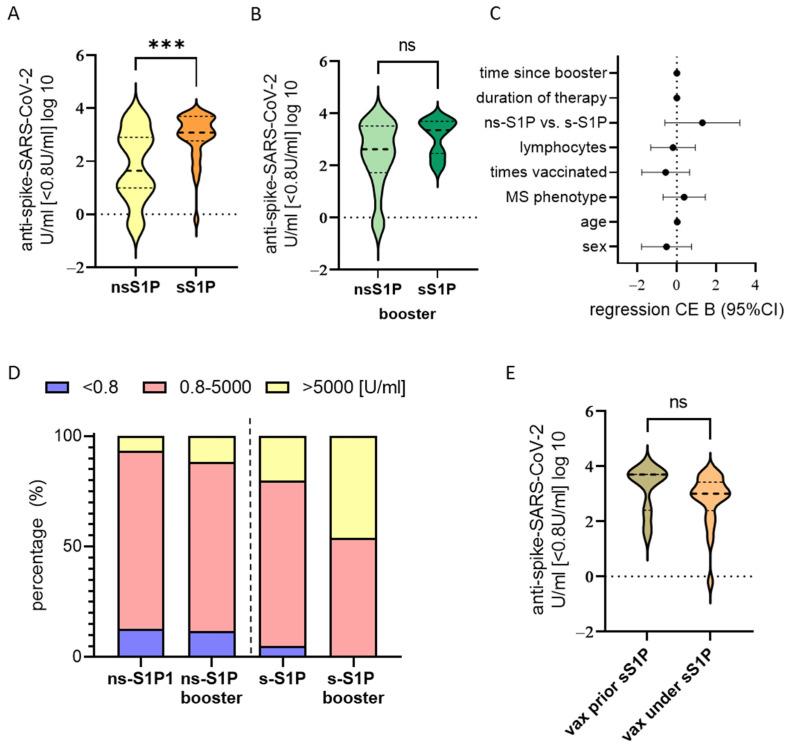
Immunomodulatory and immunosuppressive therapy is needed in people with a chronic neuroinflammatory disease of the central nervous system such as multiple sclerosis (MS). Therefore, MS requires monitoring for and preventing against infectious diseases like SARS-CoV-2. Vaccination and anti-viral treatments are, in particular, recommended for elderly people and people at risk of a severe course of infection and of MS. Here, we asked whether repetitive infection or vaccination influenced responses upon receiving high efficacy treatments, namely sphingosine-1-phosphate receptor modulator (S1P) or anti-CD20 B cell antibody (anti-CD20) treatments. We performed a prospective real-world study of people with MS (pwMS) under S1P or anti-CD20 with repetitive exposure to the SARS-CoV-2 virus or vaccine. The measurement of anti-SARS-CoV-2 antibody titres was performed by two independent immunoassays after initial immunisation and after booster vaccination or infection. Other laboratory and clinical parameters were included in the analysis of influencing factors. As secondary outcomes, lymphocyte and immunoglobulin levels were observed longitudinally under intravenous and subcutaneous anti-CD20 treatment. In a long-term real-world cohort of 201 pwMS, we found that despite lymphopenia upon S1P drugs, the SARS-CoV-2 immunisation response increased both in selective and non-selective S1P (100% and 88% seroconversion, respectively), whereas those under anti-CD20 therapies merely exhibited a slight long-term increase in antibody titres (52% seroconversion). The latter was independent of immunoglobulin or total lymphocyte levels, which mostly remained stable. If the individual was immunised prior to therapy initiation, their levels of SARS-CoV-2 antibodies remained high under treatment. PwMS under non-selective S1P benefit from repetitive vaccination. The risk of an insufficient vaccination response mirrored by lower SARS-CoV-2 antibodies remains in pwMS receiving anti-CD20 treatment, even after repetitive exposure to the vaccine or virus. Due to the compromised vaccination response in CD20-depleting drugs, prompt antiviral treatment might be necessary.
患有中枢神经系统慢性神经炎症性疾病(如多发性硬化症(MS))的患者需要免疫调节和免疫抑制治疗。因此,MS患者需要监测并预防SARS-CoV-2等传染病。尤其推荐对老年人以及有感染重症风险和MS风险的人群进行疫苗接种和抗病毒治疗。在此,我们探讨了反复感染或接种疫苗是否会影响接受高效治疗(即鞘氨醇-1-磷酸受体调节剂(S1P)或抗CD20 B细胞抗体(抗CD20)治疗)时的反应。我们对接受S1P或抗CD20治疗且反复接触SARS-CoV-2病毒或疫苗的MS患者(pwMS)进行了一项前瞻性真实世界研究。在初次免疫后以及加强接种疫苗或感染后,通过两种独立的免疫测定法检测抗SARS-CoV-2抗体滴度。其他实验室和临床参数纳入影响因素分析。作为次要结果,在静脉内和皮下抗CD20治疗期间纵向观察淋巴细胞和免疫球蛋白水平。在一个由201名pwMS组成的长期真实世界队列中,我们发现,尽管使用S1P药物后出现淋巴细胞减少,但SARS-CoV-2免疫反应在选择性和非选择性S1P治疗中均有所增加(血清转化率分别为100%和88%),而接受抗CD20治疗的患者抗体滴度仅出现轻微的长期升高(血清转化率为52%)。后者与免疫球蛋白或总淋巴细胞水平无关,这些指标大多保持稳定。如果个体在治疗开始前已接种疫苗,其SARS-CoV-2抗体水平在治疗期间仍保持较高。接受非选择性S1P治疗的pwMS患者从反复接种疫苗中获益。即使反复接触疫苗或病毒,接受抗CD20治疗的pwMS患者中,较低的SARS-CoV-2抗体反映出疫苗接种反应不足的风险仍然存在。由于CD20耗竭药物的疫苗接种反应受损,可能需要及时进行抗病毒治疗。


 Zotero 插件