
通过生物信息学和实验验证鉴定及分析脓毒症诱导的肺损伤中与PAN细胞焦亡相关的基因
Identification and Analysis of PANoptosis-Related Genes in Sepsis-Induced Lung Injury by Bioinformatics and Experimental Verification.
作者信息
Yang Zhen, Kao Xingyu, Huang Na, Yuan Kang, Chen Jingli, He Mingfeng
机构信息
The Eighth School of Clinical Medicine, Guangzhou University of Chinese Medicine, Foshan, Guangdong Province, People's Republic of China.
Foshan Hospital of Traditional Chinese Medicine, Foshan, Guangdong Province, People's Republic of China.
出版信息
J Inflamm Res. 2024 Mar 28;17:1941-1956. doi: 10.2147/JIR.S452608. eCollection 2024.
PURPOSE
Sepsis-induced lung injury (SLI) is a serious complication of sepsis. PANoptosis, a novel form of inflammatory programmed cell death that is not yet to be fully investigated in SLI. Our research aims to screen and validate the signature genes of PANoptosis in SLI by bioinformatics and in vivo experiment.
METHODS
SLI-related datasets were downloaded from NCBI Gene Expression Omnibus (GEO) database. Differentially expressed genes (DEGs) of SLI were identified and intersected with the PANoptosis gene set to obtain DEGs related to PANoptosis (SPAN_DEGs). Then, Protein-Protein Interaction (PPI) network and functional enrichment analysis were conducted based on SPAN_DEGs. SVM-REF, LASSO and RandomForest three algorithms were combined to identify the signature genes. The Nomogram and ROC curves were performed to predict diagnostic value. Immune infiltration analysis, correlation analysis and differential expression analysis were used to explore the immunological characterization, correlation and expression levels of the signature genes. Finally, H&E staining and qRT-PCR were conducted for further verification in vivo experiment.
RESULTS
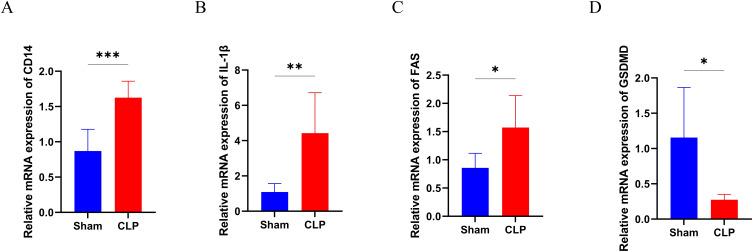
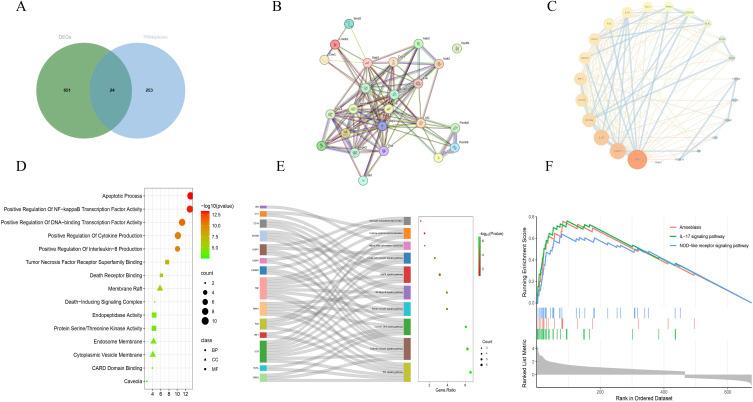
Twenty-four SPAN_DEGs were identified by intersecting 675 DEGs with the 277 PANoptosis genes. Four signature genes (CD14, GSDMD, IL1β, and FAS) were identified by three machine learning algorithms, which were highly expressed in the SLI group, and had high diagnostic value in the diagnostic model. Moreover, immune infiltration analysis showed that most immune cells and immune-related functions were higher in the SLI group than those in the control group and were closely associated with the signature genes. Finally, it was confirmed that the cecum ligation and puncture (CLP) group mice showed significant pathological damage in lung tissues, and the mRNA expression levels of CD14, IL1β, and FAS were significantly higher than the sham group.
CONCLUSION
CD14, FAS, and IL1β may be the signature genes in PANoptosis to drive the progression of SLI and involved in regulating immune processes.
目的
脓毒症诱导的肺损伤(SLI)是脓毒症的一种严重并发症。全程序死亡(PANoptosis)是一种新型的炎症程序性细胞死亡形式,在SLI中尚未得到充分研究。我们的研究旨在通过生物信息学和体内实验筛选并验证SLI中PANoptosis的特征基因。
方法
从NCBI基因表达综合数据库(GEO)下载与SLI相关的数据集。鉴定SLI的差异表达基因(DEG),并与PANoptosis基因集进行交集分析,以获得与PANoptosis相关的DEG(SPAN_DEG)。然后,基于SPAN_DEG进行蛋白质-蛋白质相互作用(PPI)网络和功能富集分析。结合支持向量机递归特征消除法(SVM-REF)、套索回归(LASSO)和随机森林三种算法来鉴定特征基因。绘制列线图和ROC曲线以预测诊断价值。采用免疫浸润分析、相关性分析和差异表达分析来探索特征基因的免疫学特征、相关性和表达水平。最后,进行苏木精-伊红(H&E)染色和定量逆转录聚合酶链反应(qRT-PCR)以在体内实验中进行进一步验证。
结果
通过将675个DEG与277个PANoptosis基因进行交集分析,鉴定出24个SPAN_DEG。通过三种机器学习算法鉴定出四个特征基因(CD14、Gasdermin D(GSDMD)、白细胞介素1β(IL1β)和FAS),它们在SLI组中高表达,并且在诊断模型中具有较高的诊断价值。此外,免疫浸润分析表明,SLI组中的大多数免疫细胞和免疫相关功能高于对照组,并且与特征基因密切相关。最后,证实盲肠结扎穿孔(CLP)组小鼠的肺组织出现明显的病理损伤,并且CD14、IL1β和FAS的mRNA表达水平显著高于假手术组。
结论
CD14、FAS和IL1β可能是PANoptosis中的特征基因,可驱动SLI的进展并参与调节免疫过程。



 Zotero 插件