
网格增强超薄铝涂层塑料薄膜的热化:应用于雅典娜X-IFU仪器的参数研究
Thermalization of Mesh Reinforced Ultra-Thin Al-Coated Plastic Films: A Parametric Study Applied to the Athena X-IFU Instrument.
作者信息
Montinaro Nicola, Sciortino Luisa, D'Anca Fabio, Lo Cicero Ugo, Bozzo Enrico, Paltani Stéphane, Todaro Michela, Barbera Marco
机构信息
Dipartimento di Ingegneria, Università Degli Studi di Palermo, Viale delle Scienze, Edificio 8, 90128 Palermo, Italy.
Istituto Nazionale di Astrofisica (INAF), Osservatorio Astronomico di Palermo, Piazza del Parlamento 1, 90134 Palermo, Italy.
出版信息
Sensors (Basel). 2024 Apr 8;24(7):2360. doi: 10.3390/s24072360.
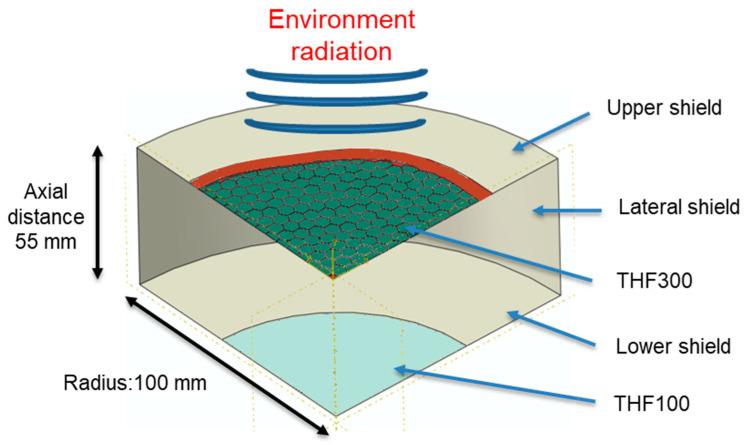
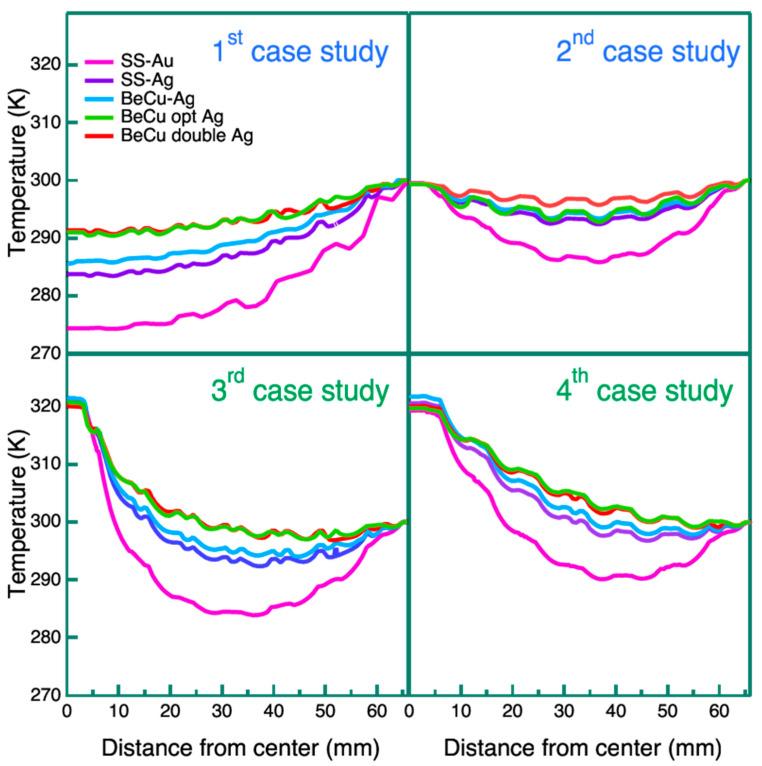
The X-ray Integral Field Unit (X-IFU) is one of the two focal plane detectors of Athena, a large-class high energy astrophysics space mission approved by ESA in the Cosmic Vision 2015-2025 Science Program. The X-IFU consists of a large array of transition edge sensor micro-calorimeters that operate at ~100 mK inside a sophisticated cryostat. To prevent molecular contamination and to minimize photon shot noise on the sensitive X-IFU cryogenic detector array, a set of thermal filters (THFs) operating at different temperatures are needed. Since contamination already occurs below 300 K, the outer and more exposed THF must be kept at a higher temperature. To meet the low energy effective area requirements, the THFs are to be made of a thin polyimide film (45 nm) coated in aluminum (30 nm) and supported by a metallic mesh. Due to the small thickness and the low thermal conductance of the material, the membranes are prone to developing a radial temperature gradient due to radiative coupling with the environment. Considering the fragility of the membrane and the high reflectivity in IR energy domain, temperature measurements are difficult. In this work, a parametric numerical study is performed to retrieve the radial temperature profile of the larger and outer THF of the Athena X-IFU using a Finite Element Model approach. The effects on the radial temperature profile of different design parameters and boundary conditions are considered: (i) the mesh design and material, (ii) the plating material, (iii) the addition of a thick Y-cross applied over the mesh, (iv) an active heating heat flux injected on the center and (v) a Joule heating of the mesh. The outcomes of this study have guided the choice of the baseline strategy for the heating of the Athena X-IFU THFs, fulfilling the stringent thermal specifications of the instrument.
X射线积分场单元(X-IFU)是雅典娜号(Athena)的两个焦平面探测器之一,雅典娜号是欧洲航天局在2015-2025年宇宙愿景科学计划中批准的大型高能天体物理太空任务。X-IFU由大量过渡边缘传感器微热量计组成,这些微热量计在一个复杂的低温恒温器内以约100 mK的温度运行。为防止分子污染并将敏感的X-IFU低温探测器阵列上的光子散粒噪声降至最低,需要一组在不同温度下运行的热滤光片(THF)。由于在300 K以下就会发生污染,外部且暴露较多的THF必须保持在较高温度。为满足低能量有效面积要求,THF由涂有铝(30 nm)并由金属网支撑的薄聚酰亚胺薄膜(45 nm)制成。由于材料厚度小且热导率低,这些薄膜因与环境的辐射耦合而容易产生径向温度梯度。考虑到薄膜的易碎性以及在红外能量域的高反射率,温度测量很困难。在这项工作中,使用有限元模型方法进行了参数化数值研究,以获取雅典娜X-IFU较大外部THF的径向温度分布。考虑了不同设计参数和边界条件对径向温度分布的影响:(i)网的设计和材料,(ii)镀层材料,(iii)在网上施加厚Y形交叉结构,(iv)在中心注入有源加热热通量,以及(v)网的焦耳加热。这项研究的结果指导了雅典娜X-IFU THF加热基线策略的选择,满足了该仪器严格的热规范要求。




 Zotero 插件