
墨西哥公共医疗系统中与糖尿病相关的门诊护理敏感病症导致的医院护理直接成本。
Hospital care direct costs due to ambulatory care sensitive conditions related to diabetes mellitus in the Mexican public healthcare system.
作者信息
Saturno-Hernández Pedro, Moreno-Zegbe Estephania, Poblano-Verastegui Ofelia, Torres-Arreola Laura Del Pilar, Bautista-Morales Arturo C, Maya-Hernández Cynthya, Uscanga-Castillo Juan David, Flores-Hernández Sergio, Gómez-Cortez Patricia María, Vieyra-Romero Waldo Iván
机构信息
National Institute of Public Health (INSP), Cuernavaca, Morelos, Mexico.
Mexican Consortium of Private Hospitals, Mexico City, Mexico.
出版信息
BMC Health Serv Res. 2024 Apr 24;24(1):507. doi: 10.1186/s12913-024-10937-w.
BACKGROUND
Hospitalizations for ambulatory care sensitive conditions (ACSC) incur substantial costs on the health system that could be partially avoided with adequate outpatient care. Complications of chronic diseases, such as diabetes mellitus (DM), are considered ACSC. Previous studies have shown that hospitalizations due to diabetes have a significant financial burden. In Mexico, DM is a major health concern and a leading cause of death, but there is limited evidence available. This study aimed to estimate the direct costs of hospitalizations by DM-related ACSC in the Mexican public health system.
METHODS
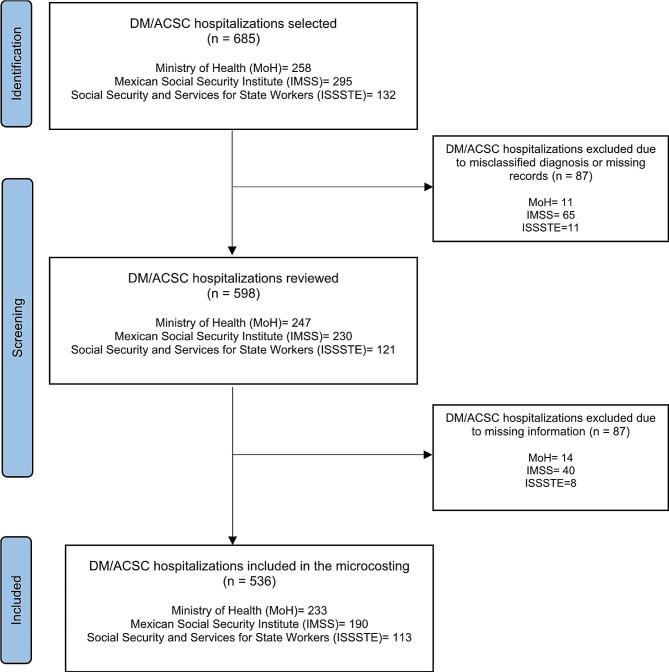
We selected three hospitals from each of Mexico's main public institutions: the Mexican Social Security Institute (IMSS), the Ministry of Health (MoH), and the Institute of Social Security and Services for State Workers (ISSSTE). We employed a bottom-up microcosting approach from the healthcare provider perspective to estimate the total direct costs of hospitalizations for DM-related ACSC. Input data regarding length of stay (LoS), consultations, medications, colloid/crystalloid solutions, procedures, and laboratory/medical imaging studies were obtained from clinical records of a random sample of 532 hospitalizations out of a total of 1,803 DM-related ACSC (ICD-10 codes) discharges during 2016.
RESULTS
The average cost per DM-related ACSC hospitalization varies among institutions, ranging from $1,427 in the MoH to $1,677 in the IMSS and $1,754 in the ISSSTE. The three institutions' largest expenses are LoS and procedures. Peripheral circulatory and renal complications were the major drivers of hospitalization costs for patients with DM-related ACSC. Direct costs due to hospitalizations for DM-related ACSC in these three institutions represent 1% of the gross domestic product (GDP) dedicated to health and social services and 2% of total hospital care expenses.
CONCLUSIONS
The direct costs of hospitalizations for DM-related ACSC vary considerably across institutions. Disparities in such costs for the same ACSC among different institutions suggest potential disparities in care quality across primary and hospital settings (processes and resource utilization), which should be further investigated to ensure optimal supply utilization. Prioritizing preventive measures for peripheral circulatory and renal complications in DM patients could be highly beneficial.
背景
因门诊可预防疾病(ACSC)住院给卫生系统带来了巨大成本,而通过充分的门诊护理可部分避免这些成本。慢性病并发症,如糖尿病(DM),被视为ACSC。先前的研究表明,糖尿病导致的住院治疗带来了巨大的经济负担。在墨西哥,糖尿病是一个主要的健康问题和主要死因,但现有证据有限。本研究旨在估算墨西哥公共卫生系统中与糖尿病相关的ACSC住院治疗的直接成本。
方法
我们从墨西哥的每个主要公共机构中各选取了三家医院:墨西哥社会保障局(IMSS)、卫生部(MoH)和国家工作人员社会保障与服务研究所(ISSSTE)。我们从医疗服务提供者的角度采用自下而上的微观成本核算方法,估算与糖尿病相关的ACSC住院治疗的总直接成本。关于住院时间(LoS)、会诊、药物、胶体/晶体溶液、手术以及实验室/医学影像检查的输入数据,是从2016年1803例与糖尿病相关的ACSC(国际疾病分类第十版编码)出院病例中随机抽取的532例住院病例的临床记录中获取的。
结果
各机构中与糖尿病相关的ACSC住院治疗的平均成本各不相同,卫生部为1427美元,IMSS为1677美元,ISSSTE为1754美元。这三个机构最大的支出是住院时间和手术费用。外周循环和肾脏并发症是与糖尿病相关的ACSC患者住院成本的主要驱动因素。这三个机构中与糖尿病相关的ACSC住院治疗的直接成本占用于卫生和社会服务的国内生产总值(GDP)的1%,占医院总护理费用的2%。
结论
与糖尿病相关的ACSC住院治疗的直接成本在各机构之间差异很大。不同机构中相同ACSC的此类成本差异表明,初级和医院环境(流程和资源利用)中的护理质量可能存在差异,应进一步调查以确保最佳供应利用。优先采取针对糖尿病患者外周循环和肾脏并发症的预防措施可能非常有益。
 Zotero 插件