Department of Neurosciences and the Shiley-Marcos Alzheimer's Disease Research Center, University of California San Diego, San Diego, CA.
Institute of Gerontology & Department of Healthcare Sciences, Wayne State University, Detroit, MI.
Diabetes Care. 2024 Jul 1;47(7):1152-1161. doi: 10.2337/dc23-2003.
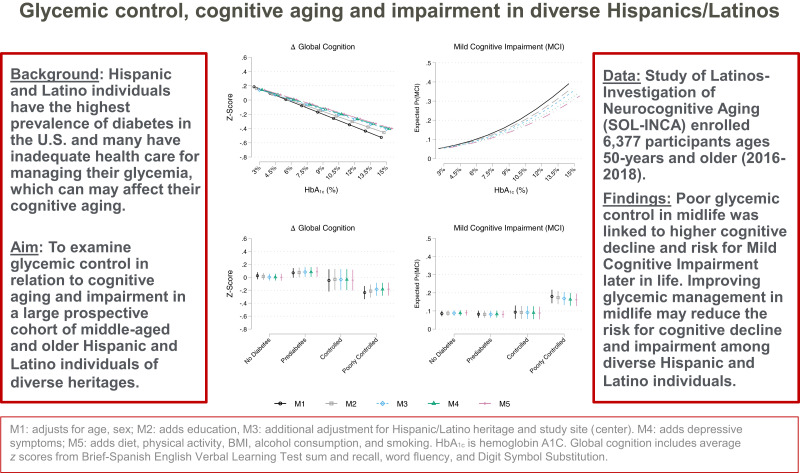
Hispanic/Latino individuals in the U.S. have the highest prevalence of undiagnosed and untreated diabetes and are at increased risk for cognitive impairment. In this study, we examine glycemic control in relation to cognitive aging and impairment in a large prospective cohort of middle-aged and older Hispanic/Latino individuals of diverse heritages.
Study of Latinos-Investigation of Neurocognitive Aging (SOL-INCA) is a Hispanic Community Health Study/Study of Latinos (HCHS/SOL) ancillary study. HCHS/SOL is a multisite (Bronx, NY; Chicago, IL; Miami, FL; and San Diego, CA), probability sampled prospective cohort study. SOL-INCA enrolled 6,377 diverse Hispanic/Latino individuals aged 50 years and older (2016-2018). The primary outcomes were cognitive function, 7-year cognitive decline, and mild cognitive impairment (MCI). The primary glycemia exposure variables were measured from fasting blood samples collected at HCHS/SOL visit 1 (2008-2011).
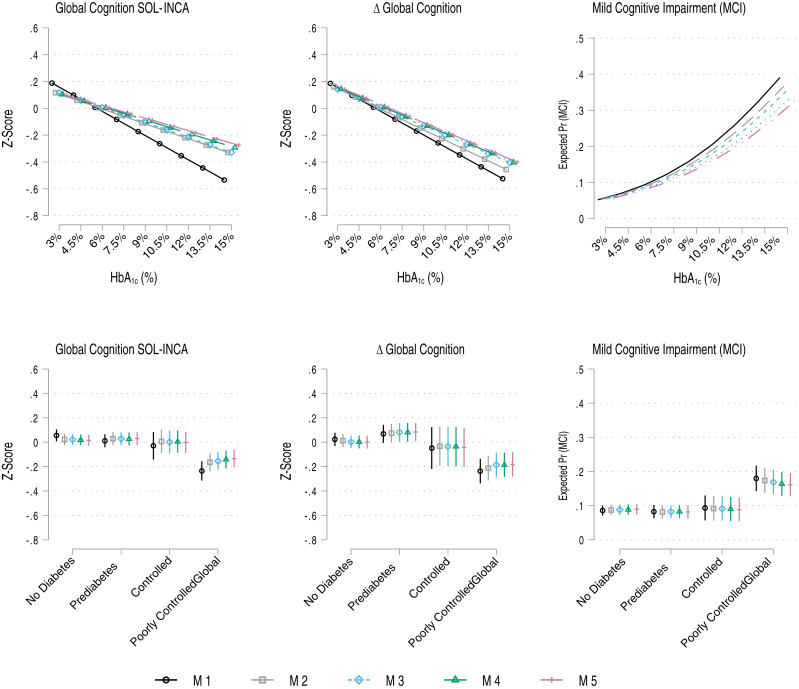
Visit 1 mean age was 56.5 years ± 8.2 SD, and the average glycosylated hemoglobin A1C (HbA1c) was 6.12% (43.5 ± 14.6 mmol/mol). After covariate adjustment, higher HbA1c was associated with accelerated 7-year global (b = -0.045; 95% CI -0.070; -0.021; in z score units) and executive cognitive decline and a higher prevalence of MCI (odds ratio 1.20; 95% CI 1.11; 1.29).
Elevated HbA1c levels were associated with 7-year executive cognitive decline and increased MCI risk among diverse middle-aged and older Hispanic/Latino individuals. Our findings indicate that poor glycemic control in midlife may pose significant risks for cognitive decline and MCI later in life among Hispanic/Latino individuals of diverse heritages.
美国的西班牙裔/拉丁裔人群患未确诊和未经治疗的糖尿病的比例最高,且认知障碍的风险也更高。在这项研究中,我们在一个由不同族裔背景的中年及以上西班牙裔/拉丁裔个体组成的大型前瞻性队列中,研究了血糖控制与认知衰老和认知障碍的关系。
拉丁裔认知衰老研究-神经认知评估(SOL-INCA)是西班牙裔社区健康研究/拉丁裔研究(HCHS/SOL)的一个辅助研究。HCHS/SOL 是一个多地点(纽约布朗克斯、伊利诺伊州芝加哥、佛罗里达州迈阿密和加利福尼亚州圣地亚哥)、概率抽样前瞻性队列研究。SOL-INCA 纳入了 6377 名年龄在 50 岁及以上的不同族裔背景的西班牙裔/拉丁裔个体(2016-2018 年)。主要结局指标为认知功能、7 年认知衰退和轻度认知障碍(MCI)。主要血糖暴露变量是通过在 HCHS/SOL 第 1 次就诊(2008-2011 年)时采集的空腹血样测量得到的。
第 1 次就诊时的平均年龄为 56.5 岁±8.2 岁标准差,平均糖化血红蛋白 A1c(HbA1c)为 6.12%(43.5±14.6 mmol/mol)。在调整了协变量后,较高的 HbA1c 与 7 年的整体(b=-0.045;95%CI-0.070;-0.021;在 z 评分单位)和执行认知衰退以及 MCI 患病率升高有关(比值比 1.20;95%CI 1.11;1.29)。
在不同族裔背景的中年及以上西班牙裔/拉丁裔个体中,HbA1c 水平升高与 7 年的执行认知衰退和 MCI 风险增加有关。我们的研究结果表明,在不同族裔背景的西班牙裔/拉丁裔个体中,中年时血糖控制不佳可能会显著增加晚年认知衰退和 MCI 的风险。