
神经内分泌癌的基因指导治疗:对 BRAF 和 MEK 抑制剂的反应。
Genetics-guided therapy in neuroendocrine carcinoma: response to BRAF- and MEK-inhibitors.
机构信息
Department of Medical Sciences, Uppsala University, Uppsala, Sweden.
Department of Radiology, Uppsala University Hospital, Uppsala, Sweden.
出版信息
Ups J Med Sci. 2024 Apr 10;129. doi: 10.48101/ujms.v129.10660. eCollection 2024.
BACKGROUND
Metastatic neuroendocrine carcinoma (NEC) is associated with short survival. Other than platinum-based chemotherapy, there is no clear standard regimen. Current guidelines suggest that combination treatment with BRAF-inhibitors should be considered for patients with V600E-mutated NEC. However, since only eight such patients have been reported in the literature, our object was to confirm the validity of this recommendation.
METHODS
This was a single-center retrospective cohort study conducted at Uppsala University Hospital. The included patients 1) had a histopathologically confirmed diagnosis of NEC, 2) were diagnosed between January 1, 2018 and December 31, 2023, 3) had tumor tissue genetically screened by a broad next-generation sequencing (NGS) panel, and 4) showed a tumor mutation for which there is a currently available targeted therapy.
RESULTS
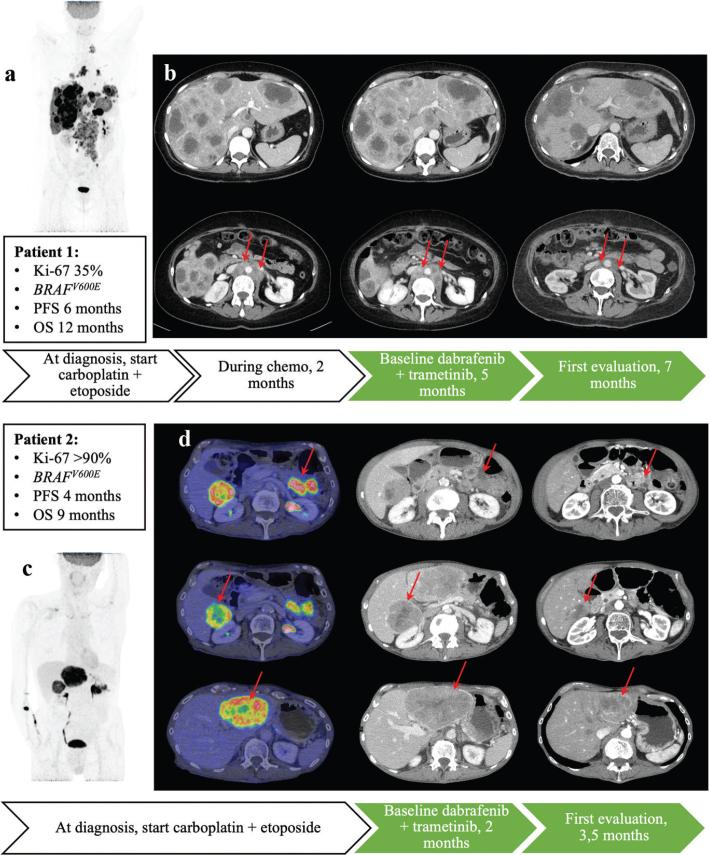
We screened 48 patients diagnosed with NEC between January 1, 2018 and December 31, 2023. Twelve had been analyzed with a broad NGS-panel, and two had a targetable mutation. Both these patients harbored a V600E-mutated colon-NEC and were treated with BRAF- and MEK-inhibitors dabrafenib and trametinib in second-line. At first radiological evaluation (RECIST 1.1), both patients had a reduction of tumor size, which decreased by 31 and 40%. Both had short response periods, and their overall survival was 12 and 9 months.
CONCLUSIONS
-mutated NEC is sensitive to treatment with BRAF- and MEK-inhibitor combination. These results further support that DNA sequencing should be considered as standard of care in NECs to screen for potential treatment targets.
背景
转移性神经内分泌癌(NEC)的生存期较短。除铂类化疗外,尚无明确的标准治疗方案。目前的指南建议,对于 V600E 突变型 NEC 患者,应考虑联合使用 BRAF 抑制剂治疗。然而,由于文献中仅报道了 8 例此类患者,我们的目的是确认这一建议的有效性。
方法
这是一项在乌普萨拉大学医院进行的单中心回顾性队列研究。纳入的患者 1)经组织病理学证实为 NEC 诊断,2)诊断时间为 2018 年 1 月 1 日至 2023 年 12 月 31 日,3)通过广泛的下一代测序(NGS)面板对肿瘤组织进行了基因筛选,4)显示存在目前有可用靶向治疗的肿瘤突变。
结果
我们筛选了 2018 年 1 月 1 日至 2023 年 12 月 31 日期间诊断为 NEC 的 48 例患者。其中 12 例患者进行了广泛的 NGS 面板分析,2 例患者存在可靶向的突变。这两位患者均携带 V600E 突变的结肠癌 NEC,并在二线接受 BRAF 和 MEK 抑制剂 dabrafenib 和 trametinib 治疗。首次影像学评估(RECIST 1.1)时,两名患者的肿瘤大小均有缩小,分别减少了 31%和 40%。两名患者的反应期均较短,总生存期分别为 12 个月和 9 个月。
结论
V600E 突变型 NEC 对 BRAF 和 MEK 抑制剂联合治疗敏感。这些结果进一步支持在 NEC 中应考虑 DNA 测序作为标准治疗方法,以筛选潜在的治疗靶点。

 Zotero 插件