
虎视眈眈:向北扩张的白纹伊蚊(双翅目:蚊科)在日本的分布建模。
Tiger prowling: Distribution modelling for northward-expanding Aedes albopictus (Diptera: Culicidae) in Japan.
机构信息
Department of Medical Entomology, National Institute of Infectious Diseases, Shinjuku, Tokyo, Japan.
Institute of Tropical Medicine, Nagasaki University, Nagasaki, Nagasaki, Japan.
出版信息
PLoS One. 2024 May 9;19(5):e0303137. doi: 10.1371/journal.pone.0303137. eCollection 2024.
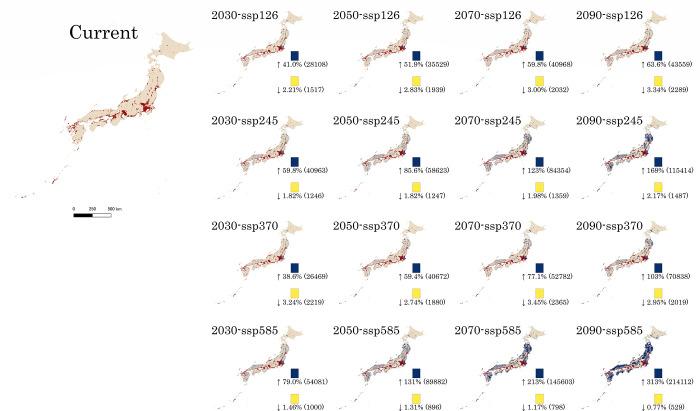
The Asian tiger mosquito, Aedes albopictus, is a significant public health concern owing to its expanding habitat and vector competence. Disease outbreaks attributed to this species have been reported in areas under its invasion, and its northward expansion in Japan has caused concern because of the potential for dengue virus infection in newly populated areas. Accurate prediction of Ae. albopictus distribution is crucial to prevent the spread of the disease. However, limited studies have focused on the prediction of Ae. albopictus distribution in Japan. Herein, we used the random forest model, a machine learning approach, to predict the current and potential future habitat ranges of Ae. albopictus in Japan. The model revealed that these mosquitoes prefer urban areas over forests in Japan on the current map. Under predictions for the future, the species will expand its range to the surrounding areas and eventually reach many areas of northeastern Kanto, Tohoku District, and Hokkaido, with a few variations in different scenarios. However, the affected human population is predicted to decrease owing to the declining birth rate. Anthropogenic and climatic factors contribute to range expansion, and urban size and population have profound impacts. This prediction map can guide responses to the introduction of this species in new areas, advance the spatial knowledge of diseases vectored by it, and mitigate the possible disease burden. To our knowledge, this is the first distribution-modelling prediction for Ae. albopictus with a focus on Japan.
亚洲虎蚊(Aedes albopictus)因其不断扩大的栖息地和媒介能力而成为一个重大的公共卫生关注点。在其入侵地区已经报告了归因于该物种的疾病暴发,其在日本的北扩引起了关注,因为在新居住地区可能会感染登革热病毒。准确预测白纹伊蚊的分布对于防止疾病传播至关重要。然而,关于预测日本白纹伊蚊分布的研究有限。在此,我们使用随机森林模型(一种机器学习方法)来预测日本白纹伊蚊当前和未来潜在的栖息地范围。该模型表明,这些蚊子在当前地图上更喜欢日本的城市地区而不是森林。在未来的预测中,该物种的范围将扩大到周边地区,并最终到达关东地区、东北地区和北海道的许多地区,不同情景下存在一些变化。然而,由于出生率下降,预计受影响的人口将会减少。人为和气候因素促成了范围的扩大,城市规模和人口对其有着深远的影响。该预测图可以指导对该物种在新地区的引入做出反应,推进其传播疾病的空间知识,并减轻可能的疾病负担。据我们所知,这是首次针对日本的白纹伊蚊分布进行建模预测。




 Zotero 插件