
对单个蜱虫的宏转录组学研究揭示了多样的微生物、病毒和新型 mRNA 样内源性病毒元件。
Metatranscriptomic investigation of single ticks reveals diverse microbes, viruses, and novel mRNA-like endogenous viral elements.
机构信息
Department of Biochemistry & Biophysics, University of California-San Francisco, San Francisco, California, USA.
Gladstone Institute of Data Science & Biotechnology, San Francisco, California, USA.
出版信息
mSystems. 2024 Jun 18;9(6):e0032124. doi: 10.1128/msystems.00321-24. Epub 2024 May 14.
UNLABELLED
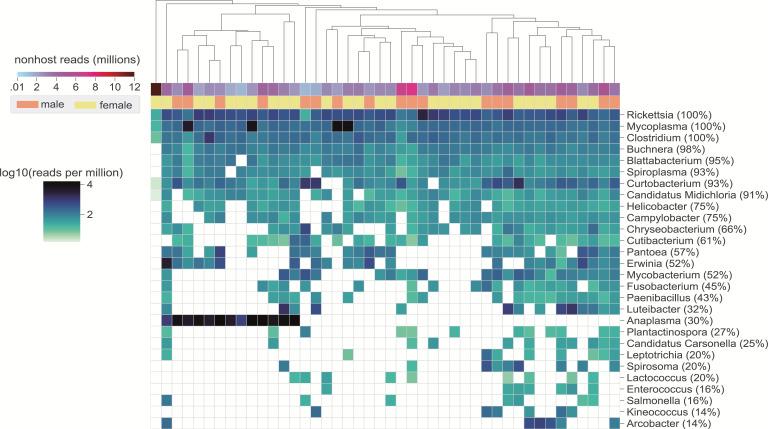
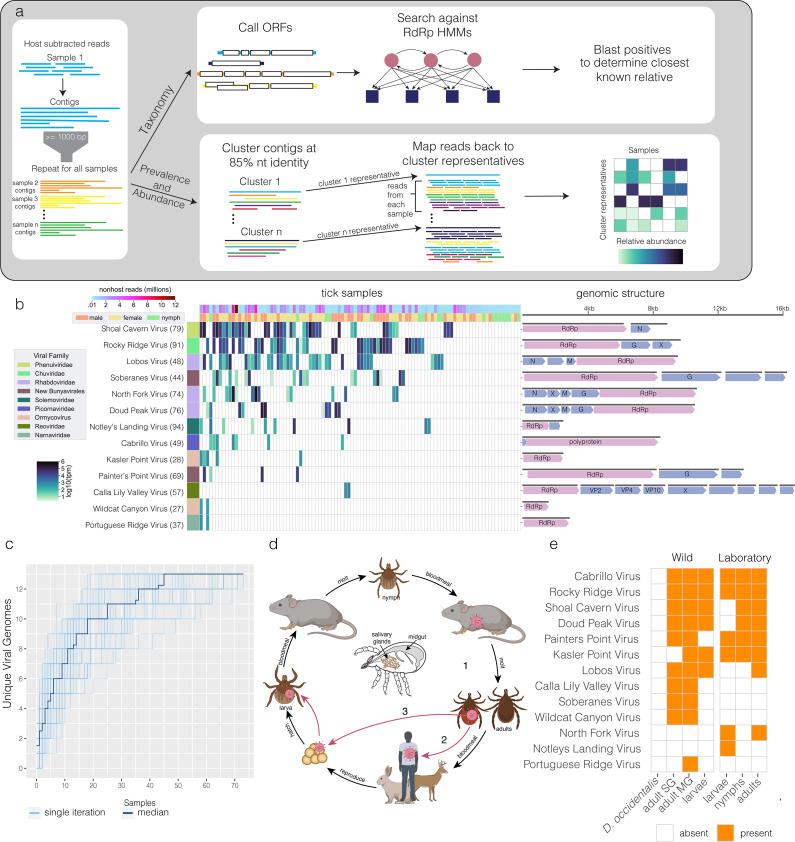
Ticks are increasingly important vectors of human and agricultural diseases. While many studies have focused on tick-borne bacteria, far less is known about tick-associated viruses and their roles in public health or tick physiology. To address this, we investigated patterns of bacterial and viral communities across two field populations of western black-legged ticks (). Through metatranscriptomic analysis of 100 individual ticks, we quantified taxon prevalence, abundance, and co-occurrence with other members of the tick microbiome. In addition to commonly found tick-associated microbes, we assembled 11 novel RNA virus genomes from , , , , , , and two highly divergent RNA virus genomes lacking sequence similarity to any known viral families. We experimentally verified the presence of these in ticks across several life stages. We also unexpectedly identified numerous virus-like transcripts that are likely encoded by tick genomic DNA, and which are distinct from known endogenous viral element-mediated immunity pathways in invertebrates. Taken together, our work reveals that ticks carry a greater diversity of viruses than previously appreciated, in some cases resulting in evolutionarily acquired virus-like transcripts. Our findings highlight how pervasive and intimate tick-virus interactions are, with major implications for both the fundamental biology and vectorial capacity of ticks.
IMPORTANCE
Ticks are increasingly important vectors of disease, particularly in the United States where expanding tick ranges and intrusion into previously wild areas has resulted in increasing human exposure to ticks. Emerging human pathogens have been identified in ticks at an increasing rate, and yet little is known about the full community of microbes circulating in various tick species, a crucial first step to understanding how they interact with each and their tick host, as well as their ability to cause disease in humans. We investigated the bacterial and viral communities of the Western blacklegged tick in California and found 11 previously uncharacterized viruses circulating in this population.
未加标签
蜱虫日益成为人类和农业疾病的重要传播媒介。尽管许多研究都集中在蜱传细菌上,但对于与蜱相关的病毒及其在公共卫生或蜱生理方面的作用知之甚少。为了解决这个问题,我们研究了两个西部黑腿蜱()野外种群的细菌和病毒群落模式。通过对 100 只个体蜱的宏转录组分析,我们量化了分类群的流行率、丰度和与蜱微生物组其他成员的共现。除了常见的蜱相关微生物外,我们还从、、、、、、和两个高度分化的缺乏与任何已知病毒家族序列相似性的 RNA 病毒基因组中组装了 11 个新的 RNA 病毒基因组。我们在几个生命阶段的 蜱中验证了这些病毒的存在。我们还意外地鉴定了许多可能由蜱基因组 DNA 编码的病毒样转录本,这些转录本与无脊椎动物中已知的内源性病毒元件介导的免疫途径不同。总的来说,我们的工作表明,与以前的认识相比, 蜱携带的病毒多样性更大,在某些情况下会导致进化获得的病毒样转录本。我们的发现强调了蜱-病毒相互作用的普遍性和密切程度,这对 蜱的基础生物学和媒介能力都有重大影响。
重要性
蜱虫作为疾病的传播媒介日益重要,尤其是在美国,蜱虫的活动范围扩大,侵入以前的野外地区,导致人类接触蜱虫的机会增加。在蜱虫中不断发现新的人类病原体,而对于各种蜱种中循环的微生物群落的全貌,人们知之甚少,这是了解它们如何相互作用以及与它们的蜱宿主相互作用的关键第一步,以及它们引起人类疾病的能力。我们研究了加利福尼亚州西部黑腿蜱的细菌和病毒群落,发现了 11 种以前未被描述的病毒在该种群中循环。


 Zotero 插件