
黄素依赖单加氧酶形成亚硝酮的机制。
Mechanism of Nitrone Formation by a Flavin-Dependent Monooxygenase.
机构信息
Department of Biochemistry, Virginia Tech, Blacksburg, Virginia 24061, United States.
Center of Drug Discovery, Virginia Tech, Blacksburg, Virginia 24061, United States.
出版信息
Biochemistry. 2024 Jun 4;63(11):1445-1459. doi: 10.1021/acs.biochem.3c00656. Epub 2024 May 23.
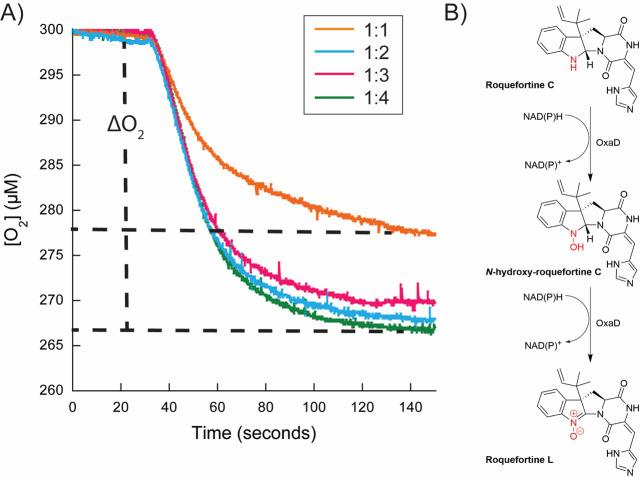
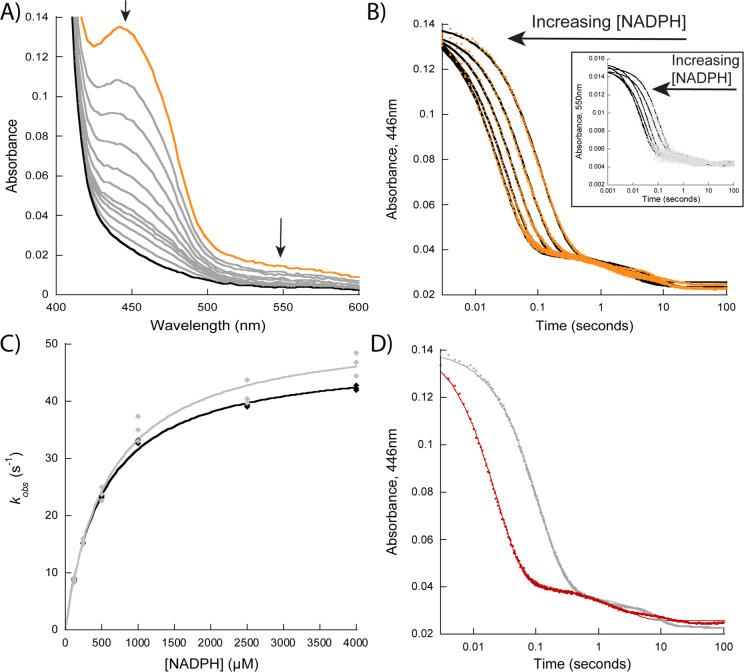
OxaD is a flavin-dependent monooxygenase (FMO) responsible for catalyzing the oxidation of an indole nitrogen atom, resulting in the formation of a nitrone. Nitrones serve as versatile intermediates in complex syntheses, including challenging reactions like cycloadditions. Traditional organic synthesis methods often yield limited results and involve environmentally harmful chemicals. Therefore, the enzymatic synthesis of nitrone-containing compounds holds promise for more sustainable industrial processes. In this study, we explored the catalytic mechanism of OxaD using a combination of steady-state and rapid-reaction kinetics, site-directed mutagenesis, spectroscopy, and structural modeling. Our investigations showed that OxaD catalyzes two oxidations of the indole nitrogen of roquefortine C, ultimately yielding roquefortine L. The reductive-half reaction analysis indicated that OxaD rapidly undergoes reduction and follows a "cautious" flavin reduction mechanism by requiring substrate binding before reduction can take place. This characteristic places OxaD in class A of the FMO family, a classification supported by a structural model featuring a single Rossmann nucleotide binding domain and a glutathione reductase fold. Furthermore, our spectroscopic analysis unveiled both enzyme-substrate and enzyme-intermediate complexes. Our analysis of the oxidative-half reaction suggests that the flavin dehydration step is the slow step in the catalytic cycle. Finally, through mutagenesis of the conserved D63 residue, we demonstrated its role in flavin motion and product oxygenation. Based on our findings, we propose a catalytic mechanism for OxaD and provide insights into the active site architecture within class A FMOs.
OxaD 是一种黄素依赖的单加氧酶(FMO),负责催化吲哚氮原子的氧化,生成硝酮。硝酮作为复杂合成中的多功能中间体,包括挑战性的环加成反应。传统的有机合成方法往往结果有限,并且涉及到有害环境的化学物质。因此,含硝酮化合物的酶促合成有望为更可持续的工业过程提供可能。在这项研究中,我们使用稳态和快速反应动力学、定点突变、光谱学和结构建模相结合的方法,探索了 OxaD 的催化机制。我们的研究表明,OxaD 催化 roquefortine C 吲哚氮的两次氧化,最终生成 roquefortine L。还原半反应分析表明,OxaD 迅速还原,并遵循“谨慎”的黄素还原机制,需要底物结合才能发生还原。这一特征将 OxaD 置于 FMO 家族的 A 类中,这一分类得到了一个具有单个 Rossmann 核苷酸结合域和谷胱甘肽还原酶折叠的结构模型的支持。此外,我们的光谱分析揭示了酶-底物和酶-中间复合物。我们对氧化半反应的分析表明,黄素脱水步骤是催化循环中的缓慢步骤。最后,通过对保守的 D63 残基的突变,我们证明了它在黄素运动和产物氧化中的作用。基于我们的发现,我们提出了 OxaD 的催化机制,并深入了解了 A 类 FMO 中的活性位点结构。




 Zotero 插件