
无机改性方式对橡胶再生混凝土力学性能的影响
Effect of the Inorganic Modification Mode on the Mechanical Properties of Rubber Recycled Concrete.
作者信息
Liu Leifei, Zong Jingmei, Hou Xueqian, Liu Xiaoyan
机构信息
School of Civil Engineering, Shangqiu Institute of Technology, Shangqiu 476000, China.
State Key Laboratory for Geomechanics and Deep Underground Engineering, China University of Mining and Technology, Xuzhou 210096, China.
出版信息
Materials (Basel). 2024 May 8;17(10):2217. doi: 10.3390/ma17102217.
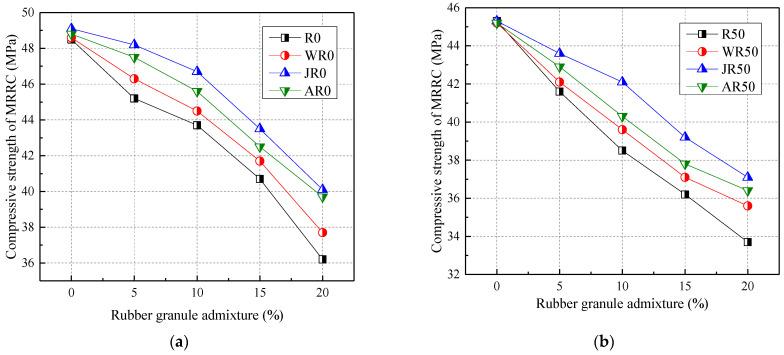
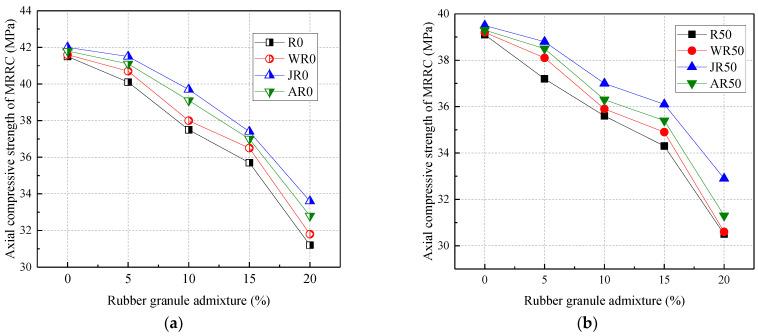
The reasonable and effective application of waste tires and discarded concrete in concrete is an important branch of green concrete development. This paper investigates the effects of the inorganic modification mode on the basic mechanical properties of rubber recycled concrete based on indoor tests. Inorganic modification, such as water washing, acid washing, and alkaline washing modification, was mainly used to treat and modify rubber particles. The factors affecting the compressive strength, the splitting tensile strength, the flexural strength, the axial compressive strength, and the modulus of elasticity of modified rubber recycled concrete were analyzed. The study results show that the incorporation of recycled aggregates and rubber reduced the mechanical properties of concrete, with the compressive and splitting tensile strengths showing the greatest reductions of 27.36% and 27.24%, respectively. Three modification methods significantly improved the mechanical properties of rubber recycled concrete. The alkali washing modification method was the most effective, maximally improving the mechanical properties of rubber recycled concrete by 7.53-15.51%. The effects of the three modifications on the mechanical properties of concrete were ranked as follows: alkali washing > acid washing > water washing. This study provides a data basis for the practical application of rubber recycled concrete in engineering and a test basis for the development of green concrete.
废旧轮胎和废弃混凝土在混凝土中的合理有效利用是绿色混凝土发展的一个重要分支。本文基于室内试验研究了无机改性方式对橡胶再生混凝土基本力学性能的影响。主要采用水洗、酸洗和碱洗改性等无机改性方法对橡胶颗粒进行处理和改性。分析了影响改性橡胶再生混凝土抗压强度、劈裂抗拉强度、抗折强度、轴心抗压强度和弹性模量的因素。研究结果表明,再生骨料和橡胶的掺入降低了混凝土的力学性能,其中抗压强度和劈裂抗拉强度降低最为显著,分别降低了27.36%和27.24%。三种改性方法显著提高了橡胶再生混凝土的力学性能。碱洗改性方法效果最为显著,最大程度地提高了橡胶再生混凝土的力学性能,提高幅度为7.53%-15.51%。三种改性方法对混凝土力学性能的影响排序为:碱洗>酸洗>水洗。本研究为橡胶再生混凝土在工程中的实际应用提供了数据依据,也为绿色混凝土的发展提供了试验依据。






 Zotero 插件