
中国北方落叶乔木(榆科)的系统地理学
The Phylogeography of Deciduous Tree (Ulmaceae) in Northern China.
作者信息
Ye Hang, Wang Yiling, Liu Hengzhao, Lei Dingfan, Li Haochen, Gao Zhimei, Feng Xiaolong, Han Mian, Qie Qiyang, Zhou Huijuan
机构信息
Key Laboratory of Resource Biology and Biotechnology in Western China, Ministry of Education, College of Life Sciences, Northwest University, Xi'an 710069, China.
School of Life Sciences, Shanxi Normal University, Taiyuan 030031, China.
出版信息
Plants (Basel). 2024 May 12;13(10):1334. doi: 10.3390/plants13101334.
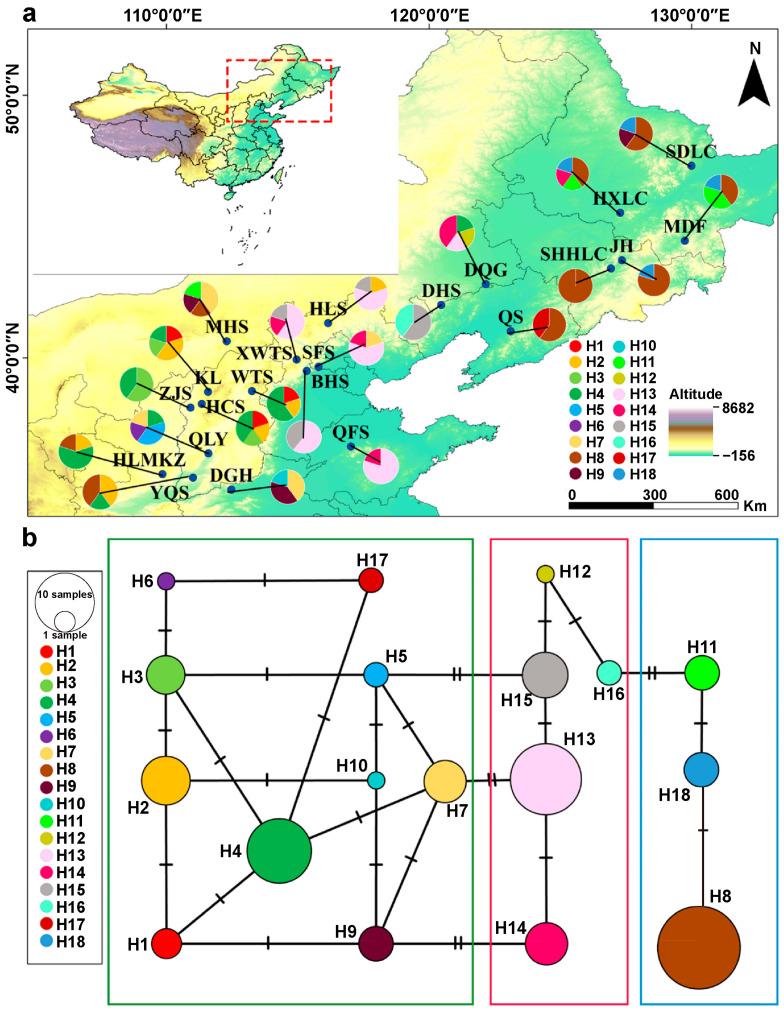
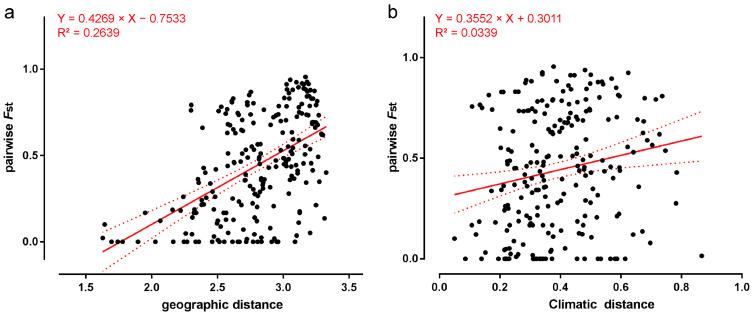
Disentangling how climate oscillations and geographical events significantly influence plants' genetic architecture and demographic history is a central topic in phytogeography. The deciduous ancient tree species is primarily distributed throughout Northern China and has timber and horticultural value. In the current study, we studied the phylogenic architecture and demographical history of using chloroplast DNA with ecological niche modeling. The results indicated that the populations' genetic differentiation coefficient () value was significantly greater than the haplotype frequency () ( < 0.05), suggesting that had a clear phylogeographical structure. Phylogenetic inference showed that the putative chloroplast haplotypes could be divided into three groups, in which the group Ⅰ was considered to be ancestral. Despite significant genetic differentiation among these groups, gene flow was detected. The common ancestor of all haplotypes was inferred to originate in the middle-late Miocene, followed by the haplotype overwhelming diversification that occurred in the Quaternary. Combined with demography pattern and ecological niche modeling, we speculated that the surrounding areas of Shanxi and Inner Mongolia were potential refugia for during the glacial period in Northern China. Our results illuminated the demography pattern of and provided clues and references for further population genetics investigations of precious tree species distributed in Northern China.
厘清气候振荡和地理事件如何显著影响植物的遗传结构和种群历史是植物地理学的核心课题。这种落叶古树主要分布于中国北方,具有木材和园艺价值。在本研究中,我们利用叶绿体DNA和生态位建模研究了该树种的系统发育结构和种群历史。结果表明,种群的遗传分化系数()值显著大于单倍型频率()(<0.05),表明该树种具有明显的系统地理结构。系统发育推断显示,假定的叶绿体单倍型可分为三组,其中第一组被认为是祖先型。尽管这些组之间存在显著的遗传分化,但仍检测到了基因流。推断所有单倍型的共同祖先起源于中新世中晚期,随后在第四纪发生了单倍型的大量分化。结合种群动态模式和生态位建模,我们推测山西和内蒙古周边地区是中国北方冰川期该树种的潜在避难所。我们的结果阐明了该树种的种群动态模式,并为中国北方分布的珍贵树种的进一步种群遗传学研究提供了线索和参考。



 Zotero 插件