
利用加利福尼亚红虫蛋白质的抗氧化酶解产物膜对分馏进行优化。
Optimization of fractionation with membranes of antioxidant enzymatic hydrolysate of Californian red worm () protein.
作者信息
Gaviria Yhoan S, Zapata Jose E
机构信息
Nutrition and Food Technology Research Group, Universidad de Antioquia, Calle 70 No. 52-21, Medellin, Colombia.
出版信息
Heliyon. 2024 May 13;10(10):e31169. doi: 10.1016/j.heliyon.2024.e31169. eCollection 2024 May 30.
PROBLEM
Earthworm is a valuable source of biologically and pharmacologically active compounds, with applications in the treatment of various types of diseases; however, the main application they have been given is in the production of organic fertilizer. One of the alternatives for obtaining bioactive compounds is by means of enzymatic hydrolysis.
AIM
This study proposes the optimization of the fractionation of the antioxidant enzymatic hydrolysate from Californian red worm () protein.
METHODOLOGY
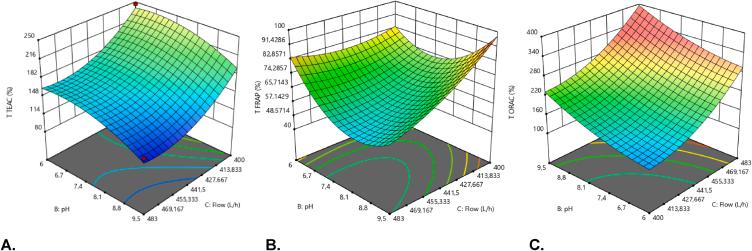
For this purpose, the worms were separated and hydrolyzed using the enzyme Alcalase 2.4L for 4000s. The obtained hydrolysate was fractionated by means of a crossflow tangential ultrafiltration system, with a 3 kDa molecular weight cut-off ceramic membrane. A response surface design of the composite central factorial type was implemented to evaluate the effect of pH, transmembrane pressure, and flow factors on the response variables transmission, volume reduction factor (VRF) and permeate flow resistance. The transmissions focused on the antioxidant peptides, measured by three conventional methods such as TEAC, FRAP, ORAC, also known as TTEAC, TFRAP and TORAC, respectively. The evaluated resistances were the total resistance (Rtotal), fouling resistance (Rfouling), and gel resistance (Rgel).
RESULT
The results showed that the three factors evaluated affect all the response variables either in their linear or quadratic terms or by some interaction. For each response variable, a mathematical model was obtained, with statistical significance and a non-significant lack of adjustment. The models obtained were used for a multi-objective optimization process in which transfers were maximized, and resistances were minimized. The efficiency of the optimum ultrafiltration process was 25 %.
CONCLUSION
The neutral-alkaline pH is ideal for the ultrafiltration process of bioactive peptides, as it is where the highest transmissions of peptides with antioxidative capacity are found. Under optimal conditions, the 3 kDa membrane permeate was found to exhibit higher antioxidant capacity than the retentate and feed. Based on this, the fraction of less than 3 kDa emerges as a potential multifunctional ingredient, thanks to its antioxidant properties.
问题
蚯蚓是生物活性和药理活性化合物的宝贵来源,可用于治疗各种类型的疾病;然而,它们的主要用途是生产有机肥料。获得生物活性化合物的一种替代方法是通过酶促水解。
目的
本研究提出优化从加州红蚯蚓()蛋白质中分离抗氧化酶水解产物的方法。
方法
为此,将蚯蚓分离并用碱性蛋白酶2.4L水解4000秒。所得水解产物通过错流切向超滤系统进行分离,使用截留分子量为3 kDa的陶瓷膜。采用复合中心复合设计的响应面设计来评估pH、跨膜压力和流速因素对响应变量透过率、体积减少因子(VRF)和渗透流阻的影响。透过率主要针对抗氧化肽,通过三种传统方法进行测量,分别为TEAC、FRAP、ORAC,也分别称为TTEAC、TFRAP和TORAC。评估的阻力包括总阻力(Rtotal)、污染阻力(Rfouling)和凝胶阻力(Rgel)。
结果
结果表明,所评估的三个因素对所有响应变量的影响,无论是线性项、二次项还是通过某些相互作用。对于每个响应变量,都获得了一个具有统计学意义且拟合不足不显著的数学模型。所获得的模型用于多目标优化过程,其中透过率最大化,阻力最小化。最佳超滤过程的效率为25%。
结论
中性至碱性pH值对于生物活性肽的超滤过程是理想的,因为在此pH值下具有抗氧化能力的肽的透过率最高。在最佳条件下,发现3 kDa膜的渗透物比截留物和进料具有更高的抗氧化能力。基于此,小于3 kDa的部分由于其抗氧化特性而成为一种潜在的多功能成分。


 Zotero 插件