
研究区域低碳发展:以中国四川省为例。
Studying regional low-carbon development: A case study of Sichuan Province in China.
机构信息
School of Business and Tourism, Sichuan Agricultural University, Chengdu, China.
Research Institute of Economics and Management, Southwest University of Finance and Economics, Chengdu, Sichuan, China.
出版信息
PLoS One. 2024 May 29;19(5):e0302733. doi: 10.1371/journal.pone.0302733. eCollection 2024.
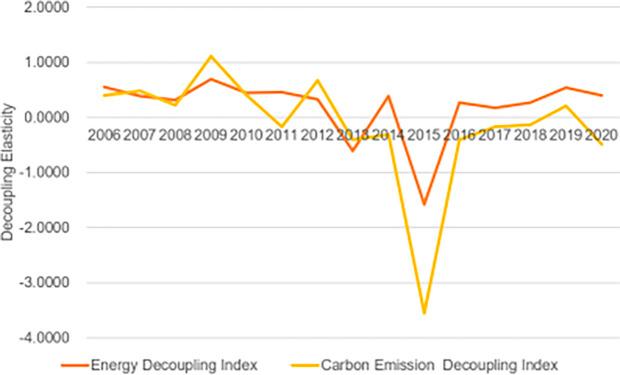
The unavoidable option for socially sustainable development is a low-carbon economy. One of the essential steps for China to attain high-quality development is reducing carbon emissions. It is necessary to realize low-carbon development in Sichuan, as it is not only an important economic zone but also an ecological protected area. The concurrent relationship among energy consumption, carbon emissions, and economic growth was examined in this study using the Tapio decoupling indicator, and the factors affecting energy consumption and carbon emissions in Sichuan were broken down using the logarithmic mean Divisia indicator (LMDI). The findings demonstrate a fundamental relative decoupling relationship between Sichuan's energy use and carbon emissions. Analysis of energy consumption and carbon emissions in Sichuan Province from 2005 to 2020 shows distinct patterns. From 2005 to 2012, in 2014, and from 2016 to 2020, the relationship between energy use and carbon emissions was relatively decoupled, with decoupling values ranging between 0 and 1. Absolute decoupling occurred in specific years: 2010, from 2013 to 2018, and in 2020. These periods are characterized by economic growth alongside reductions in carbon emissions. Factors affecting energy consumption and carbon emissions were consistently analyzed, showing similar impacts throughout the study periods. We find that population and economic growth are the main driving forces of these effects. The effects of energy intensity and industrial structure mainly play restraining roles, and the latter has a slightly weaker effect than the former.
实现社会可持续发展不可避免的选择是低碳经济。中国实现高质量发展的重要步骤之一是减少碳排放。四川实现低碳发展是必要的,因为它不仅是一个重要的经济区,也是一个生态保护区。本研究利用Tapio 脱钩指标考察了能源消耗、碳排放和经济增长之间的并发关系,并利用对数平均 Divisia 指标(LMDI)分解了四川能源消耗和碳排放的影响因素。研究结果表明,四川能源利用与碳排放之间存在基本的相对脱钩关系。对四川 2005 年至 2020 年的能源消耗和碳排放进行分析,呈现出明显的模式。2005 年至 2012 年、2014 年以及 2016 年至 2020 年,能源利用与碳排放的关系相对脱钩,脱钩值在 0 到 1 之间。在特定年份实现了绝对脱钩:2010 年、2013 年至 2018 年和 2020 年。这些时期的特点是经济增长伴随着碳排放的减少。对影响能源消耗和碳排放的因素进行了持续分析,发现各研究期间的影响相似。我们发现人口和经济增长是这些影响的主要驱动因素。能源强度和产业结构的影响主要起到抑制作用,后者的作用略弱于前者。




 Zotero 插件