
绵羊肺腺瘤病/绵羊地方性肺炎病毒感染肺组织中的差异基因表达和免疫细胞浸润。
Differential gene expression and immune cell infiltration in maedi-visna virus-infected lung tissues.
机构信息
College of Veterinary Medicine, Inner Mongolia Agricultural University, Zhao Wu Da Road No. 306, Hohhot, 010018, China.
Inner Mongolia Key Laboratory of Basic Veterinary Science, Hohhot, 010018, China.
出版信息
BMC Genomics. 2024 May 30;25(1):534. doi: 10.1186/s12864-024-10448-2.
BACKGROUND
Maedi-visna virus (MVV) is a lentivirus that infects monocyte/macrophage lineage cells in sheep, goats, and wild ruminants and causes pneumonia, mastitis, arthritis, and encephalitis. The immune response to MVV infection is complex, and a complete understanding of its infection and pathogenesis is lacking. This study investigated the in vivo transcriptomic patterns of lung tissues in sheep exposed to MVV using the RNA sequencing technology.
RESULT
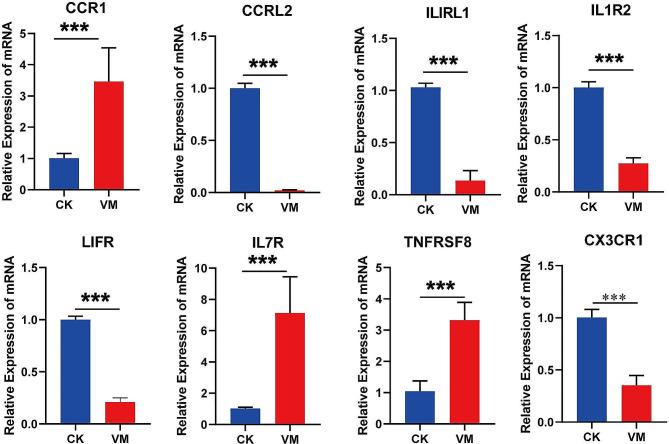
The results indicated that 2,739 genes were significantly differentially expressed, with 1,643 downregulated genes and 1,096 upregulated genes. Many variables that could be unique to MVV infections were discovered. Gene Ontology analysis revealed that a significant proportion of genes was enriched in terms directly related to the immune system and biological responses to viral infections. Kyoto Encyclopedia of Genes and Genomes analysis revealed that the most enriched pathways were related to virus-host cell interactions and inflammatory responses. Numerous immune-related genes, including those encoding several cytokines and interferon regulatory factors, were identified in the protein-protein interaction network of differentially expressed genes (DEGs). The expression of DEGs was evaluated using real-time polymerase chain reaction and western blot analysis. CXCL13, CXCL6, CXCL11, CCR1, CXCL8, CXCL9, CXCL10, TNFSF8, TNFRSF8, IL7R, IFN-γ, CCL2, and MMP9 were upregulated. Immunohistochemical analysis was performed to identify the types of immune cells that infiltrated MVV-infected tissues. B cells, CD4 and CD8 T cells, and macrophages were the most prevalent immune cells correlated with MVV infection in the lungs.
CONCLUSION
Overall, the findings of this study provide a comprehensive understanding of the in vivo host response to MVV infection and offer new perspectives on the gene regulatory networks that underlie pathogenesis in natural hosts.
背景
绵羊肺腺瘤病毒(Maedi-visna virus,MVV)是一种慢病毒,可感染绵羊、山羊和野生反刍动物的单核细胞/巨噬细胞谱系细胞,引起肺炎、乳腺炎、关节炎和脑炎。对 MVV 感染的免疫反应很复杂,对其感染和发病机制的了解还不完全。本研究采用 RNA 测序技术研究了绵羊体内 MVV 感染的肺组织转录组模式。
结果
结果表明,有 2739 个基因显著差异表达,其中 1643 个下调基因和 1096 个上调基因。发现了许多可能是 MVV 感染特有的变量。基因本体论分析表明,很大一部分基因富集在与免疫系统和病毒感染的生物反应直接相关的术语中。京都基因与基因组百科全书分析表明,最富集的途径与病毒-宿主细胞相互作用和炎症反应有关。在差异表达基因(DEG)的蛋白质-蛋白质相互作用网络中鉴定出许多免疫相关基因,包括编码几种细胞因子和干扰素调节因子的基因。使用实时聚合酶链反应和 Western blot 分析评估 DEG 的表达。CXCL13、CXCL6、CXCL11、CCR1、CXCL8、CXCL9、CXCL10、TNFSF8、TNFRSF8、IL7R、IFN-γ、CCL2 和 MMP9 上调。进行免疫组织化学分析以鉴定浸润 MVV 感染组织的免疫细胞类型。在肺部,与 MVV 感染最相关的免疫细胞是 B 细胞、CD4 和 CD8 T 细胞和巨噬细胞。
结论
总的来说,本研究的结果提供了对 MVV 感染体内宿主反应的全面理解,并为天然宿主发病机制的基因调控网络提供了新的视角。




 Zotero 插件