
评估矿物质生物标志物作为随机对照试验中多种营养素对注意力缺陷/多动障碍儿童行为改善的中介和调节因素。
Evaluating mineral biomarkers as mediators and moderators of behavioural improvements in a randomised controlled trial of multinutrients for children with attention-deficit/hyperactivity disorder.
机构信息
Department of Human Sciences, The Ohio State University, Columbus, OH, USA.
Center for Mental Health Innovation, Department of Psychiatry, Oregon Health & Science University, Portland, OR, USA.
出版信息
Br J Nutr. 2024 Aug 14;132(3):315-329. doi: 10.1017/S0007114524001132. Epub 2024 May 31.
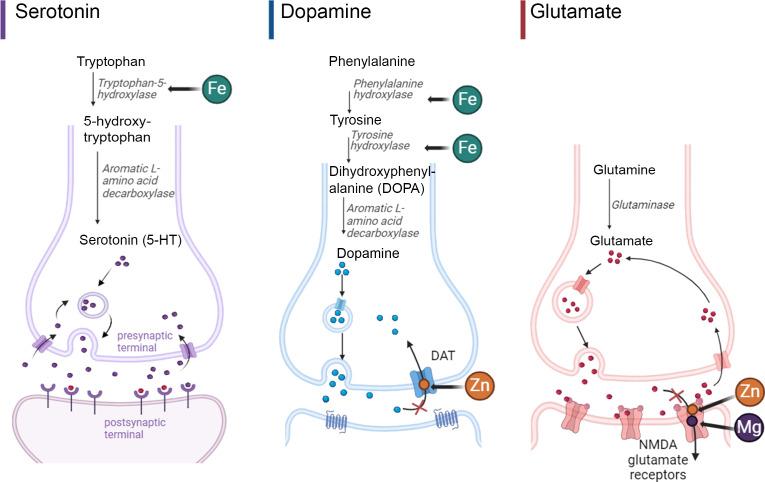
Essential minerals are cofactors for synthesis of neurotransmitters supporting cognition and mood. An 8-week fully-blind randomised controlled trial of multinutrients for attention-deficit/hyperactivity disorder (ADHD) demonstrated three times as many children (age 6-12) had significantly improved behaviour ('treatment responders') on multinutrients (54 %) compared with placebo (18 %). The aim of this secondary study was to evaluate changes in fasted plasma and urinary mineral concentrations following the intervention and their role as mediators and moderators of treatment response. Fourteen essential or trace minerals were measured in plasma and/or urine at baseline and week eight from eighty-six participants (forty-nine multinutrients, thirty-seven placebos). Two-sample tests/Mann-Whitney tests compared 8-week change between treatment and placebo groups, which were also evaluated as potential mediators. Baseline levels were evaluated as potential moderators, using logistic regression models with clinical treatment response as the outcome. After 8 weeks, plasma boron, Cr (in females only), Li, Mo, Se and vanadium and urinary iodine, Li and Se increased more with multinutrients than placebo, while plasma phosphorus decreased. These changes did not mediate treatment response. However, baseline urinary Li trended towards moderation: participants with lower baseline urinary Li were more likely to respond to multinutrients ( = 0·058). Additionally, participants with higher baseline Fe were more likely to be treatment responders regardless of the treatment group ( = 0·036.) These results show that multinutrient treatment response among children with ADHD is independent of their baseline plasma mineral levels, while baseline urinary Li levels show potential as a non-invasive biomarker of treatment response requiring further study.
必需矿物质是支持认知和情绪的神经递质合成的辅助因子。一项为期 8 周的、针对注意力缺陷多动障碍(ADHD)的多种营养素的完全双盲随机对照试验表明,与安慰剂组(18%)相比,接受多种营养素治疗的儿童(6-12 岁)中有多达三倍的行为显著改善(“治疗应答者”)(54%)。本二次研究的目的是评估干预后空腹血浆和尿液矿物质浓度的变化及其作为治疗反应的中介和调节剂的作用。从 86 名参与者(49 名接受多种营养素治疗,37 名接受安慰剂)中测量了基线和第 8 周的血浆和/或尿液中的 14 种必需或痕量矿物质。采用两样本 t 检验/曼-惠特尼 U 检验比较治疗组和安慰剂组 8 周的变化,这些变化也被评估为潜在的中介。使用逻辑回归模型,以临床治疗反应为结局,评估基线水平作为潜在的调节剂。经过 8 周,与安慰剂相比,血浆硼、Cr(仅在女性中)、Li、Mo、Se 和 V 以及尿液碘、Li 和 Se 随着多种营养素的增加而增加,而血浆磷则减少。这些变化并不能介导治疗反应。然而,基线尿 Li 呈 moderation 趋势:基线尿 Li 较低的参与者更有可能对多种营养素产生反应( = 0.058)。此外,无论治疗组如何,基线铁较高的参与者更有可能成为治疗应答者( = 0.036)。这些结果表明,ADHD 儿童的多种营养素治疗反应与其基线血浆矿物质水平无关,而基线尿 Li 水平显示出作为治疗反应的非侵入性生物标志物的潜力,需要进一步研究。



 Zotero 插件