
脉冲电场对连续式拉莫卡薯片丙烯酰胺还原及品质特性的影响
Pulsed electric field effect on acrylamide reduction and quality attributes of continuous-style Lamoka potato chips.
作者信息
Santiago-Mora Priscila, Skinner Mark, Hendricks Alyssa, Rimkus Tauras, Meyer Brian, Gratzek Jim, Pu Shin, Woodbury Luke, Bond Laura, McDougal Owen
机构信息
Department of Chemistry and Biochemistry, Food and Dairy Innovation Center, Boise State University, 1910 W University Dr, Boise, ID, 83725, USA.
Food Physics, 8512 W Elisa St, Boise, ID, 83709, USA.
出版信息
Heliyon. 2024 May 29;10(11):e31790. doi: 10.1016/j.heliyon.2024.e31790. eCollection 2024 Jun 15.
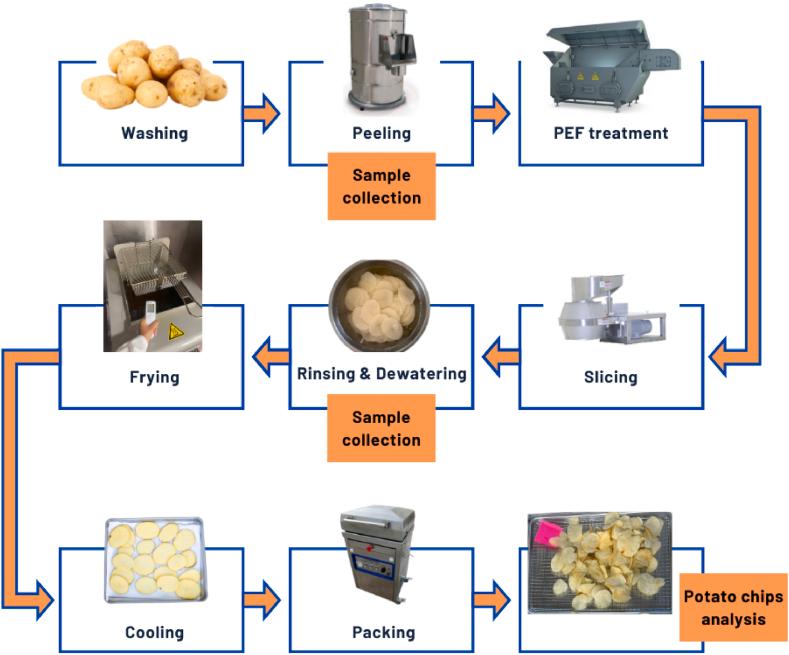
Potato chips are a popular snack, well-liked because of their texture-flavor combination. Potato chips are made by frying slices of potato in vegetable oil to achieve a crispy texture. Frying potato slices initiates the Maillard reaction, resulting in chemical changes that enhance taste, color, and texture, but also undesired acrylamides, which are suspected carcinogens. The application of pulsed electric field (PEF) technology is commonly used in French fry processing operations to prolong cutting blade sharpness and reduce waste, energy consumption, and water usage. Despite these attributes, PEF systems have not yet gained widespread adoption by potato chip producers. In the current study, Lamoka potatoes were PEF-treated prior to continuous frying into potato chips. The effect of specific energy at 0.75 kJ/kg (Low-PEF) and 1.5 kJ/kg (High-PEF) and electric field strength of 1 kV/cm, frequency of 24 kV, and pulse width of 6 μs versus untreated (control) samples was studied, then batches of 250 g of slices were fried at 170 °C or 185 °C for two frying times to obtain potato chips with acrylamide levels below the California Proposition 65 limit (275 ng/g). The Lamoka potato chip product quality metrics that were assessed include moisture, fat, reducing sugars, asparagine, acrylamide, chip color, and texture. PEF treatment of Lamoka potatoes resulted in chips fried in 10 % less time, lower oil content by 8 %, and a decrease of reducing sugars by 19.2 %, asparagine by 42.0 %, and acrylamide by 28.9 %. The PEF fried chips were lighter in color but maintained textural attributes compared to continuous frying cooking. The process of frying potato slices at 170 °C for 150 s with High-PEF yielded potato chips with acrylamide content below the California Proposition 65 limit; which speaks to the health implications for consumers and the quality and safety of these chips.
薯片是一种受欢迎的零食,因其口感与风味的结合而备受喜爱。薯片是通过将土豆片在植物油中油炸以达到酥脆的口感而制成的。油炸土豆片会引发美拉德反应,导致化学变化,从而增强口感、色泽和质地,但同时也会产生不想要的丙烯酰胺,而丙烯酰胺是疑似致癌物。脉冲电场(PEF)技术通常用于薯条加工操作中,以延长切割刀片的锋利度,并减少浪费、能源消耗和用水量。尽管有这些优点,但PEF系统尚未被薯片生产商广泛采用。在当前的研究中,拉莫卡土豆在连续油炸制成薯片之前先进行了PEF处理。研究了0.75千焦/千克(低PEF)和1.5千焦/千克(高PEF)的特定能量、1千伏/厘米的电场强度、24千伏的频率和6微秒的脉冲宽度与未处理(对照)样品相比的效果,然后将250克切片分批在170°C或185°C下油炸两次,以获得丙烯酰胺含量低于加利福尼亚州第65号提案限制(275纳克/克)的薯片。评估的拉莫卡薯片产品质量指标包括水分、脂肪、还原糖、天冬酰胺、丙烯酰胺、薯片颜色和质地。对拉莫卡土豆进行PEF处理后,炸制薯片所需的时间减少了10%,含油量降低了8%,还原糖减少了19.2%,天冬酰胺减少了42.0%,丙烯酰胺减少了28.9%。与连续油炸相比,PEF油炸的薯片颜色更浅,但保持了质地特性。在170°C下用高PEF油炸土豆片150秒的过程产生了丙烯酰胺含量低于加利福尼亚州第65号提案限制的薯片;这说明了对消费者的健康影响以及这些薯片的质量和安全性。



 Zotero 插件