
利用细胞膜的三维形状描述符表征细胞生理状态
Characterizing Cellular Physiological States with Three-Dimensional Shape Descriptors for Cell Membranes.
作者信息
Guan Guoye, Chen Yixuan, Wang Hongli, Ouyang Qi, Tang Chao
机构信息
Center for Quantitative Biology, Peking University, Beijing 100871, China.
School of Physics, Peking University, Beijing 100871, China.
出版信息
Membranes (Basel). 2024 Jun 7;14(6):137. doi: 10.3390/membranes14060137.
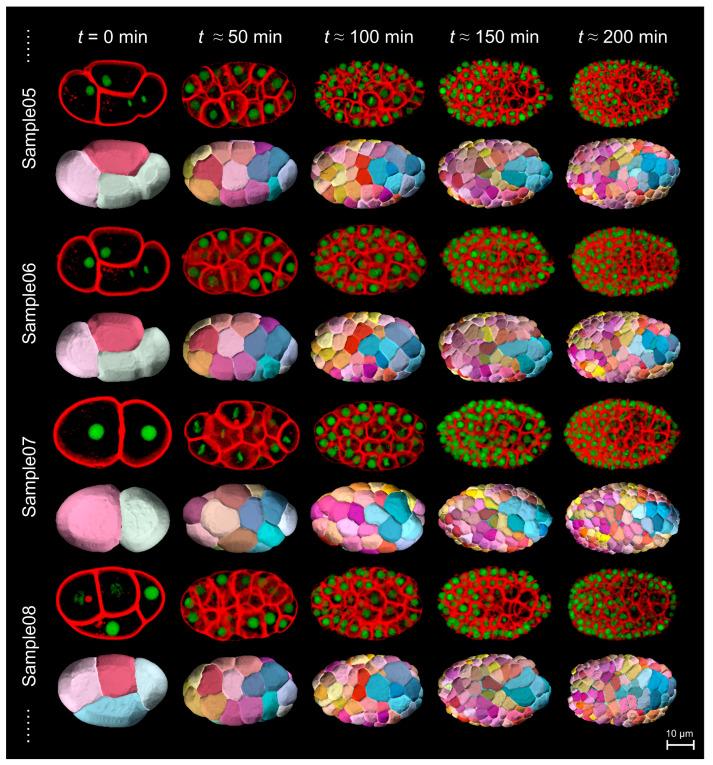
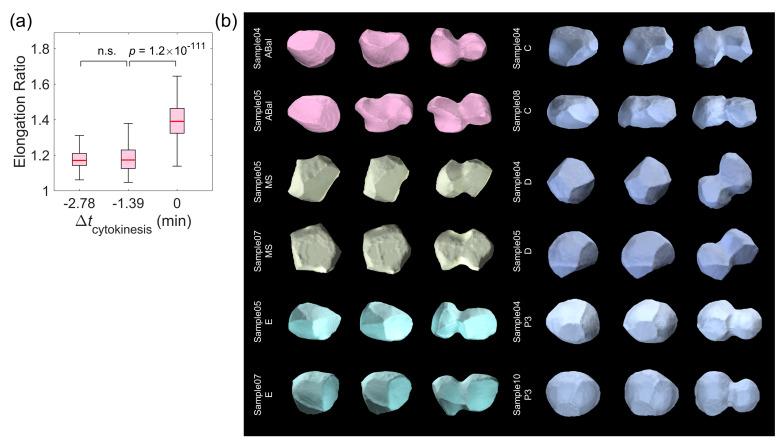
The shape of a cell as defined by its membrane can be closely associated with its physiological state. For example, the irregular shapes of cancerous cells and elongated shapes of neuron cells often reflect specific functions, such as cell motility and cell communication. However, it remains unclear whether and which cell shape descriptors can characterize different cellular physiological states. In this study, 12 geometric shape descriptors for a three-dimensional (3D) object were collected from the previous literature and tested with a public dataset of ~400,000 independent 3D cell regions segmented based on fluorescent labeling of the cell membranes in embryos. It is revealed that those shape descriptors can faithfully characterize cellular physiological states, including (1) cell division (cytokinesis), along with an abrupt increase in the elongation ratio; (2) a negative correlation of cell migration speed with cell sphericity; (3) cell lineage specification with symmetrically patterned cell shape changes; and (4) cell fate specification with differential gene expression and differential cell shapes. The descriptors established may be used to identify and predict the diverse physiological states in numerous cells, which could be used for not only studying developmental morphogenesis but also diagnosing human disease (e.g., the rapid detection of abnormal cells).
细胞由其细胞膜所界定的形状可能与其生理状态密切相关。例如,癌细胞的不规则形状和神经元细胞的细长形状通常反映了特定的功能,如细胞运动性和细胞通讯。然而,尚不清楚哪些细胞形状描述符能够表征不同的细胞生理状态以及是否存在这样的描述符。在本研究中,从先前的文献中收集了用于三维(3D)物体的12个几何形状描述符,并使用一个公共数据集进行测试,该数据集包含约40万个基于胚胎细胞膜荧光标记分割的独立3D细胞区域。结果表明,这些形状描述符能够如实地表征细胞生理状态,包括:(1)细胞分裂(胞质分裂),同时伸长率急剧增加;(2)细胞迁移速度与细胞球形度呈负相关;(3)细胞谱系特化伴随着对称模式化的细胞形状变化;以及(4)细胞命运特化伴随着差异基因表达和不同的细胞形状。所建立的描述符可用于识别和预测众多细胞中的各种生理状态,这不仅可用于研究发育形态发生,还可用于诊断人类疾病(例如,快速检测异常细胞)。




 Zotero 插件