
微观结构对使用基于AgNO/乙二醇油墨制造的喷墨打印电阻式温度探测器的 TCR 的影响。
The Influence of Microstructure on TCR for Inkjet-Printed Resistive Temperature Detectors Fabricated Using AgNO/Ethylene-Glycol-Based Inks.
作者信息
Radwan Aziz, Sui Yongkun, Zorman Christian
机构信息
Department of Electrical, Computer and Systems Engineering, Case Western Reserve University, Cleveland, OH 44106, USA.
Sandia National Laboratories, Albuquerque, NM 87123, USA.
出版信息
Micromachines (Basel). 2024 Jun 2;15(6):749. doi: 10.3390/mi15060749.
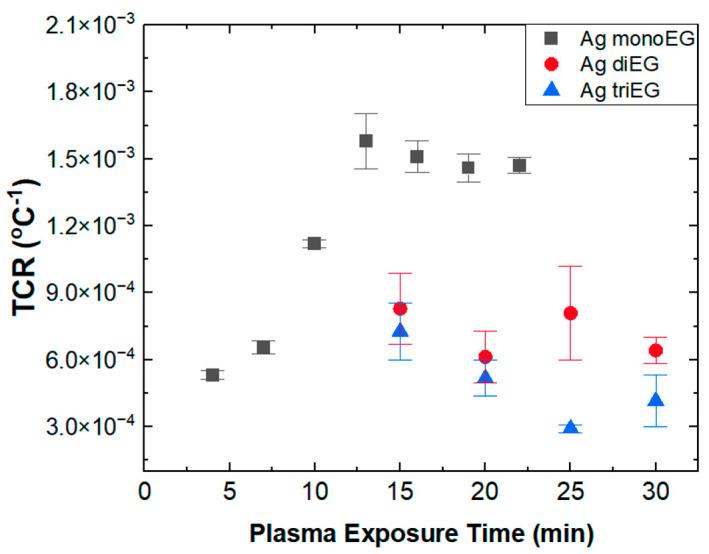
This study investigated the influence of microstructure on the performance of Ag inkjet-printed, resistive temperature detectors (RTDs) fabricated using particle-free inks based on a silver nitrate (AgNO) precursor and ethylene glycol as the ink solvent. Specifically, the temperature coefficient of resistance (TCR) and sensitivity for sensors printed using inks that use monoethylene glycol (mono-EG), diethylene glycol (di-EG), and triethylene glycol (tri-EG) and subjected to a low-pressure argon (Ar) plasma after printing were investigated. Scanning electron microscopy (SEM) confirmed previous findings that microstructure is strongly influenced by the ink solvent, with mono-EG inks producing dense structures, while di- and tri-EG inks produce porous structures, with tri-EG inks yielding the most porous structures. RTD testing revealed that sensors printed using mono-EG ink exhibited the highest TCR (1.7 × 10/°C), followed by di-EG ink (8.2 × 10/°C) and tri-EG ink (7.2 × 10/°C). These findings indicate that porosity exhibits a strong negative influence on TCR. Sensitivity was not strongly influenced by microstructure but rather by the resistance of RTD. The highest sensitivity (0.84 Ω/°C) was observed for an RTD printed using mono-EG ink but not under plasma exposure conditions that yield the highest TCR.
本研究调查了微观结构对基于硝酸银(AgNO)前驱体和乙二醇作为油墨溶剂的无颗粒油墨喷墨打印的电阻温度探测器(RTD)性能的影响。具体而言,研究了使用单乙二醇(mono-EG)、二乙二醇(di-EG)和三乙二醇(tri-EG)的油墨打印并在打印后进行低压氩(Ar)等离子体处理的传感器的电阻温度系数(TCR)和灵敏度。扫描电子显微镜(SEM)证实了先前的发现,即微观结构受油墨溶剂的强烈影响,单乙二醇油墨产生致密结构,而二乙二醇和三乙二醇油墨产生多孔结构,其中三乙二醇油墨产生的多孔结构最多。RTD测试表明,使用单乙二醇油墨打印的传感器表现出最高的TCR(1.7×10/°C),其次是二乙二醇油墨(8.2×10/°C)和三乙二醇油墨(7.2×10/°C)。这些发现表明孔隙率对TCR有强烈的负面影响。灵敏度受微观结构的影响不大,而是受RTD电阻的影响。使用单乙二醇油墨打印的RTD观察到最高灵敏度(0.84Ω/°C),但在产生最高TCR的等离子体暴露条件下未观察到。



 Zotero 插件