
子宫内膜癌和良性患者的微生物特征和连续体。
Microbial signatures and continuum in endometrial cancer and benign patients.
机构信息
Institute of Reproductive and Developmental Biology, Department of Digestion, Metabolism and Reproduction, Department of Surgery and Cancer, Imperial College Faculty of Medicine, Room 3006, 3rd Floor, Du Cane Road, London, W12 0NN, UK.
Department of Obstetrics & Gynaecology, Imperial College Healthcare NHS Trust, London, W12 0HS, UK.
出版信息
Microbiome. 2024 Jul 1;12(1):118. doi: 10.1186/s40168-024-01821-0.
BACKGROUND
Endometrial cancer is a multifactorial disease with inflammatory, metabolic and potentially microbial cues involved in disease pathogenesis. The endometrial cancer microbiome has been poorly characterised so far and studies have often overestimated bacterial biomass due to lack of integration of appropriate contamination controls. There is also a scarcity of evidence on the functionality of microbial microenvironments in endometrial cancer. This work addresses that knowledge gap by interrogating the genuine, contamination-free microbial signatures in the female genital tract and rectum of women with endometrial cancer and the mechanistic role of microbiome on carcinogenic processes.
RESULTS
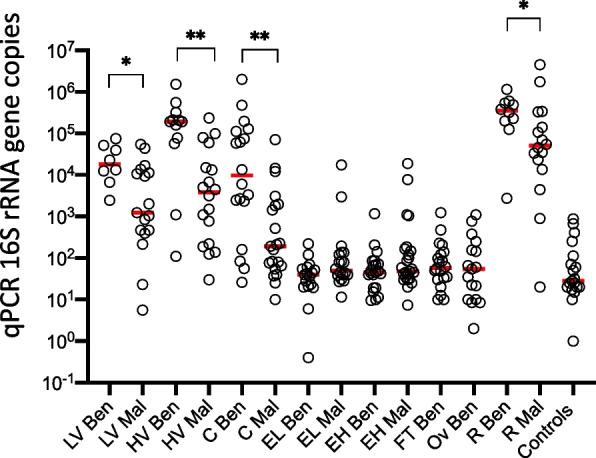
Here we sampled different regions of the reproductive tract (vagina, cervix, endometrium, fallopian tubes and ovaries) and rectum of 61 patients (37 endometrial cancer; 24 benign controls). We performed 16S rRNA gene sequencing of the V1-V2 hypervariable regions and qPCR of the 16S rRNA gene to qualitatively and quantitatively assess microbial communities and used 3D benign and endometrial cancer organoids to evaluate the effect of microbial products of L. crispatus, which was found depleted in endometrial cancer patients following primary analysis, on endometrial cell proliferation and inflammation. We found that the upper genital tract of a subset of women with and without endometrial cancer harbour microbiota quantitatively and compositionally distinguishable from background contaminants. Endometrial cancer was associated with reduced cervicovaginal and rectal bacterial load together with depletion of Lactobacillus species relative abundance, including L. crispatus, increased bacterial diversity and enrichment of Porphyromonas, Prevotella, Peptoniphilus and Anaerococcus in the lower genital tract and endometrium. Treatment of benign and malignant endometrial organoids with L. crispatus conditioned media exerted an anti-proliferative effect at high concentrations but had minimal impact on cytokine and chemokine profiles.
CONCLUSIONS
Our findings provide evidence that the upper female reproductive tract of some women contains detectable levels of bacteria, the composition of which is associated with endometrial cancer. Whether this is a cause or consequence of cancer pathophysiology and what is the functional significance of this finding remain to be elucidated to guide future screening tools and microbiome-based therapeutics. Video Abstract.
背景
子宫内膜癌是一种多因素疾病,其发病机制涉及炎症、代谢和潜在的微生物线索。迄今为止,子宫内膜癌微生物组的特征描述很差,由于缺乏对适当污染控制的整合,研究往往高估了细菌生物量。关于微生物微环境在子宫内膜癌中的功能也缺乏证据。这项工作通过检测子宫内膜癌患者女性生殖道和直肠中真正无污染的微生物特征,以及微生物组在致癌过程中的机制作用,解决了这一知识空白。
结果
在这里,我们对 61 名患者(37 名子宫内膜癌患者;24 名良性对照)的生殖道不同部位(阴道、宫颈、子宫内膜、输卵管和卵巢)和直肠进行了采样。我们对 V1-V2 高变区进行了 16S rRNA 基因测序,对 16S rRNA 基因进行了 qPCR,定性和定量评估微生物群落,并使用 3D 良性和子宫内膜癌类器官来评估在初步分析中发现缺失的 L. crispatus 的微生物产物对子宫内膜细胞增殖和炎症的影响。我们发现,一部分患有和不患有子宫内膜癌的女性的上生殖道具有在数量和组成上可与背景污染物区分开来的微生物群。子宫内膜癌与宫颈阴道和直肠细菌负荷减少以及包括 L. crispatus 在内的乳酸菌相对丰度减少、下生殖道和子宫内膜细菌多样性增加以及 Porphyromonas、Prevotella、Peptoniphilus 和 Anaerococcus 富集有关。用 L. crispatus 条件培养基处理良性和恶性子宫内膜类器官在高浓度下表现出抗增殖作用,但对细胞因子和趋化因子谱的影响最小。
结论
我们的研究结果提供了证据,表明一些女性的上生殖道含有可检测水平的细菌,其组成与子宫内膜癌有关。这是癌症病理生理学的原因还是后果,以及这一发现的功能意义是什么,仍有待阐明,以指导未来的筛查工具和基于微生物组的治疗方法。



 Zotero 插件