
基于多阶段联合方法的深度学习尘肺病分期和诊断系统。
Deep learning pneumoconiosis staging and diagnosis system based on multi-stage joint approach.
机构信息
West China School of Public Health and West China Fourth Hospital, Sichuan University, Chengdu, 610041, PR China.
West China-PUMC C.C. Chen Institute of Health, Sichuan University, Chengdu, PR China.
出版信息
BMC Med Imaging. 2024 Jul 2;24(1):165. doi: 10.1186/s12880-024-01337-x.
BACKGROUND
Pneumoconiosis has a significant impact on the quality of patient survival due to its difficult staging diagnosis and poor prognosis. This study aimed to develop a computer-aided diagnostic system for the screening and staging of pneumoconiosis based on a multi-stage joint deep learning approach using X-ray chest radiographs of pneumoconiosis patients.
METHODS
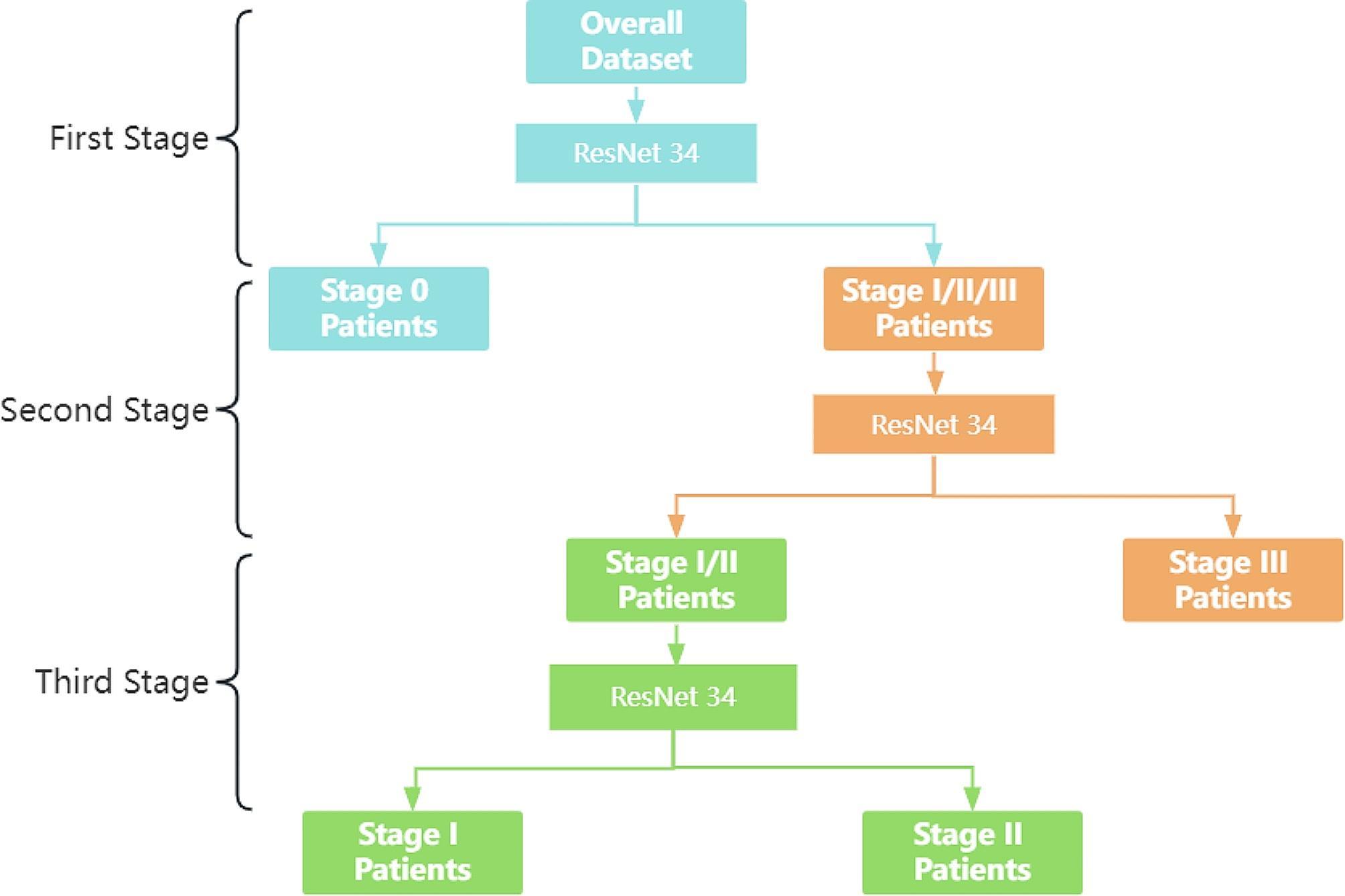
In this study, a total of 498 medical chest radiographs were obtained from the Department of Radiology of West China Fourth Hospital. The dataset was randomly divided into a training set and a test set at a ratio of 4:1. Following histogram equalization for image enhancement, the images were segmented using the U-Net model, and staging was predicted using a convolutional neural network classification model. We first used Efficient-Net for multi-classification staging diagnosis, but the results showed that stage I/II of pneumoconiosis was difficult to diagnose. Therefore, based on clinical practice we continued to improve the model by using the Res-Net 34 Multi-stage joint method.
RESULTS
Of the 498 cases collected, the classification model using the Efficient-Net achieved an accuracy of 83% with a Quadratic Weighted Kappa (QWK) score of 0.889. The classification model using the multi-stage joint approach of Res-Net 34 achieved an accuracy of 89% with an area under the curve (AUC) of 0.98 and a high QWK score of 0.94.
CONCLUSIONS
In this study, the diagnostic accuracy of pneumoconiosis staging was significantly improved by an innovative combined multi-stage approach, which provided a reference for clinical application and pneumoconiosis screening.
背景
尘肺病由于其分期诊断困难和预后不良,对患者生存质量有重大影响。本研究旨在开发一种基于多阶段联合深度学习方法的 X 射线胸片尘肺病患者计算机辅助诊断系统,用于尘肺病的筛查和分期。
方法
本研究共从华西第四医院放射科获取了 498 份医学胸部 X 光片。数据集以 4:1 的比例随机分为训练集和测试集。在对图像进行直方图均衡化增强后,使用 U-Net 模型对图像进行分割,并使用卷积神经网络分类模型进行分期预测。我们首先使用 Efficient-Net 进行多分类分期诊断,但结果表明,尘肺病的 I/II 期难以诊断。因此,基于临床实践,我们继续使用 Res-Net 34 多阶段联合方法改进模型。
结果
在所收集的 498 例病例中,使用 Efficient-Net 的分类模型的准确率为 83%,二次加权 Kappa(QWK)评分为 0.889。使用 Res-Net 34 多阶段联合方法的分类模型的准确率为 89%,曲线下面积(AUC)为 0.98,QWK 评分高,为 0.94。
结论
本研究通过创新的联合多阶段方法,显著提高了尘肺病分期的诊断准确性,为临床应用和尘肺病筛查提供了参考。




 Zotero 插件