
在无细胞生物电子平台上重现病毒感染的生物学步骤,以分析关注的病毒变体。
Recreating the biological steps of viral infection on a cell-free bioelectronic platform to profile viral variants of concern.
机构信息
Robert Frederick Smith School of Chemical and Biomolecular Engineering, Cornell University, 124 Olin Hall, Ithaca, NY, 14853, USA.
Department of Chemical Engineering and Biotechnology, University of Cambridge, Philippa Fawcett Dr., Cambridge, CB3 0AS, UK.
出版信息
Nat Commun. 2024 Jul 3;15(1):5606. doi: 10.1038/s41467-024-49415-6.
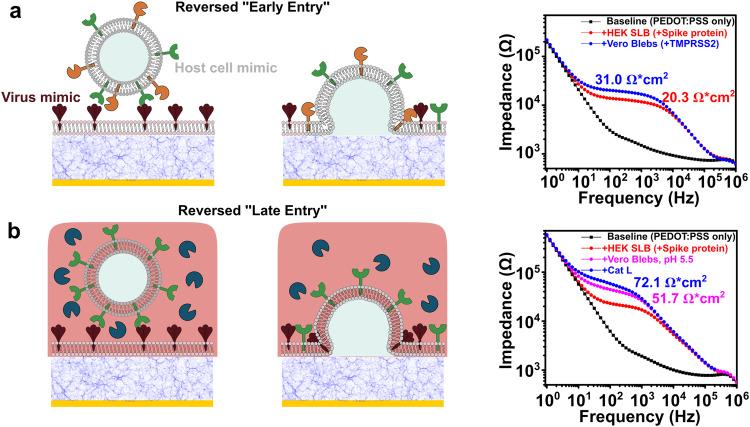
Viral mutations frequently outpace technologies used to detect harmful variants. Given the continual emergence of SARS-CoV-2 variants, platforms that can identify the presence of a virus and its propensity for infection are needed. Our electronic biomembrane sensing platform recreates distinct SARS-CoV-2 host cell entry pathways and reports the progression of entry as electrical signals. We focus on two necessary entry processes mediated by the viral Spike protein: virus binding and membrane fusion, which can be distinguished electrically. We find that closely related variants of concern exhibit distinct fusion signatures that correlate with trends in cell-based infectivity assays, allowing us to report quantitative differences in their fusion characteristics and hence their infectivity potentials. We use SARS-CoV-2 as our prototype, but we anticipate that this platform can extend to other enveloped viruses and cell lines to quantifiably assess virus entry.
病毒突变经常超过用于检测有害变异的技术。鉴于 SARS-CoV-2 变体的不断出现,需要能够识别病毒及其感染倾向的平台。我们的电子生物膜感应平台再现了独特的 SARS-CoV-2 宿主细胞进入途径,并将进入过程报告为电信号。我们专注于病毒 Spike 蛋白介导的两个必要进入过程:病毒结合和膜融合,这可以通过电区分。我们发现,密切相关的关注变体表现出不同的融合特征,这些特征与基于细胞的感染性测定中的趋势相关,使我们能够报告它们在融合特征方面的定量差异,从而报告它们的感染潜力。我们使用 SARS-CoV-2 作为我们的原型,但我们预计该平台可以扩展到其他包膜病毒和细胞系,以定量评估病毒进入。


 Zotero 插件