
全钙钛矿串联太阳能电池:从基础到技术进展
All-perovskite tandem solar cells: from fundamentals to technological progress.
作者信息
Lim Jaekeun, Park Nam-Gyu, Il Seok Sang, Saliba Michael
机构信息
Institute for Photovoltaics (ipv), University of Stuttgart Stuttgart Germany
School of Chemical Engineering and Center for Antibonding Regulated Crystals, Sungkyunkwan University Suwon Republic of Korea
出版信息
Energy Environ Sci. 2024 May 10;17(13):4390-4425. doi: 10.1039/d3ee03638c. eCollection 2024 Jul 2.
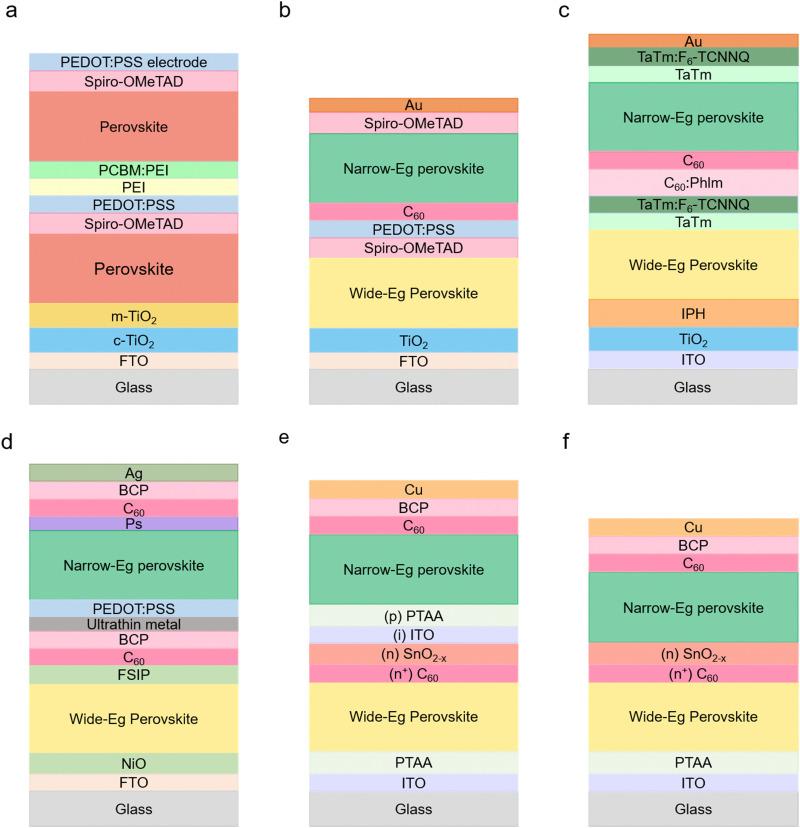
Organic-inorganic perovskite materials have gradually progressed from single-junction solar cells to tandem (double) or even multi-junction (triple-junction) solar cells as all-perovskite tandem solar cells (APTSCs). Perovskites have numerous advantages: (1) tunable optical bandgaps, (2) low-cost, solution-processing, inexpensive precursors, and compatibility with many thin-film processing technologies, (3) scalability and lightweight, and (4) eco-friendliness related to low CO emission. However, APTSCs face challenges regarding stability caused by Sn oxidation in narrow bandgap perovskites, low performance due to deficit in the wide bandgap range, non-standardisation of charge recombination layers, and challenging thin-film deposition as each layer must be nearly perfectly homogenous. Here, we discuss the fundamentals of APTSCs and technological progress in constructing each layer of the all-perovskite stacks. Furthermore, the theoretical power conversion efficiency (PCE) limitation of APTSCs is discussed using simulations.
有机-无机钙钛矿材料已逐渐从单结太阳能电池发展到串联(双结)甚至多结(三结)太阳能电池,即全钙钛矿串联太阳能电池(APTSC)。钙钛矿具有诸多优点:(1)可调节的光学带隙;(2)低成本、溶液处理、前驱体廉价且与多种薄膜加工技术兼容;(3)可扩展性和轻量化;(4)与低二氧化碳排放相关的生态友好性。然而,APTSC面临着一些挑战,包括窄带隙钙钛矿中锡氧化导致的稳定性问题、宽带隙范围内性能不足导致的低性能、电荷复合层的不标准化以及具有挑战性的薄膜沉积,因为每层都必须几乎完美均匀。在此,我们讨论APTSC的基本原理以及构建全钙钛矿叠层各层的技术进展。此外,还使用模拟讨论了APTSC的理论功率转换效率(PCE)限制。




 Zotero 插件