
重度免疫检查点抑制剂相关肺炎对非小细胞肺癌患者的预后影响
The prognostic impact of severe grade immune checkpoint inhibitor related pneumonitis in non-small cell lung cancer patients.
作者信息
Sun Ni, Li Ru, Deng Haiyi, Li Qingyang, Deng Jiaxi, Zhu Yue, Mo Wenwei, Guan Wenhui, Hu Minjuan, Liu Ming, Xie Xiaohong, Lin Xinqing, Zhou Chengzhi
机构信息
Guangzhou Medical University, Guangzhou, Guangdong, China.
State Key Laboratory of Respiratory Disease, National Clinical Research Center for Respiratory Disease, National Center for Respiratory Medicine, Department of Pulmonary and Critical Care Medicine-Section 5, Guangzhou Institute of Respiratory Health, the First Affiliated Hospital of Guangzhou Medical University, Guangzhou, Guangdong, China.
出版信息
Front Oncol. 2024 Jun 25;14:1372532. doi: 10.3389/fonc.2024.1372532. eCollection 2024.
OBJECTIVE
To compare the prognostic differences between non-small cell lung cancer (NSCLC) patients with mild and severe checkpoint inhibitor-associated pneumonitis (CIP), and explore the causes of death and prognostic risk factors in NSCLC patients with severe CIP.
METHODS
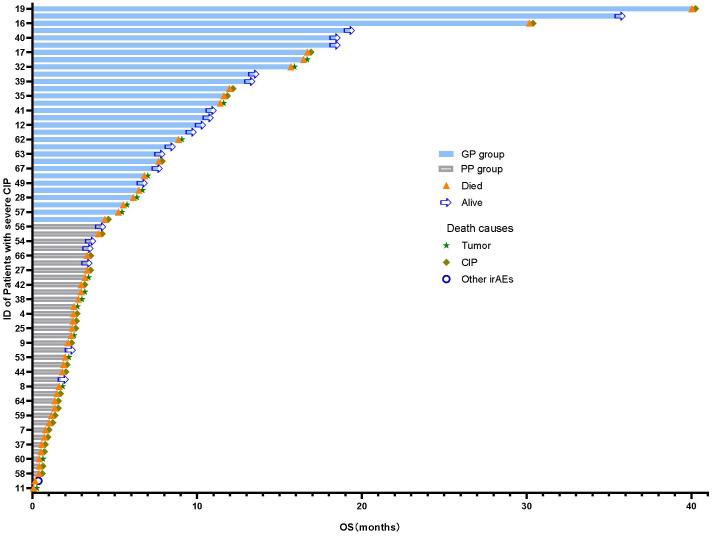
A retrospective study of a cohort of 116 patients with unresectable stage III or IV NSCLC with any grade CIP from April 2016 to August 2022 were conducted. To analyze the clinical characteristics of patients with different CIP grades, patients were divided into mild CIP group (grade 1-2, n=49) and severe CIP group (grade 3-5, n=67) according to the grade of CIP. To explore the OS-related risk factors in the severe CIP group, the patients were divided into a good prognosis (GP) group (≥ median OS, n=30) and a poor prognosis (PP) group (< median OS, n=37) based on whether their overall survival (OS) were greater than median OS. Baseline clinical and laboratory data were collected for analysis.
RESULTS
The median OS of all NSCLC patients combined with CIP was 11.4 months (95%CI, 8.070-16.100), The median OS for mild CIP and severe CIP was 22.1 months and 4.4 months respectively (HR=3.076, 95%CI, 1.904-4.970, P<0.0001). The results showed that the most common cause of death among severe CIP patients in the PP group was CIP and the most common cause in the GP group was tumor. The univariate regression analysis showed that suspension of antitumor therapy was a risk factor for poor prognosis (OR=3.598, 95%CI, 1.307-9.905, =0.013). The multivariate logistic regression analysis showed that suspension of anti-tumor therapy (OR=4.24, 95%CI, 1.067-16.915, =0.040) and elevated KL-6 (OR=1.002, 95%CI, 1.001-1.002, <0.001) were independent risk factors for poor prognosis.
CONCLUSION
In conclusion, patients with severe CIP had a poor prognosis, especially those with elevated KL-6, and the main cause of death is immune checkpoint inhibitor-associated pneumonitis complicated with infection. In addition, anti-tumor therapy for severe CIP patients should be resumed in time and should not be delayed for too long.
目的
比较轻度和重度检查点抑制剂相关肺炎(CIP)的非小细胞肺癌(NSCLC)患者的预后差异,并探讨重度CIP的NSCLC患者的死亡原因和预后危险因素。
方法
对2016年4月至2022年8月期间116例患有任何级别的CIP的不可切除III期或IV期NSCLC患者进行回顾性队列研究。为分析不同CIP级别的患者的临床特征,根据CIP级别将患者分为轻度CIP组(1-2级,n=49)和重度CIP组(3-5级,n=67)。为探讨重度CIP组中与总生存期(OS)相关的危险因素,根据患者的总生存期是否大于中位OS,将患者分为预后良好(GP)组(≥中位OS,n=30)和预后不良(PP)组(<中位OS,n=37)。收集基线临床和实验室数据进行分析。
结果
所有合并CIP的NSCLC患者的中位OS为11.4个月(95%CI,8.070-16.100),轻度CIP和重度CIP的中位OS分别为22.1个月和4.4个月(HR=3.076,95%CI,1.904-4.970,P<0.0001)。结果显示,PP组重度CIP患者最常见的死亡原因是CIP,而GP组最常见的原因是肿瘤。单因素回归分析显示,抗肿瘤治疗中断是预后不良的危险因素(OR=3.598,95%CI,1.307-9.905,P=0.013)。多因素逻辑回归分析显示,抗肿瘤治疗中断(OR=4.24,95%CI,1.067-16.915,P=0.040)和KL-6升高(OR=1.002,95%CI,1.001-1.002,P<0.001)是预后不良的独立危险因素。
结论
总之,重度CIP患者预后不良,尤其是KL-6升高的患者,主要死亡原因是免疫检查点抑制剂相关肺炎合并感染。此外,重度CIP患者的抗肿瘤治疗应及时恢复,不应延迟过长时间。


 Zotero 插件