
解析象山湾长期富营养化下大型底栖生物的生物学特征。
Deciphering macrobenthic biological traits in response to long-term eutrophication in Xiangshan Bay, China.
机构信息
School of Marine Sciences, Ningbo University, Ningbo, 315832, China.
Ministry of Natural Resources, Marine Environmental Monitoring Center of Ningbo, Ningbo, 315012, Zhejiang, China.
出版信息
Sci Rep. 2024 Aug 30;14(1):20209. doi: 10.1038/s41598-024-71239-z.
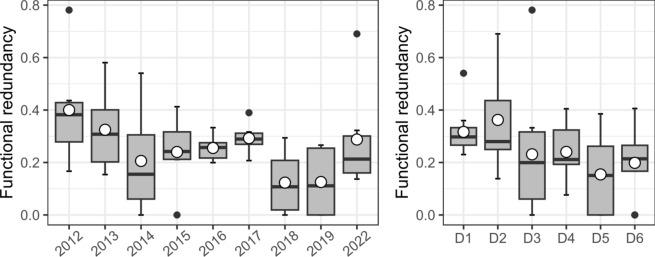
As an emerging global issue in coastal marine ecosystems, eutrophication may lead to profound ecological consequences or disasters. Six locations in Xiangshan Bay were sampled during 2012-2022 along the eutrophication gradient from the innermost bay with the most eutrophication to the outer bay with the least eutrophication. A trait-based method was adopted to explore the ecological effects of eutrophication on macrobenthic communities. The results showed that the community composition is mostly characterized by deposit feeders and predators with small (1-3 cm) and large (> 10 cm) body sizes, classified as indifferent and tolerant species (AMBI ecological groups), deposit feeders and predators (feeding mode), and a preference for a free living lifestyle. The RLQ and fourth-corner analyses further confirmed that there was a negative correlation between the abundance of small macrobenthic organisms (< 1 cm) and nitrate concentration. Phosphorus was a crucial influencing factor for macrobenthic spatial patterns and was strongly affected by the activities of deposit feeders and the decomposition of macrobenthos. Due to mass organic deposition resulting from increased primary production, long-term eutrophication had led to an increase in the proportion of detritus feeders. In addition, the significant negative correlation between the concentration of dissolved oxygen and first-order opportunistic species represented by the polychaete Capitella capitata indicated tolerance to hypoxia. The macrobenthic community in Xiangshan Bay had been negatively affected but maintains considerable stability in functional diversity and functional redundancy under the influence of long-term eutrophication.
作为沿海海洋生态系统中一个新兴的全球性问题,富营养化可能会导致深远的生态后果或灾害。2012 年至 2022 年期间,在象山湾从内湾富营养化最严重到外湾富营养化程度最低的沿营养梯度的六个地点进行了采样。采用基于特征的方法来探讨富营养化对大型底栖动物群落的生态影响。结果表明,群落组成主要以沉积物食者和捕食者为主,体型较小(1-3 厘米)和较大(>10 厘米),被归类为不敏感和耐受物种(AMBI 生态组)、沉积物食者和捕食者(摄食方式),以及自由生活方式的偏好。RLQ 和第四角分析进一步证实,小型底栖生物(<1 厘米)的丰度与硝酸盐浓度之间存在负相关。磷是大型底栖动物空间格局的关键影响因素,强烈受到沉积物食者的活动和大型底栖动物分解的影响。由于初级生产力增加导致大量有机物质沉积,长期富营养化导致碎屑食者的比例增加。此外,溶解氧浓度与多毛类 Capitella capitata 等一级机会主义物种之间的显著负相关表明其对低氧的耐受性。在长期富营养化的影响下,象山湾的大型底栖动物群落受到负面影响,但在功能多样性和功能冗余方面仍保持相当大的稳定性。



 Zotero 插件