
NFS1作为与免疫浸润相关的胃癌候选预后生物标志物。
NFS1 as a Candidate Prognostic Biomarker for Gastric Cancer Correlated with Immune Infiltrates.
作者信息
Jiang You, Li Wenbo, Zhang Jun, Liu Kun, Wu Yuee, Wang Zhengguang
机构信息
Department of General Surgery, First Affiliated Hospital of Anhui Medical University, Hefei, Anhui, 230011, People's Republic of China.
Department of General Surgery, The Second People's Hospital of Hefei, Hefei Hospital Affiliated to Anhui Medical University, Hefei, Anhui, 230011, People's Republic of China.
出版信息
Int J Gen Med. 2024 Sep 5;17:3855-3868. doi: 10.2147/IJGM.S444443. eCollection 2024.
BACKGROUND
Cysteine desulfurase (NFS1) is closely associated with the occurrence and development of human tumors, but its relationship with the prognosis and immunity of gastric cancer (GC) patients remains unclear.
METHODS
To study the relationship between NFS1 and GC, GC-related data of TCGA were downloaded and analyzed. At the same time, Tumor Immune Estimation Resource (TIMER) and Kaplan‒Meier Plotter were used for relevant online analysis. Clinical samples were collected for immunohistochemical testing to validate the results.
RESULTS
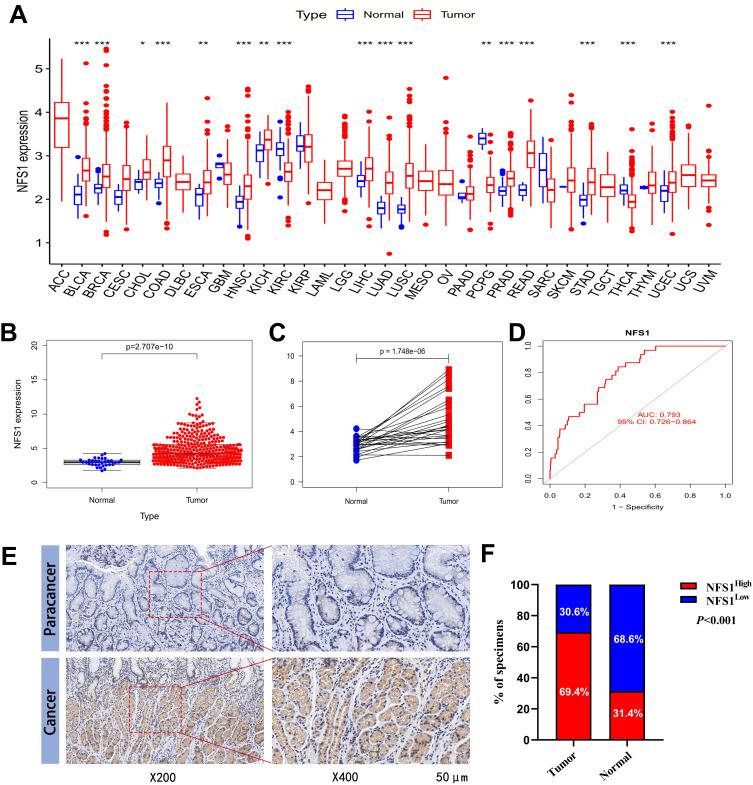
The mRNA and protein levels of NFS1 in GC tissues were significantly higher than those in normal tissues. In terms of the operating characteristic curve (ROC), the area under the curve (AUC) was 0.793, indicating that NFS1 had a high diagnostic value for GC. Further analysis showed that NFS1 expression was highly correlated with the depth of tumor invasion, lymph node metastasis, and tumor stage. Survival analysis showed that patients with high expression of NFS1 had a poorer prognosis, and NFS1 was an independent risk factor. Enrichment analysis by GO, KEGG, and GSEA showed that NFS1 was enriched in immune-related pathways. The expression of NFS1 was significantly positively correlated with the proportion of macrophages M and plasma cells but negatively correlated with the proportion of B cells memory, monocytes, and mast cells resting. In addition, NFS1 expression was significantly correlated with TMB levels and responses to immunotherapy.
CONCLUSION
Our results suggest that NFS1 may be a potential biomarker for the diagnosis and prediction of prognosis and immunotherapy efficacy in GC.
背景
半胱氨酸脱硫酶(NFS1)与人类肿瘤的发生发展密切相关,但其与胃癌(GC)患者预后及免疫的关系仍不清楚。
方法
为研究NFS1与GC的关系,下载并分析了TCGA中与GC相关的数据。同时,使用肿瘤免疫评估资源(TIMER)和Kaplan-Meier Plotter进行相关在线分析。收集临床样本进行免疫组织化学检测以验证结果。
结果
GC组织中NFS1的mRNA和蛋白水平显著高于正常组织。根据操作特征曲线(ROC),曲线下面积(AUC)为0.793,表明NFS1对GC具有较高的诊断价值。进一步分析表明,NFS1表达与肿瘤浸润深度、淋巴结转移及肿瘤分期高度相关。生存分析显示,NFS1高表达患者预后较差,且NFS1是独立危险因素。通过GO、KEGG和GSEA进行的富集分析表明,NFS1在免疫相关途径中富集。NFS1的表达与巨噬细胞M和浆细胞的比例显著正相关,但与B细胞记忆、单核细胞和静止肥大细胞的比例负相关。此外,NFS1表达与肿瘤突变负荷(TMB)水平及免疫治疗反应显著相关。
结论
我们的结果表明,NFS1可能是GC诊断、预后预测及免疫治疗疗效预测的潜在生物标志物。



 Zotero 插件