
基于下一代 AMA1 的质粒,用于增强丝状真菌中的异源表达。
Next-generation AMA1-based plasmids for enhanced heterologous expression in filamentous fungi.
机构信息
School of Molecular Sciences, University of Western Australia, Perth, Western Australia, Australia.
出版信息
Microb Biotechnol. 2024 Sep;17(9):e70010. doi: 10.1111/1751-7915.70010.
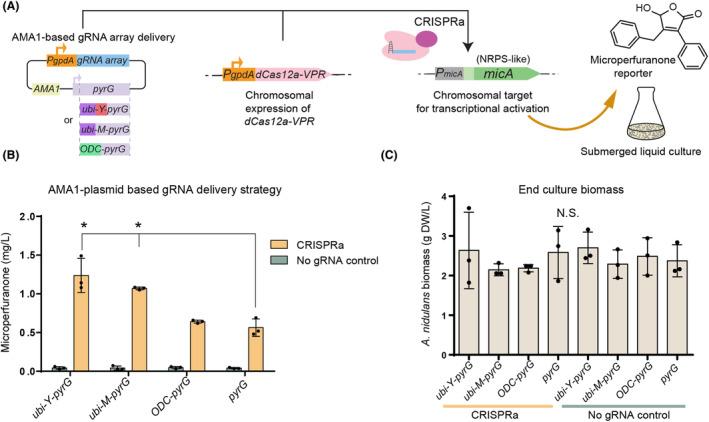
Episomal AMA1-based plasmids are increasingly used for expressing biosynthetic pathways and CRISPR/Cas systems in filamentous fungi cell factories due to their high transformation efficiency and multicopy nature. However, the gene expression from AMA1 plasmids has been observed to be highly heterogeneous in growing mycelia. To overcome this limitation, here we developed next-generation AMA1-based plasmids that ensure homogeneous and strong expression. We achieved this by evaluating various degradation tags fused to the auxotrophic marker gene on the AMA1 plasmid, which introduces a more stringent selection pressure throughout multicellular fungal growth. With these improved plasmids, we observed in Aspergillus nidulans a 5-fold increase in the expression of a fluorescent reporter, a doubling in the efficiency of a CRISPRa system for genome mining, and a up to a 10-fold increase in the production of heterologous natural product metabolites. This strategy has the potential to be applied to diverse filamentous fungi.
基于外显子 AMA1 的质粒由于其高效的转化效率和多拷贝性质,越来越多地被用于丝状真菌细胞工厂中表达生物合成途径和 CRISPR/Cas 系统。然而,在生长的菌丝体中,AMA1 质粒的基因表达一直被观察到高度异质。为了克服这一限制,我们在这里开发了基于下一代 AMA1 的质粒,以确保均匀和强大的表达。我们通过评估各种与 AMA1 质粒上的营养缺陷标记基因融合的降解标签来实现这一点,这在整个多细胞真菌生长过程中引入了更严格的选择压力。通过这些改进的质粒,我们在构巢曲霉中观察到荧光报告基因的表达增加了 5 倍,基因组挖掘的 CRISPRa 系统的效率提高了一倍,异源天然产物代谢物的产量增加了 10 倍。这种策略有可能应用于不同的丝状真菌。


 Zotero 插件