
基于结晶的高氯酸铵热释放改性
Crystallization-Based Modification of Ammonium Perchlorate Heat Release.
作者信息
Smith-Papin Natalie, Do Cynthia, Phister Meagan, Giri Gaurav, Kalman Joseph
机构信息
Department of Chemical Engineering, University of Virginia, Charlottesville, Virginia 22904, United States.
Department of Mechanical and Aerospace Engineering, California State University Long Beach, Long Beach, California 90840, United States.
出版信息
Cryst Growth Des. 2024 Sep 6;24(18):7588-7596. doi: 10.1021/acs.cgd.4c00769. eCollection 2024 Sep 18.
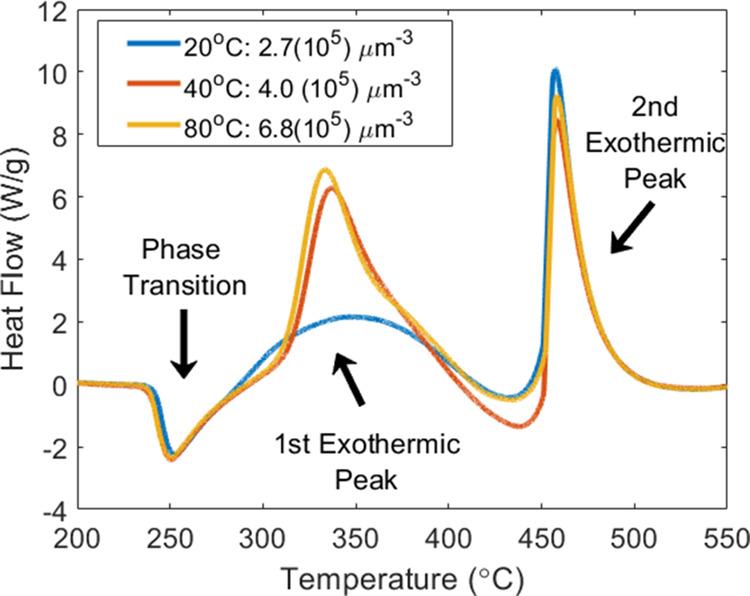
Composite propellants use the decomposition of crystalline oxidizers, such as ammonium perchlorate (AP), to produce oxidizing species that can combust with fuels. Controlled crystal microstructure must be leveraged to tailor reactivity to minimize the use of exotic energetic materials. This work uses meniscus-guided coating (MGC) to fabricate films of AP with a high degree of control over the AP crystal microstructure. Exploring a wide range of crystallization parameters resulted in film thickness ranging from 200 nm to 14 μm, particle size ranging from 18 to 110 μm, variable preferential orientation with respect to the substrate, and relative defect density ranging from 2.74 × 10 to 6.78 × 10 μm. Increasing coating blade speed and substrate temperature within the MGC process shifts the preferential orientation of the AP crystals from predominantly exhibiting (002) and (210) crystal planes parallel to the substrate to (200)/(011) crystal planes parallel to the substrate. This shift in orientation is accompanied by an increase in defect density, which is shown to increase the heat release from the low-temperature decomposition regime and decrease the heat release from the high temperature regime. These results demonstrate the ability to use recrystallization, defect density control, and orientation control to tune the heat release profiles of energetic materials to augment propellant performance.
复合推进剂利用结晶氧化剂(如高氯酸铵(AP))的分解来产生可与燃料燃烧的氧化物种。必须利用可控的晶体微观结构来调整反应活性,以尽量减少使用奇特的含能材料。这项工作使用弯月面引导涂层(MGC)来制备对AP晶体微观结构具有高度控制的AP薄膜。探索广泛的结晶参数导致薄膜厚度在200纳米至14微米之间,颗粒尺寸在18至110微米之间,相对于基底具有可变的择优取向,以及相对缺陷密度在2.74×10至6.78×10微米之间。在MGC工艺中提高涂布刮刀速度和基底温度会使AP晶体的择优取向从主要呈现与基底平行的(002)和(210)晶面转变为与基底平行的(200)/(011)晶面。这种取向的转变伴随着缺陷密度的增加,结果表明这会增加低温分解阶段的热释放,并降低高温阶段的热释放。这些结果证明了利用重结晶、缺陷密度控制和取向控制来调整含能材料的热释放曲线以提高推进剂性能的能力。


 Zotero 插件