
通过藻酸盐微珠和聚多巴胺涂层的3D打印PCL/β-TCP支架持续递送骨形态发生蛋白-2可增强长骨节段性缺损的骨再生。
Sustained BMP-2 delivery via alginate microbeads and polydopamine-coated 3D-Printed PCL/β-TCP scaffold enhances bone regeneration in long bone segmental defects.
作者信息
Lee Seoyun, Kim Jae-Hun, Kim Yong-Hun, Hong Jihyeock, Kim Woo Keyoung, Jin Songwan, Kang Byung-Jae
机构信息
Department of Veterinary Clinical Sciences, College of Veterinary Medicine and Research Institute for Veterinary Science, Seoul National University, Seoul, 08826, South Korea.
BK21 FOUR Future Veterinary Medicine Leading Education and Research Center, Seoul National University, Seoul, 08826, South Korea.
出版信息
J Orthop Translat. 2024 Oct 2;49:11-22. doi: 10.1016/j.jot.2024.08.013. eCollection 2024 Nov.
BACKGROUND/OBJECTIVE: Repair of long bone defects remains a major challenge in clinical practice, necessitating the use of bone grafts, growth factors, and mechanical stability. Hence, a combination therapy involving a 3D-printed polycaprolactone (PCL)/β-tricalcium phosphate (β-TCP) scaffold coated with polydopamine (PDA) and alginate microbeads (AM) for sustained delivery of bone morphogenetic protein-2 (BMP-2) was investigated to treat long bone segmental defects.
METHODS
Several in vitro analyses were performed to evaluate the scaffold osteogenic effects in vitro such as PDA surface modification, namely, hydrophilicity and cell adhesion; cytotoxicity and BMP-2 release kinetics using CCK-8 assay and ELISA, respectively; osteogenic differentiation in canine adipose-derived mesenchymal stem cells (Ad-MSCs); formation of mineralized nodules using ALP staining and ARS staining; and mRNA expression of osteogenic differentiation markers using RT-qPCR. Bone regeneration in femoral bone defects was evaluated in vivo using a rabbit femoral segmental bone defect model by performing radiography, micro-computed tomography, and histological observation (hematoxylin and eosin and Masson's trichrome staining).
RESULTS
The PDA-coated 3D-printed scaffold demonstrated increased hydrophilicity, cell adhesion, and cell proliferation compared with that of the control. BMP-2 release kinetics assessment showed that BMP-2 AM showed a reduced initial burst and continuous release for 28 days. co-culture with canine Ad-MSCs showed an increase in mineralization and mRNA expression of osteogenic markers in the BMP-2 AM group compared with that of the BMP-2-adsorbed scaffold group. bone regeneration evaluation 12 weeks after surgery showed that the BMP-2 AM/PDA group exhibited the highest bone volume in the scaffold, followed by the BMP-2/PDA group. High cortical bone connectivity was observed in the PDA-coated scaffold groups.
CONCLUSION
These findings suggest that the combined use of PDA-coated 3D-printed bone scaffolds and BMP-2 AM can successfully induce bone regeneration even in load-bearing bone segmental defects.
THE TRANSLATIONAL POTENTIAL OF THIS ARTICLE
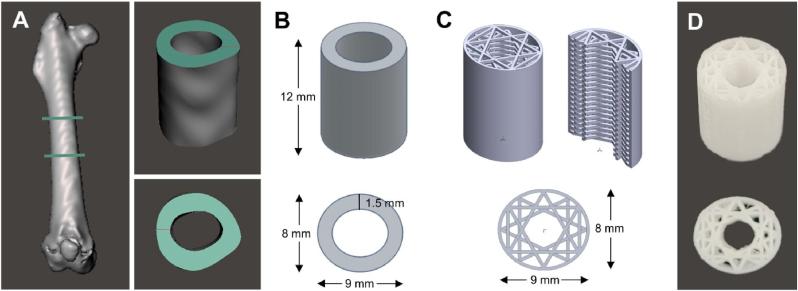
A 3D-printed PCL/β-TCP scaffold was fabricated to mimic the cortical bone of the femur. Along with the application of PDA surface modification and sustained BMP-2 release via AM, the developed scaffold could provide suitable osteoconduction, osteoinduction, and osteogenesis in both in vitro settings and in vivo rabbit femoral segmental bone defect models. Therefore, our findings suggest a promising therapeutic option for treating challenging long bone segmental defects, with potential for future clinical application.
背景/目的:长骨缺损的修复在临床实践中仍然是一项重大挑战,需要使用骨移植、生长因子和机械稳定性。因此,研究了一种联合治疗方法,即使用涂有聚多巴胺(PDA)和藻酸盐微珠(AM)的3D打印聚己内酯(PCL)/β-磷酸三钙(β-TCP)支架来持续递送骨形态发生蛋白-2(BMP-2),以治疗长骨节段性缺损。
方法
进行了多项体外分析,以评估支架的体外成骨作用,如PDA表面改性,即亲水性和细胞粘附;分别使用CCK-8测定法和ELISA评估细胞毒性和BMP-2释放动力学;犬脂肪来源间充质干细胞(Ad-MSCs)的成骨分化;使用碱性磷酸酶(ALP)染色和茜素红染色(ARS染色)评估矿化结节的形成;以及使用逆转录定量聚合酶链反应(RT-qPCR)评估成骨分化标志物的mRNA表达。通过进行X线摄影、显微计算机断层扫描和组织学观察(苏木精和伊红染色以及Masson三色染色),使用兔股骨节段性骨缺损模型在体内评估股骨骨缺损中的骨再生情况。
结果
与对照组相比,涂有PDA的3D打印支架表现出更高的亲水性、细胞粘附性和细胞增殖能力。BMP-2释放动力学评估表明,BMP-2 AM表现出初始突释减少并持续释放28天。与犬Ad-MSCs共培养显示,与吸附有BMP-2的支架组相比,BMP-2 AM组的矿化和成骨标志物的mRNA表达增加。术后12周的骨再生评估表明,BMP-2 AM/PDA组在支架中的骨体积最高,其次是BMP-2/PDA组。在涂有PDA的支架组中观察到高皮质骨连通性。
结论
这些发现表明,联合使用涂有PDA的3D打印骨支架和BMP-2 AM即使在承重骨节段性缺损中也能成功诱导骨再生。
本文的转化潜力
制作了一种3D打印的PCL/β-TCP支架以模拟股骨的皮质骨。随着PDA表面改性的应用以及通过AM实现BMP-2的持续释放,所开发的支架在体外环境和体内兔股骨节段性骨缺损模型中都能提供合适的骨传导、骨诱导和成骨作用。因此,我们的发现为治疗具有挑战性的长骨节段性缺损提供了一种有前景的治疗选择,具有未来临床应用的潜力。




 Zotero 插件