
优化节能电网性能:使用河马优化算法整合电动汽车、静止同步补偿器和可再生能源。
Optimizing energy-efficient grid performance: integrating electric vehicles, DSTATCOM, and renewable sources using the Hippopotamus Optimization Algorithm.
作者信息
Abdelaziz M A, Ali A A, Swief R A, Elazab Rasha
机构信息
Electrical Power and Machines Department, Helwan University, Cairo, Egypt.
Renewable Electrical Energy Department, The British University in Egypt, El-Sherouk, Egypt.
出版信息
Sci Rep. 2024 Nov 22;14(1):28974. doi: 10.1038/s41598-024-79381-4.
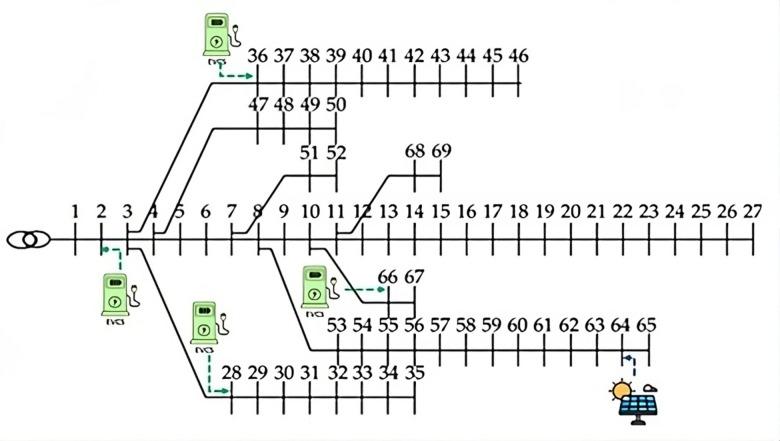
The rapid increase in renewable energy integration and electric vehicle (EV) adoption creates significant challenges for the stability and efficiency of power distribution networks. This study addresses the need for optimized placement and sizing of Electric Vehicle Charging Stations (EVCSs), photovoltaic (PV) systems, and Distribution Static Compensators (DSTATCOMs) to enhance grid performance. The motivation for this work arises from the fluctuating nature of renewable energy generation and the unpredictable demands of EV charging, which strain existing infrastructure. To address these challenges, we propose a novel optimization framework that introduces the Renewable Distributed Generation Hosting Factor (RDG-HF) and Electric Vehicle Hosting Factor (EV-HF) as key metrics. These metrics, combined with the Hippopotamus Optimization Algorithm (HO), enable strategic planning within the IEEE 69-bus system. Simulation results demonstrate that the integrated placement of EVCSs, PVs, and DSTATCOMs reduces power losses by up to 31.5% and reactive power losses by up to 29.2%. An economic analysis further reveals payback periods ranging from 2.7 to 10.4 years and potential profits of up to $1,052,365 over 25 years. These findings highlight the importance of optimized integration in improving both technical performance and long-term economic benefits for distribution networks.
可再生能源整合的快速增长以及电动汽车(EV)的广泛应用,给配电网的稳定性和效率带来了重大挑战。本研究旨在解决电动汽车充电站(EVCS)、光伏(PV)系统和配电静止补偿器(DSTATCOM)的优化布局和容量确定问题,以提高电网性能。这项工作的动机源于可再生能源发电的波动性以及电动汽车充电需求的不可预测性,这些都给现有基础设施带来了压力。为应对这些挑战,我们提出了一种新颖的优化框架,引入了可再生分布式发电容纳因子(RDG-HF)和电动汽车容纳因子(EV-HF)作为关键指标。这些指标与河马优化算法(HO)相结合,可在IEEE 69节点系统内进行战略规划。仿真结果表明,EVCS、PV和DSTATCOM的综合布局可将功率损耗降低多达31.5%,无功功率损耗降低多达29.2%。经济分析进一步显示,投资回收期为2.7至10.4年,25年内潜在利润高达1,052,365美元。这些发现凸显了优化整合对于提高配电网技术性能和长期经济效益的重要性。



 Zotero 插件