
定制3D打印增强植入物和椎间融合器:治疗严重髋臼骨缺损的有效解决方案。
Custom-Made 3D-Printed Augments and Cages: An Effective Solution for Managing Severe Acetabular Bone Loss.
作者信息
Annapareddy Adarsh, Bose Vijay C, Katariya Ameya Ajit, Mulpur Praharsha, Jayakumar Tarun, Ansari Mujtaba, S Chandan, Reddy A V Gurava
机构信息
Department of Orthopaedic, Sunshine Bone and Joint Insitute, KIMS-Sunshine Hospitals, Hyderabad, Telangana, India.
Department of Orthopaedic Surgeon, Asian Orthopaedic Institute, Chennai, Tamil Nadu, India.
出版信息
J Orthop Case Rep. 2025 Jan;15(1):208-214. doi: 10.13107/jocr.2025.v15.i01.5180.
INTRODUCTION
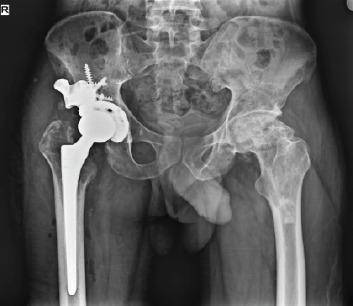
Total hip arthroplasty (THA) is recognized as one of the most effective surgical procedures for the treatment of end-stage hip arthritis. However, the increasing number of primary THA cases has led to a corresponding rise in the frequency of revision surgeries, which are often more complex and challenging due to severe acetabular bone loss. In such cases, managing Paprosky type 3A and 3B defects requires precise implant design and advanced surgical techniques. Standard acetabular augments and anti-protrusio cages are commonly used, but they often fail to provide the necessary stability, leading to re-revision rates as high as 36% within 10 years. This case series explores the efficacy of custom-made 3D-printed acetabular augments and cages in managing severe acetabular bone loss during revision THA.
MATERIALS AND METHODS
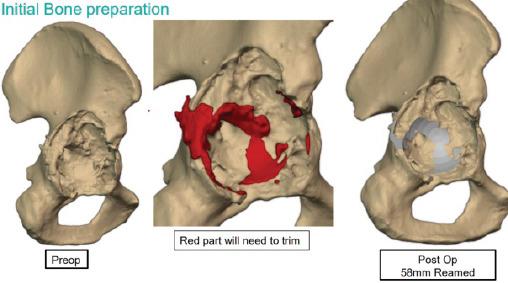
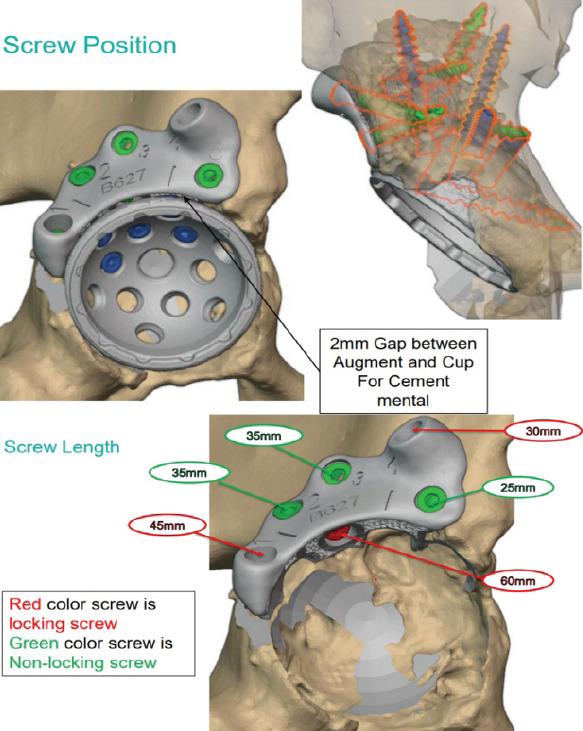
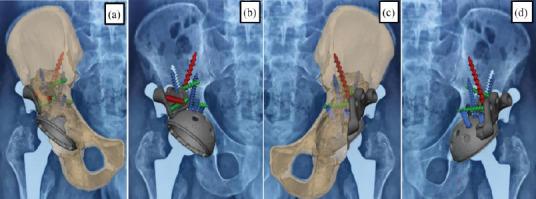
This retrospective case series includes seven patients who underwent revision THA for Paprosky grade 3 acetabular bone loss between January 2023 and April 2024 at two high-volume tertiary care centers. The mean age of the patients was 45 years, with three males and four females included in the study. Pre-operative planning involved advanced imaging techniques, including 3D-computed tomography scans and custom virtual modeling, to design the acetabular components tailored to each patient's specific anatomical requirements.During the surgeries, custom-made 3D-printed titanium augments and cages were used. These implants were fabricated using in-house software, and the turnaround time from the decision to surgery was approximately 10 days. Post-operatively, the planned 3D model was superimposed on post-operative radiographs to assess implant placement accuracy. The Harris hip score at the final follow-up averaged 69.16, with no signs of implant loosening observed.
CONCLUSION
Custom-made 3D-printed acetabular augments and cages offer a reliable and cost-effective solution for managing severe acetabular bone loss in revision THA. Despite the small sample size and short follow-up period, the results demonstrate the potential of these custom implants to improve outcomes in complex acetabular reconstructions. Further studies with larger sample sizes and longer follow-up periods are needed to confirm these findings and establish long-term efficacy.
引言
全髋关节置换术(THA)被认为是治疗终末期髋关节炎最有效的外科手术之一。然而,初次全髋关节置换病例数量的增加导致翻修手术频率相应上升,由于严重的髋臼骨丢失,翻修手术往往更加复杂且具有挑战性。在这种情况下,处理Paprosky 3A和3B型缺损需要精确的植入物设计和先进的手术技术。标准的髋臼增强物和防髋臼前突笼通常被使用,但它们往往无法提供必要的稳定性,导致10年内再次翻修率高达36%。本病例系列探讨了定制的3D打印髋臼增强物和笼在翻修全髋关节置换术中处理严重髋臼骨丢失的疗效。
材料与方法
本回顾性病例系列包括7例患者,他们于2023年1月至2024年4月在两家大型三级医疗中心接受了因Paprosky 3级髋臼骨丢失而进行的翻修全髋关节置换术。患者的平均年龄为45岁,研究纳入了3名男性和4名女性。术前规划涉及先进的成像技术,包括3D计算机断层扫描和定制虚拟建模,以设计适合每个患者特定解剖需求的髋臼组件。在手术过程中,使用了定制的3D打印钛增强物和笼。这些植入物使用内部软件制造,从决定手术到手术的周转时间约为10天。术后,将计划的3D模型叠加在术后X线片上以评估植入物放置的准确性。最后一次随访时的Harris髋关节评分平均为69.16,未观察到植入物松动的迹象。
结论
定制的3D打印髋臼增强物和笼为翻修全髋关节置换术中处理严重髋臼骨丢失提供了一种可靠且具有成本效益的解决方案。尽管样本量小且随访期短,但结果表明这些定制植入物在改善复杂髋臼重建结果方面具有潜力。需要进行更大样本量和更长随访期的进一步研究来证实这些发现并确定长期疗效。



 Zotero 插件