
基于生成对抗局部密度的无监督异常检测
Generative adversarial local density-based unsupervised anomaly detection.
作者信息
Li Xinliang, Peng Jianmin, Li Wenjing, Song Zhiping, Du Xusheng
机构信息
Chongqing College of International Business and Economics, ChongQing, China.
People's Hospital of Xinjiang Uygur Autonomous Region, Urumqi, China.
出版信息
PLoS One. 2025 Jan 24;20(1):e0315721. doi: 10.1371/journal.pone.0315721. eCollection 2025.
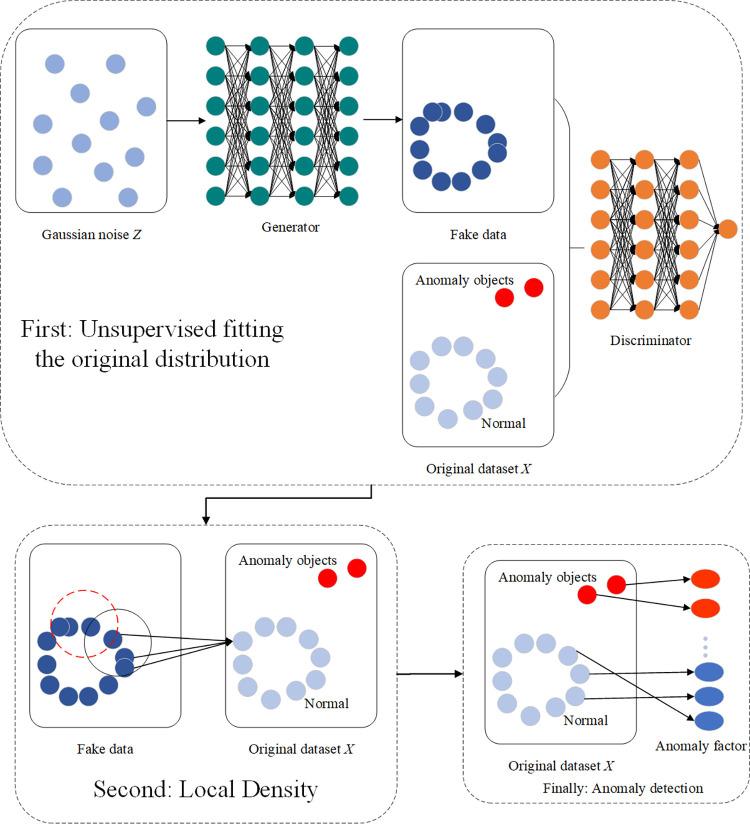
Anomaly detection is crucial in areas such as financial fraud identification, cybersecurity defense, and health monitoring, as it directly affects the accuracy and security of decision-making. Existing generative adversarial nets (GANs)-based anomaly detection methods overlook the importance of local density, limiting their effectiveness in detecting anomaly objects in complex data distributions. To address this challenge, we introduce a generative adversarial local density-based anomaly detection (GALD) method, which combines the data distribution modeling capabilities of GANs with local synthetic density analysis. This approach not only considers different data distributions but also incorporates neighborhood relationships, enhancing anomaly detection accuracy. First, by utilizing the adversarial process of GANs, including the loss function and the rarity of anomaly objects, we constrain the generator to primarily fit the probability distribution of normal objects during the unsupervised training process; Subsequently, a synthetic dataset is sampled from the generator, and the local synthetic density, which is defined by measuring the inverse of the sum of distances between a data point and all objects in its synthetic neighborhood, is calculated; Finally, the objects that show substantial density deviations from the synthetic data are classified as anomaly objects. Extensive experiments on seven real-world datasets from various domains, including medical diagnostics, industrial monitoring, and material analysis, were conducted using seven state-of-the-art anomaly detection methods as benchmarks. The GALD method achieved an average AUC of 0.874 and an accuracy of 94.34%, outperforming the second-best method by 7.2% and 6%, respectively.
异常检测在金融欺诈识别、网络安全防御和健康监测等领域至关重要,因为它直接影响决策的准确性和安全性。现有的基于生成对抗网络(GAN)的异常检测方法忽视了局部密度的重要性,限制了它们在复杂数据分布中检测异常对象的有效性。为应对这一挑战,我们引入了一种基于生成对抗局部密度的异常检测(GALD)方法,该方法将GAN的数据分布建模能力与局部合成密度分析相结合。这种方法不仅考虑了不同的数据分布,还纳入了邻域关系,提高了异常检测的准确性。首先,通过利用GAN的对抗过程,包括损失函数和异常对象的稀有性,我们在无监督训练过程中约束生成器主要拟合正常对象的概率分布;随后,从生成器中采样一个合成数据集,并计算局部合成密度,该密度通过测量数据点与其合成邻域中所有对象之间距离之和的倒数来定义;最后,将与合成数据显示出显著密度偏差的对象分类为异常对象。我们使用七种最先进的异常检测方法作为基准,对来自医疗诊断、工业监测和材料分析等不同领域的七个真实世界数据集进行了广泛实验。GALD方法的平均AUC达到0.874,准确率达到94.34%,分别比次优方法高出7.2%和6%。




 Zotero 插件