
揭示中国耐万古霉素肠球菌的驱动因素:一项全面的生态学研究。
Unveiling the drivers of vancomycin-resistant enterococcus in China: A comprehensive ecological study.
作者信息
Wang Jiongjiong, Li Xiaoying, Du Xinying, Jia Huiqun, Chen Hui, Wu Jian, Duan Guangcai, Yang Haiyan, Wang Ligui
机构信息
Department of Epidemiology, School of Public Health, Zhengzhou University, Zhengzhou 450001, Henan Province, China.
Chinese PLA Center for Disease Control and Prevention, Beijing 100071, China.
出版信息
Infect Med (Beijing). 2024 Dec 21;4(1):100159. doi: 10.1016/j.imj.2024.100159. eCollection 2025 Mar.
BACKGROUND
Vancomycin resistant enterococci (VRE) are now considered a global public health issue. In this study, we explored the relationship between vancomycin resistance incidence and various demographic and climatic factors.
METHODS
This retrospective study was performed between January 1st, 2014 and December 31st, 2021. Data covering the consumption of vancomycin, the prevalence of vancomycin resistance, and relevant demographics were collected. Spearman's rank correlation, beta regression, and spatial statistical analysis were performed using R version 4.2.2 and ArcGIS version 10.7.
RESULTS
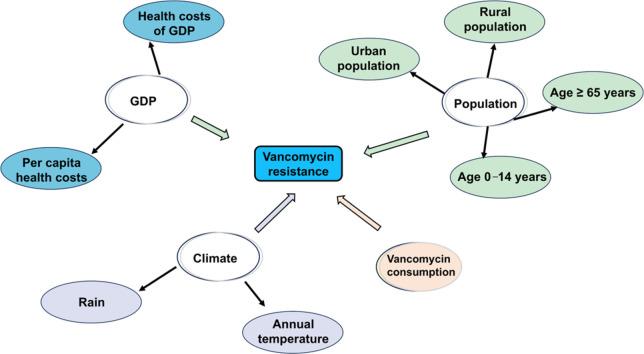
Spearman's rank correlation described the positive relation between vancomycin consumption and the prevalence of vancomycin resistant (VRE). Multiple regression analysis showed that vancomycin consumption, rural population, proportion of population aged ≥65, annual temperature, and bed number in medical institutions per thousand people were significantly correlated with VRE prevalence ( = 56.22, < 0.001; = 0.0002, < 0.001; = 0.06, < 0.001; = -0.07, < 0.001; and = -0.37, < 0.001, respectively).
CONCLUSIONS
Vancomycin utilization was the predominant factor contributing to VRE resistance; the effects of rural populations and the proportion of the population aged ≥ 65 were significant but relatively minimal. Annual temperature and the number of beds in medical institutions per thousand people were protective factors against VRE.
背景
耐万古霉素肠球菌(VRE)现已被视为一个全球公共卫生问题。在本研究中,我们探讨了万古霉素耐药发生率与各种人口统计学和气候因素之间的关系。
方法
本回顾性研究于2014年1月1日至2021年12月31日进行。收集了有关万古霉素使用量、万古霉素耐药率及相关人口统计学数据。使用R 4.2.2版本和ArcGIS 10.7版本进行斯皮尔曼等级相关分析、β回归分析和空间统计分析。
结果
斯皮尔曼等级相关分析表明万古霉素使用量与耐万古霉素肠球菌(VRE)的流行率呈正相关。多元回归分析显示,万古霉素使用量、农村人口、65岁及以上人口比例、年平均气温以及每千人医疗机构床位数与VRE流行率显著相关(分别为 = 56.22, < 0.001; = 0.0002, < 0.001; = 0.06, < 0.001; = -0.07, < 0.001; = -0.37, < 0.001)。
结论
万古霉素的使用是导致VRE耐药的主要因素;农村人口和65岁及以上人口比例的影响显著但相对较小。年平均气温和每千人医疗机构床位数是预防VRE的保护因素。


 Zotero 插件