
近期接受前列腺特异性抗原筛查的70岁男性的前列腺癌死亡率
Prostate Cancer Mortality in Men Aged 70 Years Who Recently Underwent Prostate-Specific Antigen Screening.
作者信息
Chung Dana H, Caverly Tanner J, Schipper Matthew J, Hofer Timothy P, Gulati Roman, Rose Brent S, Caram Megan E V, Tsao Phoebe A, Stensland Kristian D, Elliott David, Saini Sameer D, Bryant Alex K
机构信息
University of Michigan Medical School, Ann Arbor.
Veterans Affairs Center for Clinical Management Research, Ann Arbor, Michigan.
出版信息
JAMA Netw Open. 2025 Feb 3;8(2):e2459766. doi: 10.1001/jamanetworkopen.2024.59766.
IMPORTANCE
Continuing prostate-specific antigen (PSA) screening after age 70 years might benefit men at high risk of prostate cancer-specific mortality (PCSM) or metastatic prostate cancer (mPCa), but the relative value of clinical factors (race and ethnicity, competing mortality, and PSA history) in identifying men at higher vs lower risk is unknown.
OBJECTIVE
To examine the value of PSA levels, race and ethnicity, and competing mortality in risk stratification for PCSM and mPCa in men after age 70 years.
DESIGN, SETTING, AND PARTICIPANTS: In this cohort study, clinical data of all men receiving health care through the Veterans Health Administration who turned age 70 years between 2008 and 2020 and had a normal screening PSA value between age 65 and 69 years (<4 ng/mL [baseline PSA]) and no prior history of prostate cancer or biopsy were examined. The data cutoff date was December 26, 2023.
EXPOSURE
The most recent screening PSA value from age 65 to 69 years, self-reported race and ethnicity, and competing mortality risk derived from a machine learning model.
MAIN OUTCOME AND MEASURES
The 10-year absolute risk of PCSM and mPCa were determined using regression modeling.
RESULTS
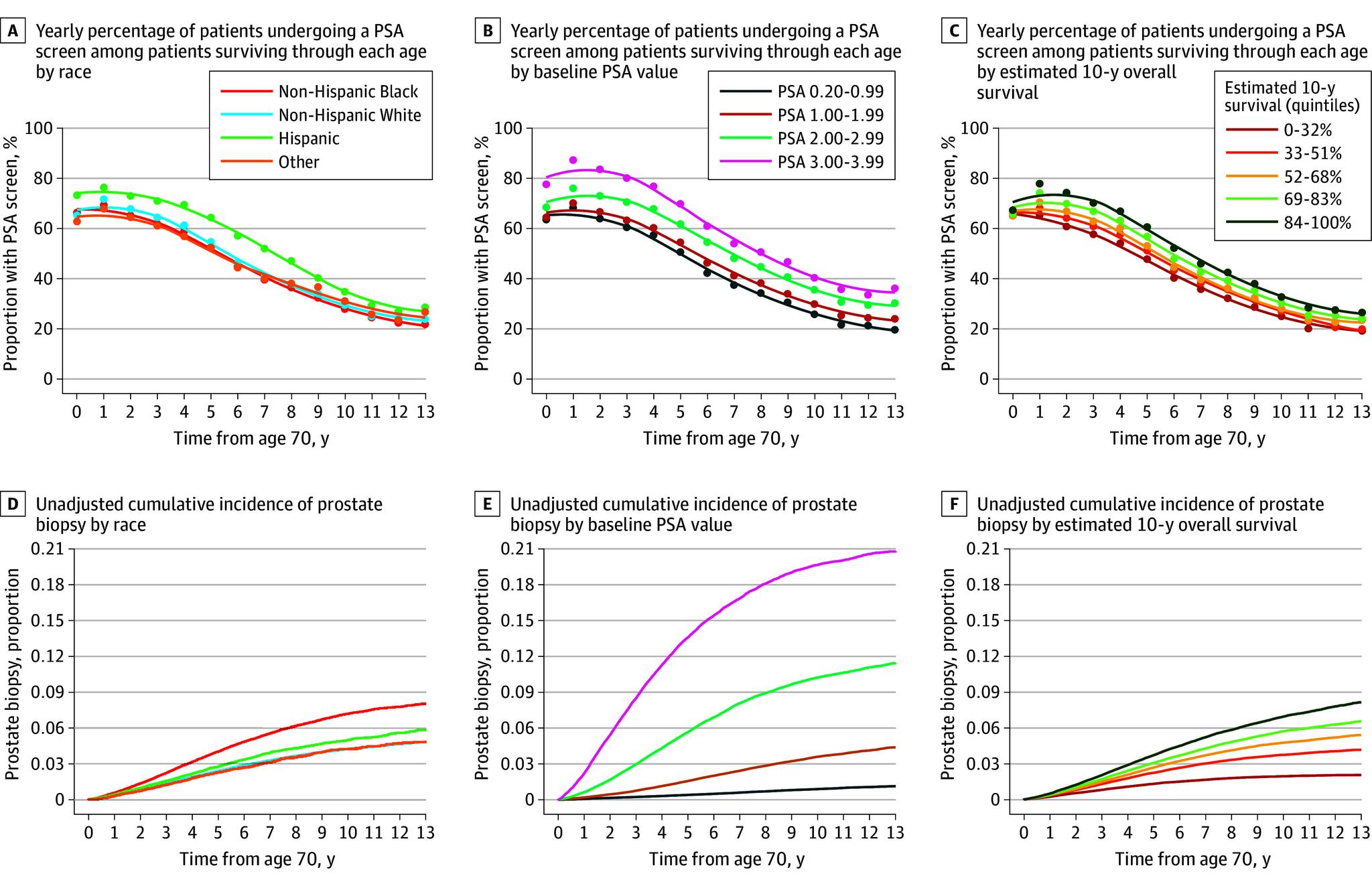
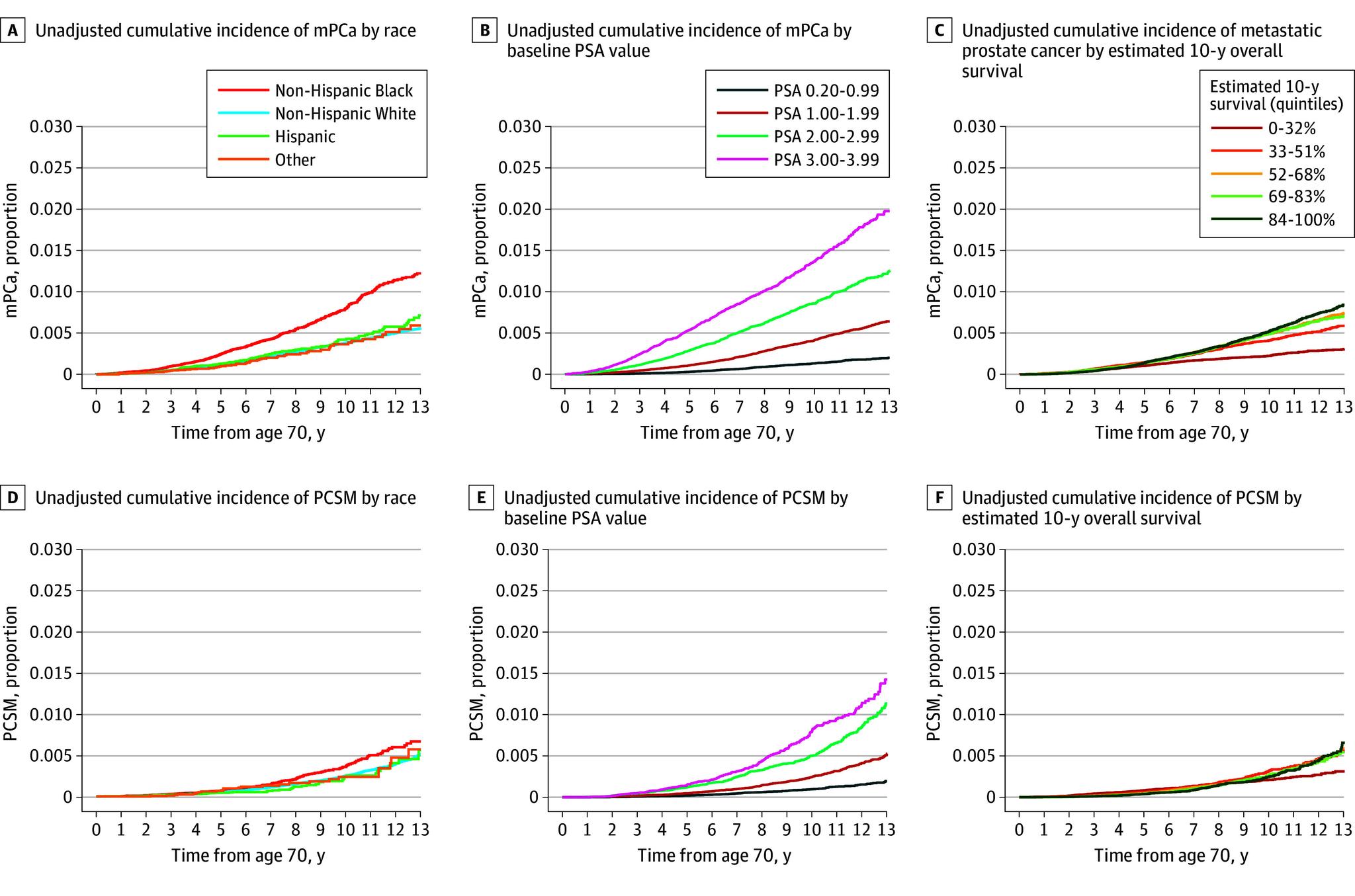
The cohort included 921 609 men who turned 70 years between 2008 and 2020; 11% of whom self-reported as Black and 82% as White race. Between age 65 and 70 years, 45% of patients had a baseline PSA of less than 1.00 ng/mL, and 32% had a baseline PSA of 1.00 to 1.99 ng/mL. Most patients (87%) continued to undergo screening past age 70 years, with little variation by competing mortality risk or race and ethnicity. The 10-year cumulative incidence of PCSM was 0.26% overall, and 95% of men had a 10-year risk less than 0.73%. Higher baseline PSA level between age 65 and 69 years was associated with 10-year PCSM risk (0.79% for 3.00-3.99 ng/mL vs 0.10% for 0.20-0.99 ng/mL), race and ethnicity (0.36% for Black vs 0.25% for White), and competing mortality (0.24% for the highest quintile vs 0.21% for the lowest quintile). Similar results were found for mPCa. Low PSA (0.20-0.99 ng/mL) was associated with very low PCSM and mPCa risk, even among Black men in the healthiest quintile of competing mortality risk (10-year PCSM risk, 0.08% [95% CI, 0.01%-0.44%]; 10-year mPCa risk 0.24% [95% CI, 0.10%-0.52%]).
CONCLUSIONS AND RELEVANCE
In this cohort study, the findings suggest that most men receiving care through the VHA continue PSA screening after age 70 years despite low absolute 10-year PCSM risks. The PSA values from age 65 to 69 years may be highly informative for adverse prostate cancer outcomes after age 70 years, with a PSA less than 1 ng/mL associated with a very low risk of long-term PCSM and mPCa.
重要性
70岁后继续进行前列腺特异性抗原(PSA)筛查可能使前列腺癌特异性死亡(PCSM)或转移性前列腺癌(mPCa)高风险男性受益,但临床因素(种族和民族、竞争性死亡风险以及PSA病史)在识别高风险与低风险男性中的相对价值尚不清楚。
目的
探讨PSA水平、种族和民族以及竞争性死亡风险在70岁以上男性PCSM和mPCa风险分层中的价值。
设计、设置和参与者:在这项队列研究中,对2008年至2020年间年满70岁、65至69岁时筛查PSA值正常(<4 ng/mL[基线PSA])且无前列腺癌或活检病史、通过退伍军人健康管理局接受医疗保健的所有男性的临床数据进行了检查。数据截止日期为2023年12月26日。
暴露因素
65至69岁时最近的筛查PSA值、自我报告的种族和民族以及通过机器学习模型得出的竞争性死亡风险。
主要结局和指标
使用回归模型确定PCSM和mPCa的10年绝对风险。
结果
该队列包括921609名2008年至2020年间年满70岁的男性;其中11%自我报告为黑人,82%为白人。在65至70岁之间,45%的患者基线PSA低于1.00 ng/mL,32%的患者基线PSA为1.00至1.99 ng/mL。大多数患者(87%)在70岁后继续接受筛查,竞争性死亡风险或种族和民族之间差异不大。PCSM的10年累积发病率总体为0.26%,95%的男性10年风险低于0.73%。65至69岁之间较高的基线PSA水平与10年PCSM风险相关(3.00 - 3.99 ng/mL时为0.79%,0.20 - 0.99 ng/mL时为0.10%)、种族和民族相关(黑人中为0.36%,白人中为0.25%)以及竞争性死亡风险相关(最高五分位数时为0.24%,最低五分位数时为0.21%)。mPCa也有类似结果。低PSA(0.20 - 0.99 ng/mL)与非常低的PCSM和mPCa风险相关,即使在竞争性死亡风险最健康五分位数的黑人男性中也是如此(10年PCSM风险,0.08%[95%CI,0.01% - 0.44%];10年mPCa风险0.24%[95%CI,0.10% - 0.52%])。
结论及意义
在这项队列研究中,研究结果表明,尽管10年PCSM绝对风险较低,但大多数通过退伍军人健康管理局接受治疗的男性在70岁后仍继续进行PSA筛查。65至69岁时的PSA值对于70岁后的不良前列腺癌结局可能具有高度参考价值,PSA低于1 ng/mL与长期PCSM和mPCa的极低风险相关。


 Zotero 插件