
尽管糖基酶表达相同,但IgA仍表现出位点和亚类特异性糖型差异。
IgA displays site- and subclass-specific glycoform differences despite equal glycoenzyme expression.
作者信息
Falck David, Sokolova Maria V, Koeleman Carolien A M, Irumva Vanessa, Kirchner Philipp, Schulz Sebastian R, Schmidt Katja G, Harrer Thomas, Ekici Arif B, Spriewald Bernd, Schett Georg, Wuhrer Manfred, Herrmann Martin, Steffen Ulrike
机构信息
Center for Proteomics and Metabolomics, Glycomics and Clinical Proteomics Group, Leiden University Medical Center, Leiden, Netherlands.
Department of Internal Medicine 3 - Rheumatology and Immunology, Friedrich-Alexander-Universität Erlangen-Nürnberg and Uniklinikum Erlangen, Erlangen, Germany.
出版信息
Cell Commun Signal. 2025 Feb 17;23(1):92. doi: 10.1186/s12964-025-02088-0.
BACKGROUND
Glycosylation is an important posttranslational modification of proteins and in most cases indispensable for proper protein function. Like most soluble proteins, IgA, the second most prevalent antibody in human serum, contains several N- and O-glycosylation sites. While for IgG the impact of Fc glycosylation on effector functions and inflammatory potential has been studied intensively, only little is known for IgA. In addition, only glimpses exist regarding the regulation of IgA glycosylation. We have previously shown that IgA1 and IgA2 differ functionally and also show differences in their glycosylation pattern. The more pro-inflammatory IgA2 which is linked to autoimmune diseases displays decreased sialylation, galactosylation, fucosylation and bisection as compared to IgA1. In the present study, we aimed to investigate these differences in glycosylation in detail and to explore the mechanisms underlying them.
METHODS
IgA1 and IgA2 was isolated from serum of 12 healthy donors. Site specific glycosylation was analyzed by mass spectrometry. In addition, human bone marrow plasma cells were investigated using single cell mRNA sequencing, flow cytometry and ELISpot.
RESULTS
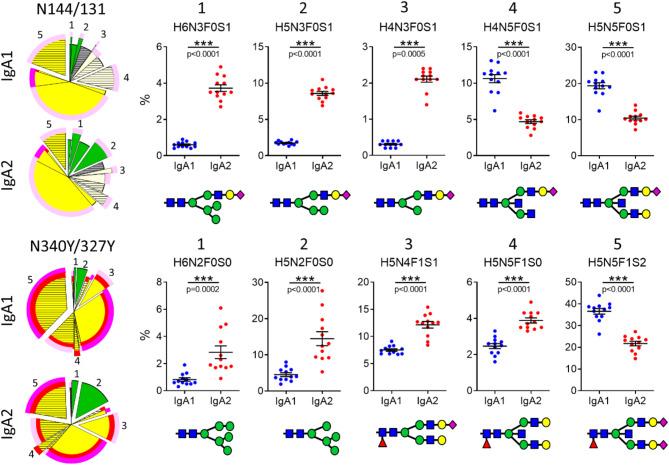
We found that certain glycoforms greatly differ in their abundance between IgA1 and IgA2 while others are equally abundant. Overall, the IgA2 glycans displayed a more immature phenotype with a higher prevalence of oligomannose and fewer fully processed glycans. Of note, these differences can't be explained by differences in the glycosylation enzyme machinery as mRNA sequencing and flow cytometry analysis showed equal enzyme expression in IgA1 and IgA2 producing plasma cells. ELISpot analysis suggested a slightly increased antibody production rate in IgA2 producing plasma cells which might contribute to its lower glycan processing rates. But this difference was only minor, suggesting that further factors such as steric accessibility determine glycan processing. This is supported by the fact that glycans at different positions on the same IgA chain differ dramatically in fucosylation, sialylation and bisection.
CONCLUSION
In summary, our detailed overview of IgA1 and IgA2 glycosylation shows a class, subclass, and site-specific glycosylation fingerprint, most likely due to structural differences of the protein backbones.
背景
糖基化是蛋白质重要的翻译后修饰,在大多数情况下对于蛋白质的正常功能不可或缺。与大多数可溶性蛋白质一样,人血清中第二常见的抗体IgA含有多个N-糖基化位点和O-糖基化位点。虽然针对IgG,Fc糖基化对效应功能和炎症潜能的影响已得到深入研究,但对于IgA却知之甚少。此外,关于IgA糖基化的调控也仅有一些初步了解。我们之前已经表明,IgA1和IgA2在功能上存在差异,其糖基化模式也有所不同。与自身免疫性疾病相关的促炎作用更强的IgA2,与IgA1相比,其唾液酸化、半乳糖基化、岩藻糖基化和二分作用均有所降低。在本研究中,我们旨在详细研究这些糖基化差异,并探索其潜在机制。
方法
从12名健康供体的血清中分离出IgA1和IgA2。通过质谱分析位点特异性糖基化。此外,使用单细胞mRNA测序、流式细胞术和酶联免疫斑点法对人骨髓浆细胞进行研究。
结果
我们发现,某些糖型在IgA1和IgA2之间的丰度差异很大,而其他糖型则同样丰富。总体而言,IgA2聚糖表现出更不成熟的表型,寡甘露糖的患病率更高,完全加工的聚糖更少。值得注意的是,这些差异无法用糖基化酶机制的差异来解释,因为mRNA测序和流式细胞术分析表明,产生IgA1和IgA2的浆细胞中酶表达相同。酶联免疫斑点法分析表明,产生IgA2的浆细胞中抗体产生率略有增加,这可能导致其聚糖加工率较低。但这种差异很小,表明诸如空间可及性等其他因素决定了聚糖加工。同一IgA链上不同位置的聚糖在岩藻糖基化、唾液酸化和二分作用方面存在显著差异,这一事实支持了这一点。
结论
总之,我们对IgA1和IgA2糖基化的详细概述显示出一种类别、亚类和位点特异性的糖基化指纹,很可能是由于蛋白质骨架的结构差异所致。


 Zotero 插件