
肾功能损害对二尖瓣经导管缘对缘修复术后临床结局的影响。
Effect of Renal Impairment on Clinical Outcomes After Mitral Valve Transcatheter Edge-to-Edge Repair.
作者信息
Tanaka Kazuki, Yamaguchi Junichi, Yoshikawa Masafumi, Shibahashi Eiji, Otsuki Hisao, Kawamoto Takanori, Koyanagi Chihiro, Inagaki Yusuke, Kogure Tomohito, Yamamoto Masanori, Saji Mike, Asami Masahiko, Nakashima Masaki, Enta Yusuke, Shirai Shinichi, Izumo Masaki, Mizuno Shingo, Watanabe Yusuke, Amaki Makoto, Kodama Kazuhisa, Kubo Shunsuke, Nakajima Yoshifumi, Naganuma Toru, Bota Hiroki, Ohno Yohei, Yamawaki Masahiro, Ueno Hiroshi, Mizutani Kazuki, Otsuka Toshiaki, Hayashida Kentaro
机构信息
Department of Cardiology Tokyo Woman's Medical University, Tokyo, Japan.
Department of Cardiology Tokyo Woman's Medical University, Tokyo, Japan.
出版信息
JACC Asia. 2025 Feb;5(2):273-282. doi: 10.1016/j.jacasi.2024.10.025. Epub 2025 Jan 14.
BACKGROUND
Renal impairment is associated with poor clinical outcomes in patients with cardiovascular diseases. Some studies have revealed the impact of renal impairment on the clinical outcomes of patients who underwent mitral valve transcatheter edge-to-edge repair (M-TEER). However, limited data are available regarding the impact of baseline renal impairment after M-TEER in Asian-Pacific patients with heart failure and severe mitral regurgitation.
OBJECTIVES
This study sought to examine the effect of renal impairment on clinical outcomes after M-TEER using a large-scale nationwide registry in Japan.
METHODS
A total of 2,150 patients enrolled in the OCEAN-Mitral (Optimized Catheter Valvular Intervention) registry were divided into 3 groups according to the estimated glomerular filtration rate (eGFR) before M-TEER: normal eGFR (≥60 mL/min/1.73 m) (n = 291), renal impairment (<60 mL/min/1.73 m) (n = 1,746), and dialysis (n = 113). The impact of renal impairment and dialysis on major adverse cardiovascular events (MACE) (a composite of all-cause death and hospitalization for heart failure) was examined.
RESULTS
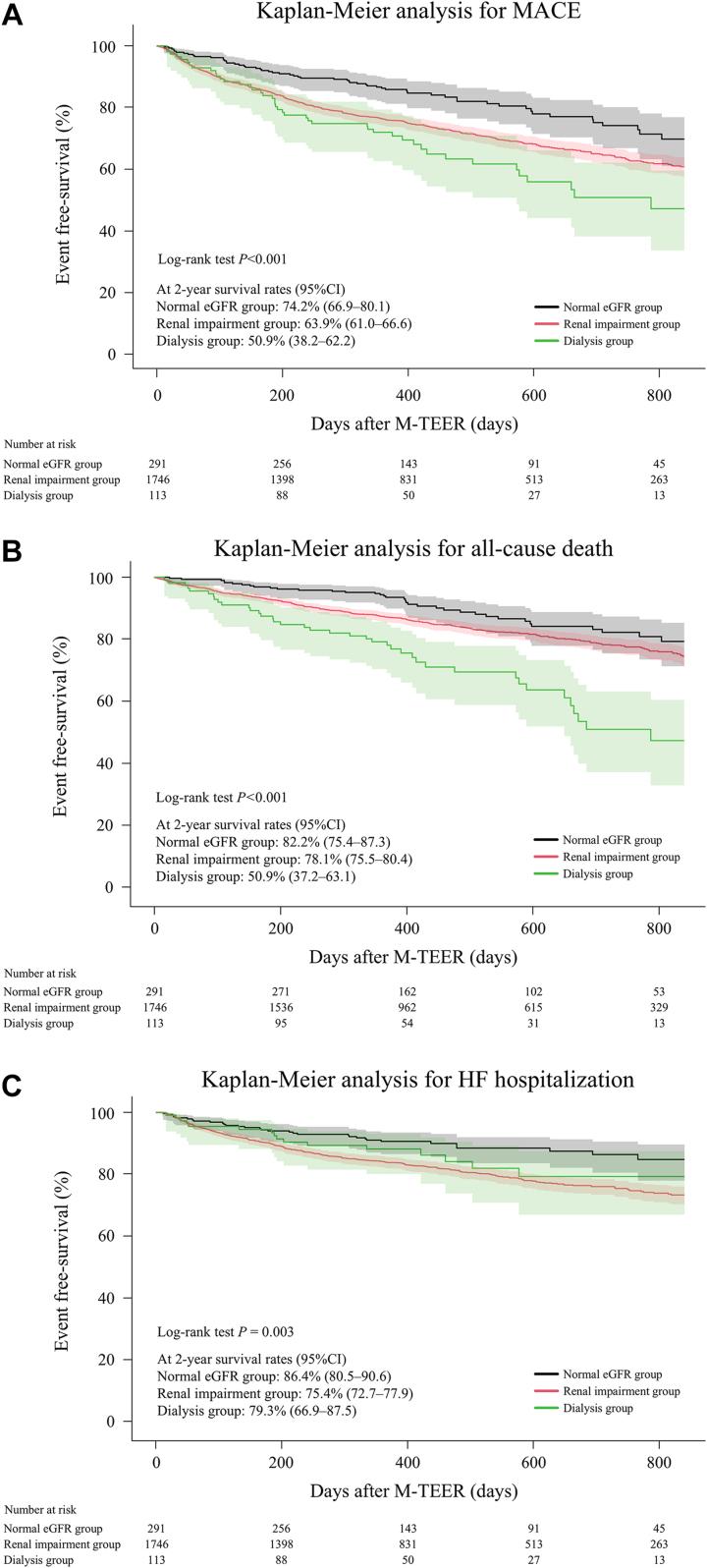
Kaplan-Meier analysis revealed that the renal impairment and dialysis groups had a significantly higher incidence of MACE (survival rates at 2 years: normal eGFR, 74.2% [95% CI: 66.9%-80.1%] vs renal impairment, 63.9% [95% CI: 61.0%-66.6%] vs dialysis, 50.9% [95% CI: 38.2%-62.2%]; P < 0.001). Multivariate Cox regression analysis identified dialysis as the strongest independent predictor of MACE (HR: 1.95; 95% CI: 1.33-2.85; P < 0.001).
CONCLUSIONS
Renal impairment was associated with an increased incidence of major adverse events, and dialysis was the strongest independent predictor of poor clinical outcomes after M-TEER in Asian-Pacific patients.
背景
肾功能损害与心血管疾病患者的不良临床结局相关。一些研究揭示了肾功能损害对接受二尖瓣经导管缘对缘修复术(M-TEER)患者临床结局的影响。然而,关于亚太地区心力衰竭合并严重二尖瓣反流患者M-TEER术后基线肾功能损害的影响,现有数据有限。
目的
本研究旨在利用日本一项大规模全国性注册研究,探讨肾功能损害对M-TEER术后临床结局的影响。
方法
共有2150例纳入OCEAN-Mitral(优化导管瓣膜干预)注册研究的患者,根据M-TEER术前估计肾小球滤过率(eGFR)分为3组:eGFR正常(≥60 mL/min/1.73 m²)(n = 291)、肾功能损害(<60 mL/min/1.73 m²)(n = 1746)和透析(n = 113)。研究了肾功能损害和透析对主要不良心血管事件(MACE,全因死亡和心力衰竭住院的复合事件)的影响。
结果
Kaplan-Meier分析显示,肾功能损害组和透析组MACE发生率显著更高(2年生存率:eGFR正常组为74.2% [95%CI:66.9%-80.1%],肾功能损害组为63.9% [95%CI:61.0%-66.6%],透析组为50.9% [95%CI:38.2%-62.2%];P < 0.001)。多因素Cox回归分析确定透析是MACE最强的独立预测因素(HR:1.95;95%CI:1.33-2.85;P < 0.001)。
结论
肾功能损害与主要不良事件发生率增加相关,透析是亚太地区患者M-TEER术后不良临床结局最强的独立预测因素。


 Zotero 插件