
寻求刺激与风险调整:奖励敏感性在动态风险决策中的作用。
Sensation seeking and risk adjustment: the role of reward sensitivity in dynamic risky decisions.
作者信息
Qianlan Yin, Shou Chen, Tianya Hou, Wei Dong, Liu Taosheng
机构信息
Faculty of Psychology and Mental Health, Naval Medical University, Shanghai, China.
出版信息
Front Behav Neurosci. 2025 Feb 7;19:1492312. doi: 10.3389/fnbeh.2025.1492312. eCollection 2025.
OBJECTIVE
The primary objective of our research is to delve into the relationships between sensation seeking (SS), reward sensitivity (RS), and risk adjustment (RA) within the context of dynamic risk-taking behaviors. By integrating the reinforcement learning model and neural measures obtained from dynamic risk-taking tasks, we aim to explore how these personality traits influence individual decision-making processes and engagement in risk-related activities. We aim to dissect the neural and cognitive mechanisms underlying this interplay, thereby shedding light on the stable brain-based characteristics contributing to the observed variability in risk-taking and decision-making behaviors. Understanding these links could significantly enhance our ability to predict individual differences in risk preferences and develop targeted interventions for managing risky behaviors across different contexts.
METHOD
We developed a task to measure RA through a structured yet uncertain environment modeled after the Balloon Analog Risk Task. We enlisted 80 young adults to perform this task, and of these, 40 were subjected to electroencephalography (EEG) to assess neural correlates of RS. Subsequently, we analyzed event-related potentials and spectral perturbations to discern neural distinctions related to RS. We compared these distinctions concerning RA among participants exhibiting different levels of SS.
RESULTS
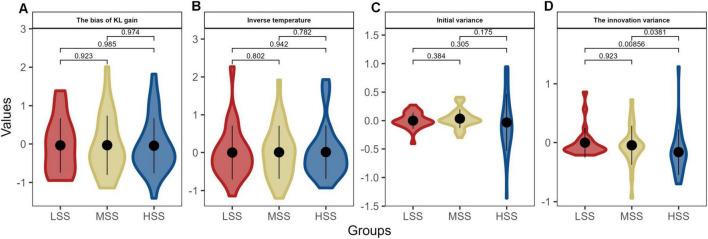
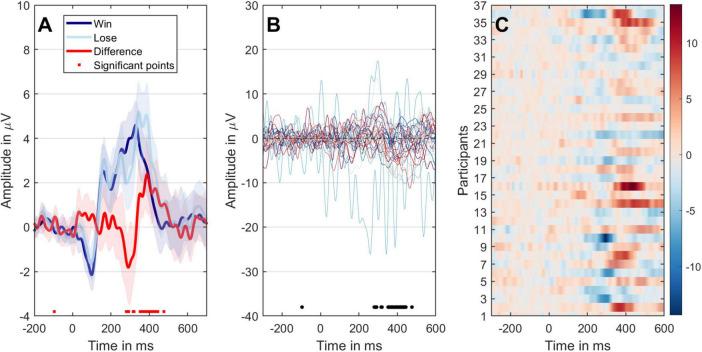
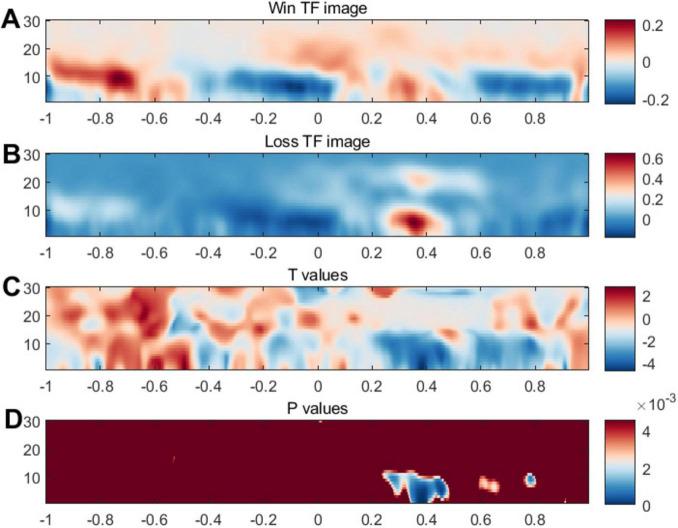
Individuals exhibiting higher levels of SS (HSS) in the study displayed a tendency to disregard past risks, potentially resulting in diminished behavioral adaptability. EEG results indicated that individuals with HSS exhibited reduced neural responses to feedback compared to those with low SS, potentially affecting their feedback processing and decision-making. Moreover, the comparison of effects underscores the significant impact of RS and SS on shaping RA during dynamic decision-making scenarios.
CONCLUSION
This study has advanced the understanding of how SS and RS influence RA, revealing that RS prompts RA, while individuals with HSS often exhibit blunted RS, leading to worse RA. Future research should focus on the specific aspects of HSS and their implications for decision-making across different risk contexts. Employing advanced neuroimaging and cognitive modeling techniques will be pivotal in unraveling the neural mechanisms driving these individual differences in risky behavior.
目的
我们研究的主要目的是深入探究在动态冒险行为背景下,寻求刺激(SS)、奖励敏感性(RS)和风险调整(RA)之间的关系。通过整合强化学习模型和从动态冒险任务中获得的神经测量数据,我们旨在探索这些人格特质如何影响个体决策过程以及参与与风险相关活动的情况。我们旨在剖析这种相互作用背后的神经和认知机制,从而揭示导致观察到的冒险和决策行为差异的基于大脑的稳定特征。理解这些联系可以显著提高我们预测个体风险偏好差异的能力,并针对不同情境下的冒险行为制定有针对性的干预措施。
方法
我们开发了一项任务,通过模仿气球模拟风险任务构建一个结构化但不确定的环境来测量RA。我们招募了80名年轻成年人来执行此任务,其中40人接受了脑电图(EEG)检查以评估RS的神经相关性。随后,我们分析了事件相关电位和频谱扰动,以辨别与RS相关的神经差异。我们比较了在表现出不同水平SS的参与者中与RA有关的这些差异。
结果
在该研究中表现出较高水平SS(HSS)的个体表现出忽视过去风险的倾向,这可能导致行为适应性降低。EEG结果表明,与低SS个体相比,HSS个体对反馈的神经反应减少,这可能会影响他们的反馈处理和决策。此外,效应比较强调了在动态决策场景中RS和SS对塑造RA的重大影响。
结论
本研究推进了对SS和RS如何影响RA的理解,揭示了RS促使RA,而HSS个体通常表现出迟钝的RS,导致较差的RA。未来的研究应关注HSS的具体方面及其对不同风险情境下决策的影响。采用先进的神经成像和认知建模技术对于揭示驱动这些冒险行为个体差异的神经机制至关重要。


 Zotero 插件