
马格里布东部新石器时期觅食者血统的高度连续性。
High continuity of forager ancestry in the Neolithic period of the eastern Maghreb.
作者信息
Lipson Mark, Ringbauer Harald, Lucarini Giulio, Aouadi Nabiha, Aoudia Louiza, Belhouchet Lotfi, Cheronet Olivia, Dahmani Ariane-Rym, Genchi Francesco, La Pastina Francesco, Lucci Michaela, de Lumley Henry, Mansouri Nabila, Nava Alessia, Touj Fatma, Mallick Swapan, Rohland Nadin, Coppa Alfredo, Pinhasi Ron, Reich David
机构信息
Department of Human Evolutionary Biology, Harvard University, Cambridge, MA, USA.
Department of Archaeogenetics, Max Planck Institute for Evolutionary Anthropology, Leipzig, Germany.
出版信息
Nature. 2025 May;641(8064):925-931. doi: 10.1038/s41586-025-08699-4. Epub 2025 Mar 12.
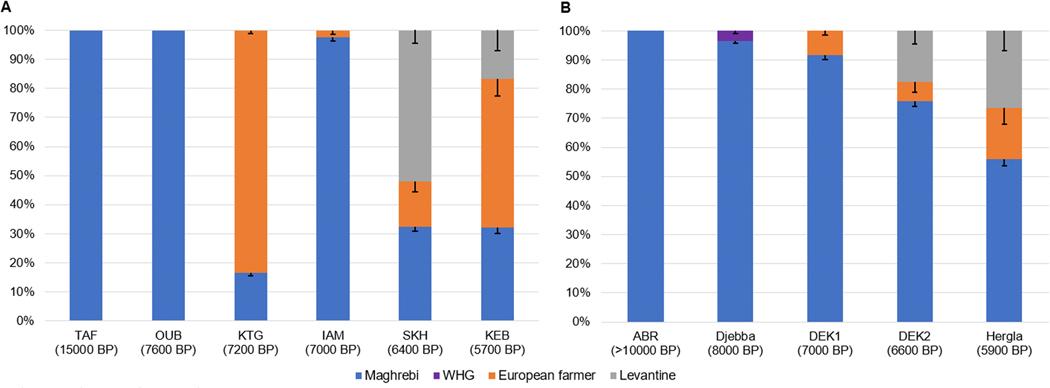
Ancient DNA from the Mediterranean region has revealed long-range connections and population transformations associated with the spread of food-producing economies. However, in contrast to Europe, genetic data from this key transition in northern Africa are limited, and have only been available from the far western Maghreb (Morocco). Here we present genome-wide data for nine individuals from the Later Stone Age through the Neolithic period from Algeria and Tunisia. The earliest individuals cluster with pre-Neolithic people of the western Maghreb (around 15,000-7,600 years before present (BP)), showing that this 'Maghrebi' ancestry profile had a substantial geographic and temporal extent. At least one individual from Djebba (Tunisia), dating to around 8,000 years BP, harboured ancestry from European hunter-gatherers, probably reflecting movement in the Early Holocene across the Strait of Sicily. Later Neolithic people from the eastern Maghreb retained largely local forager ancestry, together with smaller contributions from European farmers (by around 7,000 years BP) and Levantine groups (by around 6,800 years BP), and were thus far less impacted by external gene flow than were populations in other parts of the Neolithic Mediterranean.
来自地中海地区的古代DNA揭示了与粮食生产经济传播相关的远距离联系和人口转变。然而,与欧洲不同的是,来自北非这一关键转型期的基因数据有限,且仅来自遥远的马格里布西部地区(摩洛哥)。在此,我们展示了来自阿尔及利亚和突尼斯的9个个体从旧石器时代晚期到新石器时代的全基因组数据。最早的个体与马格里布西部的新石器时代前人群聚类(距今约15000 - 7600年),这表明这种“马格里布”祖先谱系具有相当大的地理和时间范围。来自杰巴(突尼斯)的至少一个个体,可追溯到距今约8000年,拥有欧洲狩猎采集者的血统,这可能反映了全新世早期人们穿越西西里海峡的迁徙。来自马格里布东部的新石器时代晚期人群在很大程度上保留了当地觅食者的血统,同时有来自欧洲农民(约距今7000年)和黎凡特群体(约距今6800年)的少量血统贡献,因此与新石器时代地中海其他地区的人群相比,受外部基因流动的影响要小得多。




 Zotero 插件