
通过免疫组化生物标志物对三阴性乳腺癌进行分子分型和靶点鉴定。
Molecular subtyping and target identification in triple negative breast cancer through immunohistochemistry biomarkers.
作者信息
Bouzid Rima Saad, Bouzid Radhia, Labed Housna, Serhani Iman, Hellal Dounia, Oumeddour Leilia, Boudhiaf Ines, Ibrir Massouda, Khadraoui Hachani, Belaaloui Ghania
机构信息
Laboratory of Acquired and Constitutional Genetic Diseases (MAGECA), Faculty of Medicine, University of Batna 2, 05000, Batna, Algeria.
Department of Biology of Organisms, Faculty of Natural and Life Sciences, University of Batna 2, 05000, Batna, Algeria.
出版信息
BMC Cancer. 2025 Mar 13;25(1):454. doi: 10.1186/s12885-025-13832-7.
BACKGROUND
The Triple-Negative Breast Cancer (TNBC) molecular subtyping and target identification based on Immunohistochemistry (IHC) is of considerable worth for routine use. Yet, literature on this topic is limited worldwide and needs to be enriched with data from different populations.
METHODS
We assessed the IHC expression of subtyping biomarkers (Cytokeratins 5, 14 and 17, Epidermal Growth Factor Receptor, Claudins 3 and 7, E-cadherin, Vimentin and Androgen receptor) and predictive biomarkers (Tumor-infiltrating lymphocytes (TILs) density, Breast Cancer Antigen 1 (BRCA1) and P53) in a cohort of TNBC patients. Clinicopathologic parameters and overall survival (OS) were investigated as well.
RESULTS
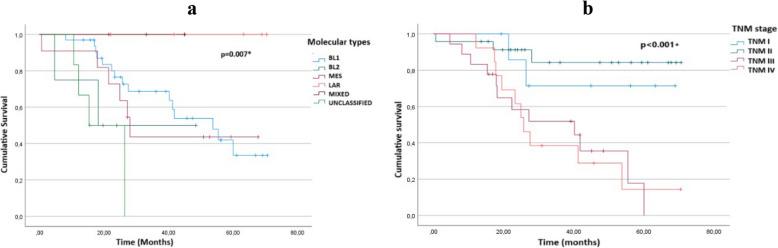
The patients were aged 50.11 ± 12.13y (more than 40y in 76.56% of patients), and 23.44% had a BC family history. They were in a non-advanced stage: 51.6% T2 stage, 56.2% negative lymph node involvement, 76.6% without metastasis and 64.1% grade II Scarff-Bloom-Richardson classification (SBR). The IHC subtypes were: 53.1% Basal-like1 (BL1), 6.3% Basal-like2 (BL2), 17.2% Mesenchymal (MES), 9.4% Luminal Androgen Receptor (LAR), 4.7% Mixed subtype and 9.4% "Unclassified" type. The LAR subtype involved the youngest patients (40.17 ± 8.68y, p = 0.02). The "Unclassified" subtype expressed the p53 mutated-type pattern more frequently (100%, p = 0.07). The BRCA1 mutated pattern and TILs infiltration were present in (23.44% and 37.5% of patients, respectively). The OS of the subtypes differed significantly (p = 0.007, log-rank test). The subtypes median OS were, respectively, 15.47 mo. (Unclassified), 18.94 mo. (BL2), 27.23 mo. (MES), 27.28 mo. (Mixed), 30.88 mo. (BL1), and 45.07 mo. (LAR). There was no difference in the OS following age, BRCA1 expression, p53 pattern and TILs density. Though, the OS following the TNM stage was different (p = 0.001). A multivariable Cox proportional hazards regression analysis showed that TNM staging and TNBC subtypes, independently influence the OS (p < 0.001 and p = 0.017, respectively). Hence, IHC is useful in TNBC subtyping for prognostic purposes and in the identification of therapeutic biomarkers. Further investigation is required to confirm our results and to implement IHC as a routine tool to improve patient's care.
背景
基于免疫组织化学(IHC)的三阴性乳腺癌(TNBC)分子亚型分类及靶点识别在常规应用中具有重要价值。然而,全球范围内关于该主题的文献有限,需要纳入来自不同人群的数据以丰富相关内容。
方法
我们评估了TNBC患者队列中各亚型生物标志物(细胞角蛋白5、14和17、表皮生长因子受体、紧密连接蛋白3和7、E-钙黏蛋白、波形蛋白和雄激素受体)以及预测性生物标志物(肿瘤浸润淋巴细胞(TILs)密度、乳腺癌抗原1(BRCA1)和P53)的IHC表达情况。同时还研究了临床病理参数和总生存期(OS)。
结果
患者年龄为50.11±12.13岁(76.56%的患者年龄超过40岁),23.44%有乳腺癌家族史。患者处于非晚期:51.6%为T2期,56.2%淋巴结阴性,76.6%无转移,64.1%为斯卡夫-布卢姆-理查森分类(SBR)二级。IHC亚型分类为:53.1%基底样1型(BL1),6.3%基底样2型(BL2),17.2%间充质型(MES),9.4%腔面雄激素受体型(LAR),4.7%混合型,9.4%“未分类”型。LAR亚型患者最年轻(40.17±8.68岁,p = 0.02)。“未分类”亚型更频繁地表达p53突变型模式(100%,p = 0.07)。BRCA1突变模式和TILs浸润分别出现在23.44%和37.5%的患者中。各亚型的OS有显著差异(p = 0.007,对数秩检验)。各亚型的OS中位数分别为:15.47个月(未分类),18.94个月(BL2),27.23个月(MES),27.28个月(混合型),30.88个月(BL1),45.07个月(LAR)。年龄、BRCA1表达、p53模式和TILs密度对OS无差异。然而,TNM分期对OS有差异(p = 0.001)。多变量Cox比例风险回归分析表明,TNM分期和TNBC亚型分别独立影响OS(分别为p < 0.001和p = 0.017)。因此,IHC对于TNBC亚型分类的预后评估以及治疗生物标志物的识别是有用的。需要进一步研究以证实我们的结果,并将IHC作为改善患者护理的常规工具加以应用。
 Zotero 插件