
人背根神经节中泰勒细胞的转录组学和组织学特征
Transcriptomic and Histological Characterization of Telocytes in the Human Dorsal Root Ganglion.
作者信息
Haberberger Rainer V, Matusica Dusan, Shiers Stephanie, Sankaranarayanan Ishwarya, Price Theodore J
机构信息
Department of Anatomy and Pathology, School of Biomedicine, The University of Adelaide, Adelaide, Australia.
Anatomy, Histology & Pathology, College of Medicine and Public Health, Flinders University, Adelaide, Australia.
出版信息
J Comp Neurol. 2025 Mar;533(3):e70044. doi: 10.1002/cne.70044.
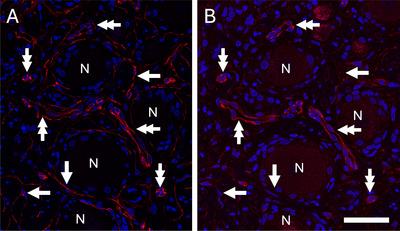
Telocytes are interstitial cells characterized by long processes that span considerable distances within tissues, likely facilitating coordination and interaction with various cell types. Although present in central and peripheral neuronal tissues, their role remains elusive. Dorsal root ganglia (DRG) house pseudounipolar afferent neurons responsible for transmitting signals related to temperature, proprioception, and nociception. This study aimed to investigate the presence and function of telocytes in human DRG by examining their transcriptional profile, anatomical location, and ultrastructure. Combined expression of CD34 and PDGFRA is a marker gene set for telocytes, and our sequencing data revealed CD34 and PDGFRA expressing cells comprise roughly 1.5%-3% of DRG cells. Combined expression of CD34 and PDGFRA is a putative marker gene set for telocytes. Further analysis identified nine subclusters with enriched cluster-specific genes. Kyoto Encyclopedia of Genes and Genomes (KEGG) and Gene Ontology (GO) pathway analysis suggested vascular, immune, and connective tissue-associated putative telocyte subtypes, mapping over 3000 potential receptor-ligand interactions between sensory neurons and these CD34 and PDGFRA expressing putative telocytes were identified using a ligand-receptors interactome platform. Immunohistochemistry identified CD34+ve telocytes in the endoneural space of DRGs, next to neuron-satellite complexes, in perivascular spaces and in the endoneural space between nerve fiber bundles, consistent with pathway analysis. Transmission electron microscopy (TEM) confirmed their location identifying characteristic elongated nucleus, long and thin telopodes containing vesicles, often surrounded by a basal lamina. This study provides the first gene expression analysis of telocytes in complex human tissue, specifically the DRG, highlighting functional differences based on tissue location while revealing no significant ultrastructural variations.
端细胞是一种间质细胞,其特征在于具有长的突起,这些突起在组织内跨越相当长的距离,可能有助于与各种细胞类型进行协调和相互作用。尽管它们存在于中枢和外周神经组织中,但其作用仍不清楚。背根神经节(DRG)包含假单极传入神经元,负责传递与温度、本体感觉和伤害感受相关的信号。本研究旨在通过检查端细胞的转录谱、解剖位置和超微结构,来研究其在人DRG中的存在和功能。CD34和血小板衍生生长因子受体A(PDGFRA)的联合表达是端细胞的一组标记基因,我们的测序数据显示,表达CD34和PDGFRA的细胞约占DRG细胞的1.5%-3%。CD34和PDGFRA的联合表达是端细胞的一组假定标记基因。进一步分析确定了九个具有丰富的簇特异性基因的亚群。京都基因与基因组百科全书(KEGG)和基因本体(GO)通路分析表明,存在与血管、免疫和结缔组织相关的假定端细胞亚型,利用配体-受体相互作用组平台确定了感觉神经元与这些表达CD34和PDGFRA的假定端细胞之间超过3000种潜在的受体-配体相互作用。免疫组织化学在DRG的神经内膜间隙、神经元-卫星复合体旁、血管周围间隙以及神经纤维束之间的神经内膜间隙中鉴定出CD34阳性的端细胞,这与通路分析结果一致。透射电子显微镜(TEM)证实了它们的位置,识别出具有特征性的细长细胞核、含有小泡的长而细的端粒,且通常被基膜包围。本研究首次对复杂人体组织(特别是DRG)中的端细胞进行了基因表达分析,突出了基于组织位置的功能差异,同时未发现明显的超微结构变化。



 Zotero 插件