
针对32512名银屑病患者,在巴西医疗体系中纳入银屑病靶向治疗后病假时长缩短情况的分析:一项回顾性队列研究。
Analysis of the Reduction in the Duration of Sick Leave for 32,512 Psoriasis Patients Following the Integration of Targeted Therapies for Psoriatic Disease into the Brazilian Healthcare System: a Retrospective Cohort Study.
作者信息
D'Almeida Luiza Ferreira Vieira, Duarte Gleison Vieira, Godinho Marcos Paulo, Cariello Louise Habka, Sousa George Jó Bezerra, Gomes Ciro Martins
机构信息
Programa de Pós-Graduação em Ciências Médicas da Faculdade de Medicina, Universidade de Brasília, Brasília, Distrito Federal, Brazil.
Dermatology Department, Instituto de Dermatologia Do Prof. Rubem David Azulay, Rio de Janeiro, Brazil.
出版信息
Psoriasis (Auckl). 2025 Mar 28;15:105-116. doi: 10.2147/PTT.S513878. eCollection 2025.
PURPOSE
The Brazilian Unified Health System is an interesting model for international healthcare innovation analysis. Covering over 200 million people, this system stands out as one of the largest purchasers of healthcare technologies worldwide. Our goal in this study was to evaluate how targeted therapies reduce the duration of sick leave for psoriasis patients.
PATIENTS AND METHODS
We conducted a retrospective cohort study within the Brazilian National Institute of Social Security. The primary outcome was the return to work (cessation of sick leave) of patients with psoriasis. Factors such as age, sex, and access to targeted therapies were evaluated using a Cox proportional hazards model.
RESULTS
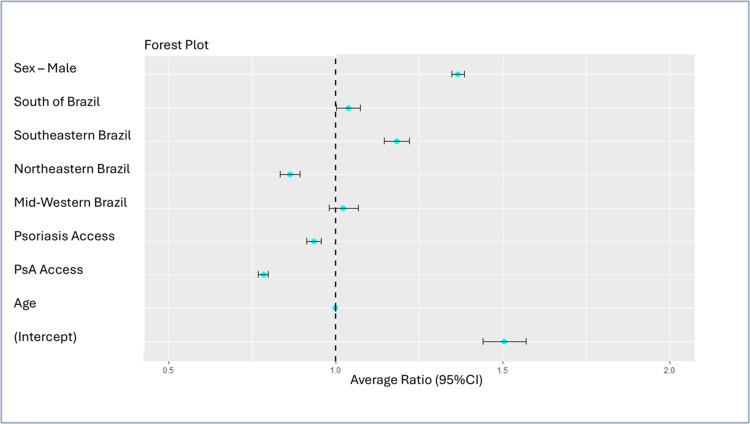
Over the 25-year period from 1998 to 2023, 32,512 benefits were granted for psoriasis, totalling an expenditure of $577,478,002.15. Public access to psoriatic arthritis (PsA)-targeted therapies decreased the average minimum wage granted to psoriasis patients on sick leave by 22%, and public access to psoriasis-targeted therapies reduced the average wage by 7%. The availability of these therapies was associated with earlier cessation of sick leave in our proportional hazards model (targeted therapies for PsA: hazard ratio (HR) = 1.90, 95% confidence interval (CI) = 1.82-2.00; targeted therapies for psoriasis: HR = 1.63, 95% CI = 1.54-1.70).
CONCLUSION
This study highlights a remarkable reduction in costs and sick leave duration due to the implementation of therapies for psoriatic disease by the Brazilian Unified Health System, which underscores the importance of considering detailed indirect cost data when evaluating new health technologies for large populations.
目的
巴西统一卫生系统是国际医疗保健创新分析的一个有趣模型。该系统覆盖超过2亿人,是全球最大的医疗技术购买者之一。我们在本研究中的目标是评估靶向治疗如何缩短银屑病患者的病假时长。
患者与方法
我们在巴西国家社会保障局内进行了一项回顾性队列研究。主要结局是银屑病患者的复工(病假结束)情况。使用Cox比例风险模型评估年龄、性别和获得靶向治疗等因素。
结果
在1998年至2023年的25年期间,共批准了32,512例银屑病福利申请,总支出为577,478,002.15美元。公众获得银屑病关节炎(PsA)靶向治疗使病假中的银屑病患者获得的平均最低工资降低了22%,公众获得银屑病靶向治疗使平均工资降低了7%。在我们的比例风险模型中,这些治疗的可及性与病假更早结束相关(PsA靶向治疗:风险比(HR)=1.90,95%置信区间(CI)=1.82 - 2.00;银屑病靶向治疗:HR = 1.63,95% CI = 1.54 - 1.70)。
结论
本研究强调了巴西统一卫生系统实施银屑病疾病治疗后成本和病假时长显著降低,这凸显了在评估针对大量人群的新医疗技术时考虑详细间接成本数据的重要性。




 Zotero 插件